
The Real Financial Breakdown of Soldering Workstations
When evaluating the tools for soldering, most buyers fixate on the upfront price of the iron itself. However, as we navigate the 2026 electronics landscape, the true cost of a soldering ecosystem extends far beyond the initial hardware purchase. A complete cost analysis must account for thermal recovery efficiency, tip metallurgy degradation, power supply requirements, and the recurring tax of consumables like flux and solder wire.
Whether you are a weekend hobbyist building mechanical keyboards or a professional repair technician reworking BGA components, understanding the Total Cost of Ownership (TCO) is critical. Below, we dissect the financial reality of the three dominant tiers of soldering equipment available today.
Tier 1: The Entry-Level & Open-Source Route ($30 - $80)
The entry-level market has been entirely disrupted by USB-C PD (Power Delivery) smart irons. The Pinecil V2 and Miniware TS101 dominate this space, leveraging RISC-V and ARM microcontrollers to deliver PID temperature control in a form factor the size of a marker.
The Hardware Cost
- Pinecil V2 (Bare): $26.00
- 65W GaN USB-C Power Brick: $15.00 - $25.00
- Silicone Stand & Base: $12.00
- Initial Tip Set (Shortbits): $18.00 (Pack of 4)
Total Entry Cost: ~$71.00 - $81.00
Hidden Costs & Failure Modes
While the upfront cost is negligible, the hidden costs emerge in tip longevity and thermal mass limitations. The Pinecil V2 uses a modified TS100 tip architecture where the heating element is separate from the tip sleeve. When soldering heavy ground planes on multi-layer PCBs, the iron suffers from severe thermal lag. This forces the user to dwell on the pad longer, increasing the risk of pad delamination—a failure mode heavily documented by the NASA Electronic Parts and Packaging (NEPP) Program regarding thermal stress on printed wiring assemblies.
Pro Tip: To mitigate thermal lag on budget USB-C irons, pre-heat your PCBs to 80°C using a silicone heating mat ($25). This reduces the thermal delta the iron must overcome, extending tip life and saving your PCB pads.
Tier 2: The Mid-Range Professional Standard ($100 - $150)
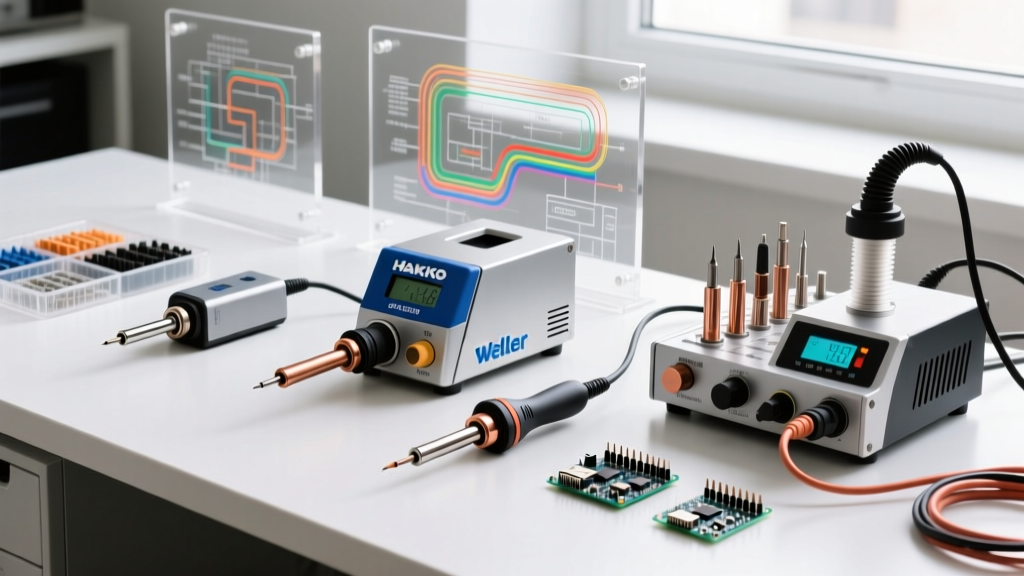
For decades, the Hakko FX-888D and the Weller WE1010NA have been the undisputed kings of the mid-range workbench. These stations utilize dedicated 70W to 75W transformers and ceramic heating elements.
Hardware & Consumable Economics
The Hakko FX-888D retails for roughly $110. It uses the ubiquitous T18 tip series, which costs about $7.50 per tip. The Weller WE1010NA sits slightly higher at $125, utilizing ETA tips at roughly $9.00 each. The thermal recovery here is vastly superior to USB-C irons, handling 0805 and 0603 SMD components with ease.
However, the mid-range tier suffers from a specific metallurgical inefficiency: the air gap between the ceramic heater and the inner wall of the soldering tip. This gap acts as a thermal insulator. Over time, oxidation builds up in this gap, permanently degrading heat transfer. In a professional environment where the iron is on for 8 hours a day, a Hakko T18 tip will typically require replacement every 3 to 4 weeks, adding roughly $90 annually in tip costs alone.
Tier 3: High-Frequency Industrial Cartridge Systems ($450+)
At the apex of soldering technology are direct-drive cartridge systems, most notably the JBC CD-2BE and Metcal PS-900. These systems abandon the traditional separate heater-and-tip design. Instead, the heating element and thermocouple are integrated directly into the copper tip cartridge.
The Premium Price Tag
- JBC CD-2BE Station: $450.00
- JBC C245 Cartridge Tip: $48.00 - $55.00 each
Why pay $50 for a single tip? Because the thermal recovery is measured in milliseconds, not seconds. When a C245 tip touches a massive copper pour, the station detects the temperature drop and delivers 130W of instantaneous power directly to the point of contact. This strict adherence to rapid thermal compensation ensures compliance with the stringent wetting and intermetallic compound (IMC) formation requirements outlined in the IPC J-STD-001 standard for Class 3 high-reliability assemblies.
Furthermore, JBC's "Sleep & Standby" modes drop the tip temperature to 180°C when placed in the aluminum stand, virtually halting oxidation. A single C245 tip in a professional repair lab can easily last 6 to 8 months, drastically altering the long-term cost analysis.
The Hidden Tax: Consumables and Maintenance in 2026
No cost analysis of tools for soldering is complete without factoring in the chemical consumables. The industry's shift toward reliable, low-spatter no-clean fluxes has changed the budgeting landscape.
| Consumable Category | Budget / Hobbyist Choice | Professional / IPC-Compliant Choice | Cost Delta |
|---|---|---|---|
| Solder Wire (63/37 Leaded) | Generic Rosin Core ($22 / 0.5lb) | Kester 245 / 44 ($45 / 1lb) | +$23.00 |
| Tack Flux (Syringe) | Generic Amtech clones ($12 / 10cc) | Amtech NC-559-V2-TF ($32 / 10cc) | +$20.00 |
| Desoldering Braid | Off-brand copper wick ($4 / 5ft) | Chemtronics 80-1-5 ($9 / 5ft) | +$5.00 |
| Tip Cleaner | Damp cellulose sponge ($2) | Hakko 599B Brass Wool ($14) | +$12.00 |
Note: Using a damp cellulose sponge on high-end cartridge tips (like JBC or Metcal) causes severe thermal shock. The rapid temperature drop can micro-fracture the internal ceramic heater and degrade the iron plating on the copper core. Always use dry brass wool for industrial systems.
5-Year Total Cost of Ownership (TCO) Matrix
To visualize the true financial impact, we project the costs over a 5-year period assuming moderate-to-heavy use (approx. 15 hours per week). This includes the station, power requirements, tip replacements, and baseline consumables.
| System Tier | Upfront Hardware | 5-Year Tip Spend | 5-Year Consumables | Estimated 5-Yr TCO | Cost Per Successful Joint |
|---|---|---|---|---|---|
| Pinecil V2 (USB-C) | $75 | $180 (High turnover) | $150 | $405 | ~$0.012 |
| Hakko FX-888D | $110 | $450 (Moderate turnover) | $250 | $810 | ~$0.024 |
| JBC CD-2BE | $450 | $300 (Low turnover) | $400 (Premium flux) | $1,150 | ~$0.034 |
Analyzing the Matrix
While the JBC system boasts the highest upfront and absolute TCO, the cost per successful joint tells a different story for professionals. The JBC system virtually eliminates cold solder joints, pad lift-offs, and rework time. If a single botched BGA rework or damaged multi-layer PCB costs a repair shop $150 in ruined donor parts and labor, the JBC station pays for itself after preventing just three catastrophic failures.
Strategic Procurement Framework: Which Tier Matches Your ROI?
Do not blindly buy the most expensive iron, but do not false-economize on the tools for soldering if your time has a high hourly value. Use this framework to make your 2026 purchasing decision:
- The Hobbyist & Maker (Pinecil V2): If you are soldering through-hole components, basic wire harnesses, or standard 0805 SMDs on simple 2-layer boards, the Pinecil V2 is mathematically unbeatable. The $75 entry point leaves you ample budget for high-quality Kester solder and a good multimeter.
- The Field Technician & Educator (Hakko FX-888D): If you need a rugged, lockable interface that can survive being knocked off a workbench or used by students in a classroom, the FX-888D remains the gold standard. The T18 tips are cheap enough that you won't panic if a student leaves the iron on at 400°C over the weekend.
- The Rework Specialist & Audio Engineer (JBC CD-2BE): If your daily workflow involves QFN chips, tight-pitch SMDs, heavy ground planes, or vintage audio restoration where lifting a 40-year-old PCB pad means destroying an irreplaceable artifact, the JBC is a mandatory investment. The 2-second thermal recovery is an insurance policy against catastrophic board damage.
Ultimately, the most expensive tool in your workshop is not the soldering station—it is the damaged component caused by using the wrong thermal profile. Invest in the tier that respects the thermal limits of your specific PCB assemblies.