
The 2026 Landscape of Automated Soldering Equipment
The transition to high-mix, low-volume (HMLV) manufacturing has fundamentally reshaped how electronics contract manufacturers approach through-hole and mixed-technology PCB assembly. In 2026, relying on manual soldering for complex mixed-technology boards is no longer just a bottleneck; it is a critical reliability risk. To understand the current state of automated soldering equipment, we convened insights from senior manufacturing engineers, process quality managers, and PCB assembly specialists. This expert roundup synthesizes their real-world evaluations of selective soldering systems, robotic soldering arms, and advanced wave systems, providing a definitive buyer’s guide for modern electronics production.
'The days of masking SMD components and running a mixed-technology board through a standard wave solder machine are over. The thermal shock and flux contamination risks simply violate modern IPC-A-610 reliability standards. Automated selective and robotic systems are now the baseline for Class 2 and Class 3 assemblies.' — Senior Process Engineer, Tier-1 Automotive EMS Provider
Selective Soldering Systems: The HMLV Champion
For boards with a high density of surface-mount devices (SMDs) adjacent to through-hole technology (THT) components, selective soldering is the undisputed industry standard. Our expert panel overwhelmingly favors inline and offline selective systems that utilize nitrogen-inerted environments and precision drop-jet fluxing.
Top Tier: Pillarhouse International Orion Series
The Pillarhouse Orion remains a favorite among high-reliability manufacturers. Experts highlight its closed-loop pyrometer temperature control, which monitors the actual temperature of the solder joint in real-time rather than just the solder pot. This is critical when soldering heavy ground planes that act as massive heat sinks. The Orion’s nitrogen inerting system reduces dross formation on SAC305 (lead-free) alloys by up to 92%, drastically lowering consumable costs over a 12-month production cycle.
Mid-Volume Workhorse: EBSO EBS-400
For mid-sized operations, the EBSO EBS-400 offers an exceptional balance of footprint and capability. Process engineers praise its micro-spray fluxing module, which restricts flux application to a tight 2mm to 4mm diameter. This prevents the 'flux splatter' issue that often plagues cheaper automated soldering equipment, where no-clean flux residues accidentally coat adjacent test pads, causing false failures during in-circuit testing (ICT).
Robotic Soldering Arms: Precision for Complex Geometries
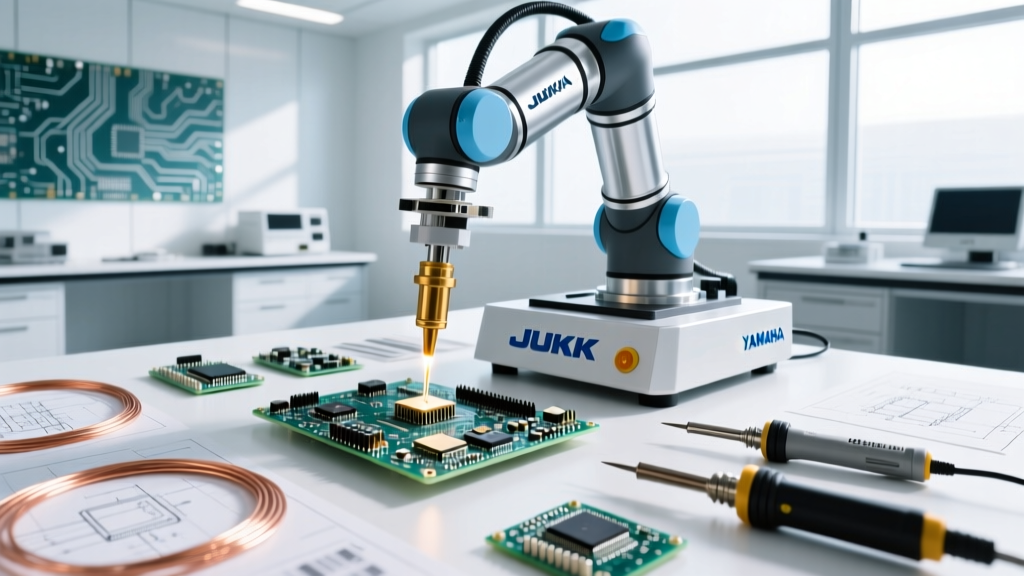
While selective soldering handles standard THT components, robotic soldering arms are the experts' choice for odd-form components, heavy-gauge wire terminations, and heat-sensitive connectors that cannot survive the preheat tunnel of a selective machine.
Industry Leader: JBC RS-500 Robotic Soldering Station
The JBC RS-500 dominates the 2026 robotic soldering market due to its exclusive heating technology. Unlike traditional ceramic heaters, JBC integrates the thermocouple directly into the soldering tip. Experts report thermal recovery times of under 0.4 seconds, even when applying 63/37 or SAC305 solder to large copper pours. The RS-500’s integrated wire feeder and automatic tip cleaner (which uses a specialized brass wire brush and vacuum system) extend tip life by an average of 300% compared to manual soldering operations.
Alternative Contender: Hakko FR-8300 Series Equivalents
Hakko’s robotic integration lines continue to be a staple for high-speed, uniform soldering of pin headers and simple wire harnesses. Experts note that while Hakko systems may lack the ultra-fast thermal recovery of JBC, their vision systems and CAD-import software make programming complex multi-point soldering paths incredibly intuitive for operators without advanced coding backgrounds.
Expert Comparison Matrix: Selective vs. Robotic Systems
To help buyers choose the right automated soldering equipment, our panel developed the following comparison matrix based on 2026 manufacturing metrics.
| Feature / Metric | Selective Soldering (e.g., Pillarhouse Orion) | Robotic Soldering (e.g., JBC RS-500) |
|---|---|---|
| Primary Use Case | Standard THT components on mixed-tech PCBs | Odd-form, wire harnesses, heat-sensitive parts |
| Cycle Time (Avg) | 2.5 - 4.0 seconds per joint | 4.0 - 7.0 seconds per joint |
| Flux Application | Piezo drop-jet or micro-spray (highly targeted) | Integrated liquid flux dispenser or pre-fluxed wire |
| Thermal Management | Nitrogen-inerted mini-wave, bottom-side preheat | Direct tip-to-joint conduction, localized heating |
| Capital Cost (2026) | $85,000 - $160,000 (Inline) | $18,000 - $35,000 per cell |
| Maintenance Focus | Solder pot dross, nitrogen generator, pump seals | Tip oxidation, wire feeder jams, axis calibration |
Critical Failure Modes and Edge Cases in Automation
Automated soldering equipment is not a 'set it and forget it' solution. Our experts identified three specific failure modes that frequently plague poorly optimized automated lines in 2026.
1. MLCC Cracking from Thermal Shock
When automated equipment applies a 350°C mini-wave or robotic tip directly adjacent to a Multilayer Ceramic Capacitor (MLCC), the rapid localized expansion can cause micro-cracks in the ceramic dielectric. These cracks often pass initial visual inspection but lead to catastrophic field failures. Expert Fix: Program a minimum 3mm keep-out zone around MLCCs for automated soldering, or utilize robotic systems with programmable ramp-up profiles that pre-heat the joint area with hot air before making physical contact.
2. Piezoelectric Flux Starvation
Drop-jet fluxers are highly precise, but they are prone to clogging if the no-clean flux solvent evaporates during weekend shutdowns. A clogged jet results in 'dry' solder joints that fail wetting balance tests. Expert Fix: Implement automated purge cycles that fire a micro-droplet of flux into a waste receptacle every 4 hours during idle periods, and strictly adhere to the manufacturer's solvent-flush protocols on Monday mornings.
3. Solder Ball Formation in Selective Wave
As boards exit the selective solder wave, the drag-off can create microscopic solder balls that lodge under fine-pitch SMD components. According to the IPC-A-610 Standard for Electronic Assemblies, mobile solder balls are a major defect risk. Expert Fix: Optimize the board's exit angle from the solder wave (typically between 4 and 7 degrees) and ensure the nitrogen inerting atmosphere is maintained right up to the point of wave detachment to prevent premature oxidation of the solder meniscus.
2026 Pricing, ROI, and Implementation Framework
When evaluating automated soldering equipment, buyers must look beyond the initial capital expenditure. The Surface Mount Technology Association (SMTA) frequently publishes data showing that the true cost of automated soldering includes nitrogen generation, flux consumption, and maintenance downtime.
- Entry-Level Robotic Cells ($18k - $25k): Ideal for low-volume wire harness assembly or replacing manual operators on specific, repetitive odd-form tasks. ROI is typically achieved within 14 to 18 months based on labor savings and reduced rework rates.
- Offline Selective Systems ($45k - $75k): Best for high-mix environments where changeovers are frequent. These systems require manual board loading but offer the precision of inline machines. Expect an ROI of 24 months, heavily dependent on the reduction of manual touch-up labor.
- Inline Selective Systems ($90k - $160k+): The standard for high-volume mixed-technology boards. When integrated with automated board handlers, these systems run lights-out. ROI is calculated not just in labor, but in the massive reduction of scrap and the ability to meet strict automotive or medical traceability requirements.
Final Expert Verdicts
The consensus among manufacturing experts is clear: the best automated soldering equipment for your facility depends entirely on your product mix and thermal constraints. If your primary challenge is processing standard through-hole connectors on densely populated SMD boards, an inline selective system like the Pillarhouse Orion is non-negotiable for meeting modern reliability standards. However, if your production involves heavy-gauge wires, large heat-sinks, or delicate connectors that cannot withstand bottom-side preheating, investing in a fleet of JBC RS-500 robotic cells will yield the highest quality and fastest return on investment. For deeper dives into process optimization, we highly recommend reviewing the latest manufacturing reports published by Assembly Magazine to stay ahead of emerging alloy and flux technologies.