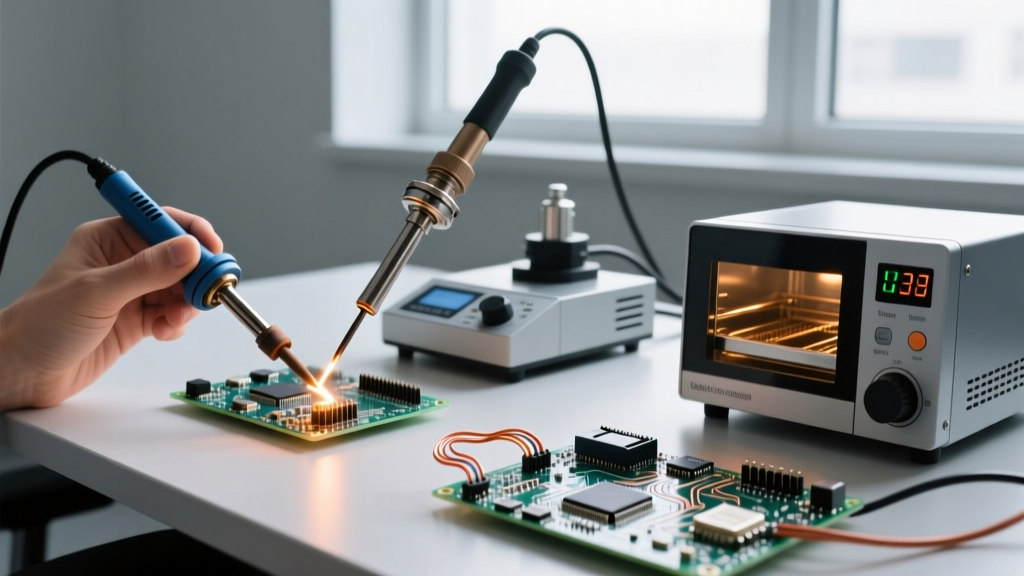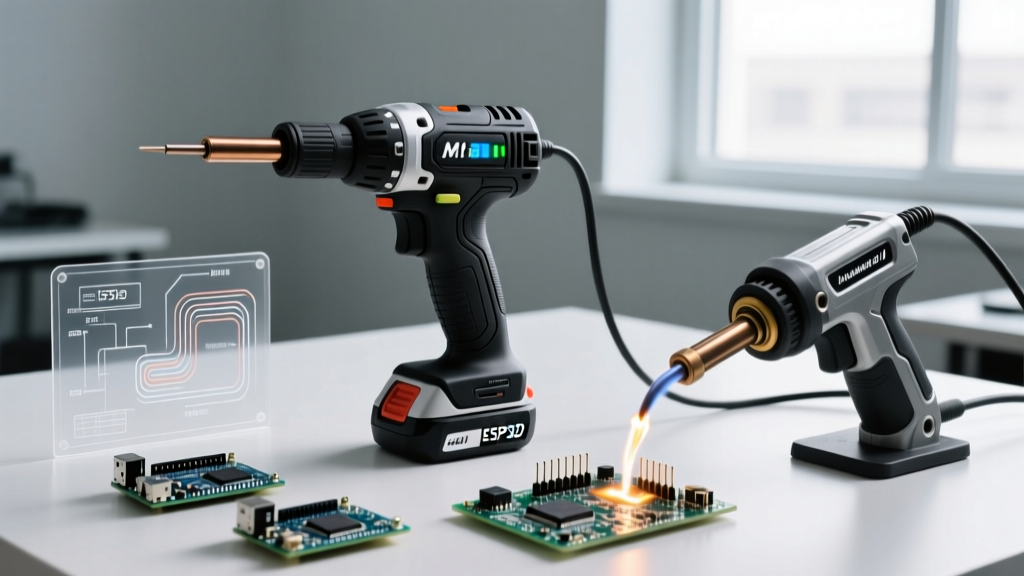

The 'Milwaukee Soldering Gun' Misconception
If you are searching for a Milwaukee soldering gun, you are likely looking for a heavy-duty, high-wattage tool capable of soldering thick gauge wires, automotive battery lugs, or marine connectors in the field. Traditionally, a 'soldering gun' refers to a pistol-grip, transformer-based tool (like the classic Weller D-550) that uses a high-current pulse through a copper wire loop tip to generate instant, massive heat.
Here is the critical distinction every professional electrician and electronics technician must understand: Milwaukee Tool does not manufacture a traditional transformer-based soldering gun. Instead, they have engineered the Milwaukee M18 Cordless Soldering Iron (Model 2488-20) and the smaller M12 variant (2487-20). These are pencil-style, ceramic-heater irons powered by lithium-ion battery packs. However, because the M18 delivers up to 100 watts of peak thermal output and is designed for heavy-duty fieldwork, many professionals colloquially search for it as a 'soldering gun.' In this deep dive, we will analyze the Milwaukee M18 Cordless Soldering Iron, evaluating its thermal recovery, battery dynamics, tip ecosystem, and how it stacks up against traditional AC-powered soldering guns in 2026.
Milwaukee M18 (2488-20) Technical Deep Dive
The Milwaukee M18 Soldering Iron is built for the trades. Unlike standard 40W-60W benchtop irons designed for delicate printed circuit board (PCB) work, the M18 is engineered to overcome the high thermal mass of large connectors, 8 AWG to 2 AWG battery cables, and heavy-duty XT90/AS150 RC connectors.
Power Delivery and Battery Thermals
The 2488-20 operates on the M18 REDLITHIUM ecosystem. It features a rapid-heating ceramic core that reaches its maximum temperature of 800°F (426°C) in approximately 28 seconds. This is a significant engineering feat for a battery-powered tool. To achieve this, the iron draws roughly 5.5 to 6 amps continuously from an 18V nominal battery pack during the initial heat-up phase.
When using a standard 5.0Ah (90Wh) XC battery, you can expect roughly 45 to 60 minutes of intermittent use. However, if you are soldering massive thermal sinks (like 2/0 AWG copper lugs), the iron will draw peak current continuously to maintain the setpoint, which can reduce operational time to 20-30 minutes and cause the battery's internal BMS (Battery Management System) to throttle output due to heat buildup.
Thermal Mass vs. Wattage: Soldering Heavy Gauge Wire
The primary reason technicians search for a 'soldering gun' is to handle high thermal mass. A standard 60W iron will simply stall and freeze when applied to a 4 AWG battery cable because the copper acts as a massive heatsink, pulling heat away from the tip faster than the heater can replen = 'Standard Chisel'>4 AWG - 8 AWG Battery Lugs
M18 Cordless Iron vs. Traditional Transformer Guns
How does the modern M18 cordless ecosystem compare to the classic AC-powered transformer guns that have dominated fieldwork for decades? Below is a direct comparison matrix based on 2026 field testing.
| Feature | Milwaukee M18 (2488-20) | Traditional 250W Soldering Gun |
|---|---|---|
| Peak Wattage | 100W (Peak) / 60W (Sustained) | 250W (High Trigger) / 150W (Low) |
| Heat-Up Time | 28 seconds to 800°F | Instant (Transformer pulse) |
| Portability | Excellent (Cordless, ~1.8 lbs with battery) | Poor (Tethered to 120V AC, ~3.5 lbs) |
| Temperature Control | Closed-loop thermocouple (600°F - 800°F) | Open-loop (Trigger dependent) |
| Best Use Case | Automotive, Marine, RC, Field Repair | Stained glass, heavy plumbing, thick lugs |
Tip Metallurgy and the Proprietary Ecosystem
One of the most critical aspects of any soldering tool is the tip ecosystem. Traditional soldering guns use bare copper wire loops that must be manually bent, filed, and replaced as they pit and dissolve in molten solder. The Milwaukee M18, conversely, uses modern iron-plated copper tips with an integrated thermocouple.
The Catch: Milwaukee utilizes a proprietary threaded tip connection. You cannot simply slide a standard Hakko 9488BD or Weller W100PG tip onto the M18. You are locked into the Milwaukee proprietary tip ecosystem. While Milwaukee offers a solid range of chisel, conical, and bevel tips, the variety does not match the vast, cheap, third-party aftermarket available for Hakko or JBC systems. When purchasing the M18, factor in the cost and availability of Milwaukee-specific replacement tips, which typically retail between $12 and $18 each.
Real-World Failure Modes and Edge Cases
No tool is perfect, and the M18 cordless iron has specific failure modes that field technicians must be aware of to avoid ruined joints and damaged components.
Voltage Sag and Cold Joints
As an M18 battery depletes past the 20% mark, voltage sag becomes prominent under heavy load. When you press a large chisel tip into a thick copper ground plane, the heater demands maximum current. If the battery cannot deliver the amperage without dropping below the tool's low-voltage cutoff, the tip temperature will plummet. This results in a 'cold joint'—a dull, grainy solder connection that violates IPC-A-610 acceptability standards for electronic assemblies and poses a severe fire hazard in high-current automotive applications. Rule of thumb: Swap to a fresh High-Output battery before tackling heavy-gauge lug soldering.
Tip Oxidation and Dry-Firing
Because the M18 is cordless, users often leave it turned on while routing wires or stripping cables. Leaving the iron at 800°F in ambient air without a layer of solder will oxidize the iron plating in a matter of minutes. Once a tip turns black and refuses to wet with solder, its thermal transfer efficiency drops by over 80%. Always keep a damp brass sponge nearby and tin the tip heavily before setting the tool down.
Adherence to IPC Standards in the Field
When soldering in professional environments, adherence to industry standards is non-negotiable. According to the guidelines outlined by IPC (Association Connecting Electronics Industries), a proper solder joint must exhibit a smooth, shiny, concave fillet with complete wetting. The M18 excels at achieving this on heavy wires, provided the correct flux is used.
For field work, always use a high-quality, no-clean: pre-tin both surfaces, apply flux generously, and let the heat do the work. Do not use the solder as a glue to bridge unheated components.
Final Verdict: Is the M18 the Ultimate Field Tool?
If you are searching for a 'Milwaukee soldering gun' to replace your old 1970s transformer gun for automotive wiring, marine battery repairs, or heavy-duty RC hobby work, the Milwaukee M18 2488-20 is a phenomenal upgrade. It eliminates the need for a bulky inverter or running a generator just to solder a battery cable. However, if your primary work involves delicate 0402 SMD components or multi-layer PCBs, the M18's high thermal mass and aggressive heat profile make it the wrong tool for the job. For those applications, stick to a temperature-controlled benchtop station. But for the tradesman who needs reliable, high-heat soldering on a job site, roof, or boat, the M18 cordless iron stands in a class of its own.