
The Metallurgical Shift in Copper Pipe Joinery
Copper piping remains the gold standard in premium residential and commercial plumbing in 2026, prized for its bacteriostatic properties, UV resistance, and 50-plus-year lifespan. However, while the copper tube itself has remained largely unchanged since the 1930s, the method of joining these pipes—sweat soldering—has undergone a radical metallurgical and technological evolution. The practice of soldering plumbing pipes has transitioned from the forgiving, toxic lead-tin alloys of the mid-20th century to the high-temperature, precision-demanding lead-free and silver-bearing alloys of today. Understanding this history is not just an academic exercise; it dictates how modern plumbers and DIYers must approach heat management, flux selection, and joint preparation to prevent catastrophic leaks.
The Pre-1980s Era: The Reign of Lead-Tin Alloys
For decades, the undisputed king of plumbing solder was the 50/50 tin-lead alloy (50% tin, 50% lead), alongside the 95/5 tin-lead variant. Lead was the miracle metal of early plumbing for several highly practical reasons:
- Low Melting Point: Eutectic lead-tin solders melted at a highly manageable 361°F (183°C). This allowed plumbers to use low-heat gasoline blowtorches without risking damage to surrounding wood framing.
- The "Pasty Range": Unlike pure metals that melt and freeze instantly, 50/50 solder has a wide "pasty" or plastic range between its solidus and liquidus temperatures. This allowed old-school plumbers to physically "wipe" the molten solder over a joint with a gloved hand or cloth, creating a smooth, lead-wiped joint that sealed perfectly even on poorly fitted pipes.
- Superior Wetting: Lead naturally reduced surface tension, allowing the solder to effortlessly wick into the capillary space between the copper pipe and the fitting.
However, this ease of use came with a devastating public health cost. As water sat in these pipes, lead leached into the municipal water supply, leading to severe neurological and developmental issues, particularly in children.
The Catalyst for Change: The 1986 SDWA Amendments
The turning point for soldering plumbing pipes arrived with the Safe Drinking Water Act (SDWA) Amendments of 1986. The U.S. Congress officially banned the use of any solder or flux containing more than 0.2% lead in pipes and fittings carrying drinking water. This mandate forced the plumbing industry into a rapid, albeit painful, metallurgical pivot. Early lead-free alternatives were notoriously difficult to work with; they lacked the wetting properties of lead, required significantly higher heat, and resulted in a high rate of "cold joints" and callbacks for early adopters. According to the EPA's Reduction of Lead in Drinking Water Act, the definition of "lead-free" was further tightened in 2011 (effective 2014) to a weighted average of less than 0.25% on wetted surfaces, permanently closing loopholes regarding brass fittings and ancillary components.
"The transition away from lead-based solders fundamentally changed the physics of capillary action in plumbing. Modern plumbers can no longer rely on the solder to bridge gaps; the joint preparation must be mathematically precise."
Modern Alloys: What We Use in 2026
Today, the market for plumbing solder is dominated by two primary lead-free categories, each engineered for specific pressure and temperature demands. All modern solders must carry NSF/ANSI 61 certification to be legally used on potable water lines.
1. 95/5 Tin-Antimony (Sn95Sb5)
This is the standard-bearer for modern residential water lines. The addition of 5% antimony replaces the structural role of lead, increasing the tensile strength and narrowing the pasty range. It melts between 437°F and 464°F. While it requires more heat than legacy lead solder, modern fluxes have largely solved its wetting issues. A 1-pound spool of premium 95/5 (such as Oatey Safe-Flo) typically costs between $35 and $45 in 2026.
2. Silver-Bearing Lead-Free Alloys (Sn96Ag4 or Sn95.5Ag4Cu0.5)
For high-pressure commercial lines, underground municipal tie-ins, and HVAC/refrigeration copper lines, silver-bearing solders are mandatory. The inclusion of 3% to 4% silver dramatically increases the tensile strength (up to 14,000 PSI) and raises the melting point to roughly 430°F - 440°F (solidus). Products like Harris Bridgit or Oatey Silver Lead-Free command a premium, often costing $65 to $85 per pound, but they provide the vibration resistance required for mechanical rooms and compressor lines.
Historical vs. Modern Solder Comparison Matrix
| Alloy Composition | Common Name | Melting Range (°F) | Tensile Strength (PSI) | 2026 Avg Cost/lb | Best Application |
|---|---|---|---|---|---|
| 50% Sn / 50% Pb | Legacy 50/50 | 361 - 418 | 6,100 | N/A (Banned) | Historical / Non-Potable Drain |
| 95% Sn / 5% Sb | 95/5 Lead-Free | 437 - 464 | 8,000 | $35 - $45 | Residential Potable Water |
| 96% Sn / 4% Ag | Silver-Bearing | 430 - 440 | 14,000+ | $65 - $85 | HVAC, High-Pressure Commercial |
| 95.5% Sn / 4% Ag / 0.5% Cu | SAC 405 | 423 - 432 | 13,500 | $70 - $90 | Medical Gas, High-Vibration |
The Evolution of Heat: From Gasoline to Induction
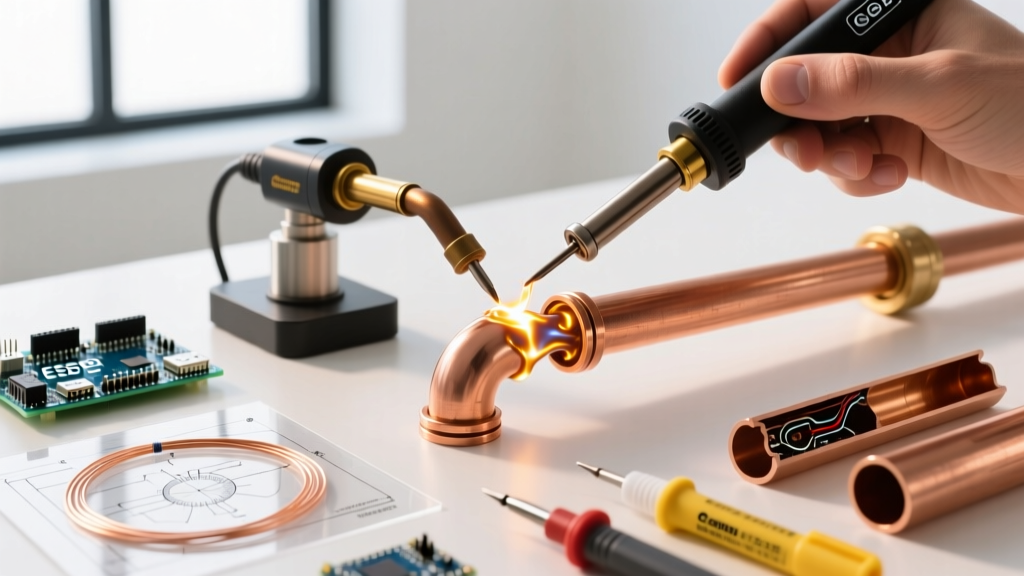
The history of soldering plumbing pipes is equally defined by the tools used to melt the alloy. In the 1920s and 30s, plumbers used pressurized gasoline blowtorches. These were notoriously dangerous, prone to soot buildup, and required constant pumping to maintain pressure. By the 1970s, disposable Propane and MAPP gas cylinders revolutionized the trade. However, true MAPP gas (methylacetylene-propadiene) was discontinued in 2008 due to manufacturing complexities.
Today, the standard is MAP-Pro (propylene), which burns at 3,730°F in air—significantly hotter than propane's 3,600°F. High-efficiency swirl torches, like the Bernzomatic TS8000, concentrate this heat into a tight, needle-like flame, allowing plumbers to heat a 1-inch copper joint to 450°F in under 15 seconds while minimizing thermal transfer to nearby joists.
The latest frontier in 2026 is portable induction soldering. Tools utilizing high-frequency electromagnetic fields heat the copper fitting directly from the inside out, without an open flame. This is a game-changer for tight joist bays, historic renovations, and commercial spaces where hot-work permits and fire watches make traditional torch work prohibitively expensive.
Capillary Action and Joint Preparation: Timeless Physics
While alloys and torches have evolved, the physics of capillary action remains unchanged. The Copper Development Association (CDA) dictates that the annular space between the pipe and the fitting must be exactly 0.001 to 0.005 inches for solder to wick properly. Modern lead-free solders are far less forgiving of poor preparation than their leaded ancestors.
- Abrasion: Plumbers must use specialized sandcloth or aluminum-oxide Scotch-Brite pads. Never use steel wool. Steel wool leaves microscopic iron particles embedded in the copper, which will trigger galvanic corrosion and pinhole leaks within 3 to 5 years.
- Flux Selection: Modern water-soluble fluxes (like Oatey No. 5) are engineered to clean the copper at 400°F and become completely inert once flushed. Tallow-based or highly acidic pastes of the past are no longer compliant with the Uniform Plumbing Code (UPC) for potable water systems due to their corrosive residue.
- Temperature Verification: Because lead-free solder requires precise heat, professionals use temperature-indicating sticks (e.g., Tempilstik). Swiping a 450°F stick on the opposite side of the fitting guarantees the copper has reached the exact thermal threshold required for the solder to flash and wick.
Troubleshooting Modern Lead-Free Solder Joints
The most common failure mode for DIYers transitioning to modern soldering is the "burnt flux" phenomenon. If a propane or MAP-Pro torch is held on a fitting for too long before applying the solder, the flux reaches its carbonization point (usually above 600°F). It turns into a hard, black, glassy barrier. When the solder is finally applied, it will ball up and roll off the fitting rather than wicking inside. The only remedy is to disassemble the joint while hot, mechanically re-clean the copper, re-flux, and try again. Conversely, a "cold joint"—characterized by a dull, grainy, gray appearance—occurs when the heat is removed too early. The solder melts from the heat of the torch tip rather than the thermal mass of the copper, resulting in a joint with zero tensile strength that will fail under the first 60-PSI water hammer shock.
Conclusion
The evolution of soldering plumbing pipes is a testament to the plumbing industry's ability to adapt to environmental and health mandates without sacrificing system integrity. By trading the toxic forgiveness of lead for the high-strength reliability of tin-antimony and silver alloys, modern copper systems are safer and more durable than ever. However, this progress demands a higher level of craftsmanship. Success in 2026 requires respecting the exact melting points of modern alloys, utilizing high-efficiency MAP-Pro or induction heat sources, and adhering strictly to the timeless physics of capillary preparation.