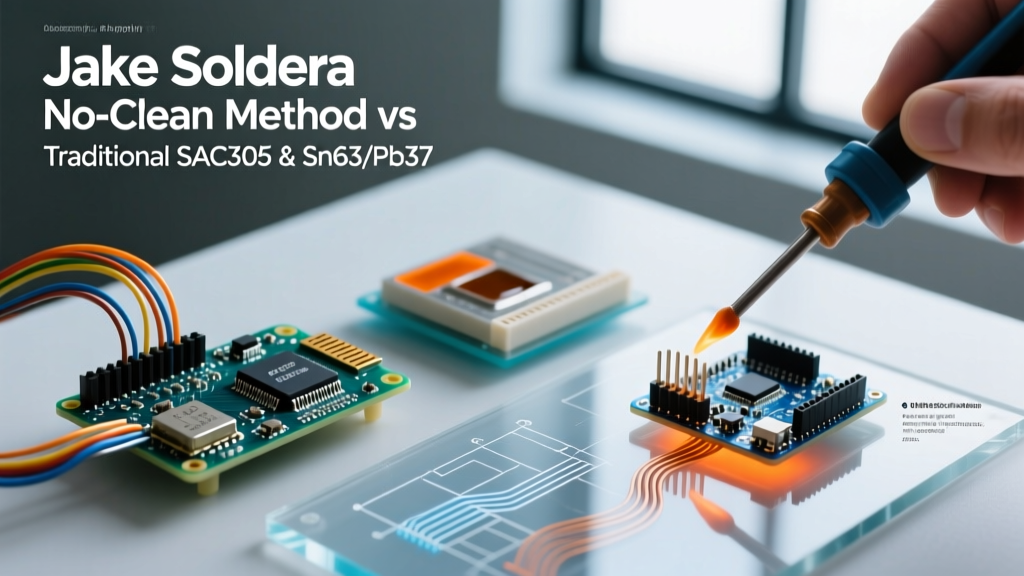

The Evolution of Precision Rework: Enter the Jake Soldera Method
As the electronics manufacturing and DIY repair sectors push deeper into 2026, the demand for high-reliability, no-clean soldering methodologies has never been higher. While traditional eutectic and standard lead-free alloys have dominated workbenches for decades, the Jake Soldera no-clean method has emerged as a specialized benchmark for aerospace, medical, and high-end consumer PCB rework. This method is not just about the alloy; it is a comprehensive thermal and chemical protocol designed to achieve IPC-A-610 Class 3 compliance without post-solder cleaning.
In this comprehensive method comparison, we will dissect the Jake Soldera methodology against two industry stalwarts: standard SAC305 (Tin-Silver-Copper) and traditional Sn63/Pb37 (Tin-Lead) eutectic soldering. We will evaluate metallurgical properties, thermal execution, failure modes, and real-world ROI to help you decide which method belongs on your 2026 workbench.
Understanding the Jake Soldera Methodology
The Jake Soldera method relies on a proprietary micro-alloyed wire system. Unlike off-the-shelf SAC305, Jake Soldera wire utilizes a Sn96.5/Ag3.0/Cu0.5 base that is intentionally doped with trace amounts of Nickel (Ni) and Germanium (Ge). This micro-alloying serves two critical purposes: it depresses the melting point slightly (from 217°C down to roughly 214°C) and significantly refines the grain structure of the solder joint, reducing the likelihood of thermal fatigue cracking.
The Flux Chemistry: ROL0 vs. Standard Activators
The true differentiator of the Jake Soldera method is its flux core. It employs a highly engineered ROL0 (Rosin, Zero Halogen, Low Solid) no-clean flux. Traditional SAC305 wires often use RO1 (Rosin, Halogen) fluxes to compensate for the poor wetting characteristics of lead-free alloys. While RO1 fluxes wet faster, they leave behind corrosive ionic residues that mandate cleaning in high-humidity environments. The Jake Soldera ROL0 formulation utilizes a synthetic rosin-ester blend that activates precisely at 160°C and carbonizes minimally, leaving a benign, electrically insulating residue that passes rigorous SIR (Surface Insulation Resistance) testing.
Expert Insight: According to guidelines published by the IPC Standards for Flux and Solder, ROL0 fluxes are mandated for Class 3 no-clean assemblies where long-term reliability in harsh environments is required, yet achieving adequate wetting with zero halogens requires strict thermal control—exactly what the Jake Soldera method provides.
Method Comparison Matrix: Jake Soldera vs. SAC305 vs. Sn63/Pb37
To understand where the Jake Soldera method fits into your workflow, we must compare its physical and operational characteristics against standard alternatives. The table below outlines the critical metrics for 2026 production and rework environments.
| Characteristic | Jake Soldera Method | Standard SAC305 | Sn63/Pb37 (Eutectic) |
|---|---|---|---|
| Base Alloy | Sn96.5/Ag3.0/Cu0.5 + Ni/Ge | Sn96.5/Ag3.0/Cu0.5 | Sn63/Pb37 |
| Flux Classification | ROL0 (No-Clean, Zero Halogen) | RO1 (Moderate Halogen) | RMA (Rosin Mildly Activated) |
| Solidus / Liquidus | 214°C / 216°C | 217°C / 220°C | 183°C (Eutectic) |
| Optimal Iron Temp | 330°C - 345°C | 350°C - 380°C | 300°C - 320°C |
| Wetting Speed (OSP) | 1.8 - 2.2 seconds | 2.5 - 3.5 seconds | 0.8 - 1.2 seconds |
| Post-Solder Cleaning | Not Required | Highly Recommended | Optional (Aesthetic) |
| Avg. Cost per 500g (2026) | $85.00 - $92.00 | $60.00 - $68.00 | $40.00 - $48.00 |
Thermal Execution: Step-by-Step Protocols
The primary reason DIYers and technicians fail when transitioning to the Jake Soldera method is applying the aggressive thermal profiles used for standard SAC305. Because the ROL0 flux lacks harsh halogen activators, it cannot survive prolonged exposure to temperatures above 360°C without breaking down and losing its wetting capability.
Executing the Jake Soldera Method
- Tip Selection: Use a high-thermal-mass chisel tip (e.g., Weller RT4 or Hakko T18-D24). Avoid fine conical tips, which cannot transfer heat fast enough to compensate for the lower iron temperature.
- Temperature Setting: Set your soldering station to exactly 340°C. This provides a 125°C delta above the alloy's liquidus point, ensuring rapid heat transfer without scorching the flux.
- Pre-Heating (Critical for QFN/BGA): For multi-layer boards, apply a bottom pre-heat of 90°C to 110°C to reduce the thermal mass of the ground planes.
- The 2-Second Rule: Apply the iron to the pad and lead simultaneously. Feed the Jake Soldera wire into the joint after 0.5 seconds. Total dwell time must not exceed 2.5 seconds to prevent OSP pad degradation.
- Cooling: Allow the joint to cool naturally. Do not blow on it. The Ni/Ge doping promotes a smooth, shiny fillet even with natural convection cooling.
Executing Standard SAC305
Standard SAC305 requires higher iron temperatures (typically 360°C+) to force the RO1 flux to activate and overcome the alloy's inherent sluggish wetting. This often leads to flux spatter, accelerated tip oxidation, and a higher risk of lifting micro-vias on complex HDI boards. The SMTA Technical Resources on Lead-Free Alloys frequently highlight that excessive heat application with standard SAC305 is the leading cause of pad cratering in modern smartphone rework.
Real-World Failure Modes and Edge Cases
No soldering method is immune to operator error or environmental variables. Understanding the specific failure modes of each method is crucial for achieving high-yield rework.
- Flux Charring (Jake Soldera): If the iron temperature is mistakenly set above 370°C, the synthetic rosin-ester in the Jake Soldera wire will carbonize, turning black and forming a barrier that prevents wetting. Solution: Clean the tip with brass wool and lower the station to 335°C.
- Head-in-Pillow / HiP (SAC305): Common in BGA rework where the solder paste on the component and the wire solder on the pad do not fully coalesce. The Jake Soldera method's lower liquidus point and superior flux activity significantly reduce HiP defects compared to standard SAC305 wire.
- Thermal Fatigue Cracking (Sn63/Pb37): While leaded solder wets beautifully and operates at low temperatures, it is highly susceptible to creep and thermal fatigue in high-vibration or wide-temperature-cycling environments. The NIST Metallurgy Division has extensively documented the superior long-term mechanical stability of silver-bearing lead-free alloys over eutectic tin-lead in harsh operational profiles.
- Tombstoning (Jake Soldera on 0201 Passives): Because the ROL0 flux is less aggressive, uneven heating on ultra-small 0201 or 01005 passive components can result in one pad wetting before the other, pulling the component upright. Solution: Use a micro-pencil tip and apply heat to the pad, not the component body, ensuring simultaneous wetting.
Cost and ROI Analysis for 2026 Production Runs
At first glance, the Jake Soldera method appears expensive. At roughly $85 to $92 per 500g spool, it carries a 40% premium over standard SAC305 and nearly double the cost of Sn63/Pb37. However, evaluating ROI requires looking beyond the raw material cost.
When utilizing standard SAC305 with RO1 flux, high-reliability manufacturers must factor in the cost of aqueous or solvent-based cleaning systems, the labor required to scrub flux residues, and the environmental compliance costs associated with disposing of contaminated cleaning solvents. Furthermore, the aggressive nature of RO1 fluxes and higher iron temperatures accelerates soldering tip degradation. A standard chisel tip might last 2,000 joints with Sn63/Pb37, but only 800 joints with high-temp SAC305.
The Jake Soldera method, with its lower operating temperature and non-corrosive ROL0 flux, extends tip life by an average of 35% compared to standard lead-free methods. When you eliminate the cleaning step entirely and reduce tip replacement frequency, the fully burdened cost per solder joint drops significantly, often making it more economical than standard SAC305 for low-to-medium volume, high-mix rework environments.
Final Verdict: Which Method Should You Choose?
The choice between the Jake Soldera method, standard SAC305, and Sn63/Pb37 ultimately depends on your specific application, regulatory environment, and budget.
Choose Sn63/Pb37 if: You are working on vintage electronics, hobbyist projects, or non-critical consumer repairs where long-term thermal cycling reliability is not a concern, and you want the easiest, most forgiving wetting experience.
Choose Standard SAC305 if: You are performing general commercial lead-free rework, have an established cleaning protocol for flux residues, and need to keep raw material costs as low as possible while maintaining RoHS compliance.
Choose the Jake Soldera Method if: You are executing IPC Class 3 rework on medical, aerospace, or high-end automotive electronics. If you require a true no-clean process that guarantees zero ionic contamination, superior grain structure for vibration resistance, and are willing to invest in precise thermal profiling, the Jake Soldera methodology is currently the premier choice on the market in 2026.