
The Metallurgical Journey of Soldering Metal
When we power up a soldering iron and touch a rosin-core wire to a copper pad, we are participating in a metallurgical tradition that spans over five millennia. The concept of soldering metal—using a lower-melting-point filler alloy to join two base metals without melting the base metals themselves—is one of humanity's oldest manufacturing techniques. However, the specific alloys we use have undergone radical transformations, driven by the demands of the industrial revolution, the microelectronics boom, and modern environmental legislation.
For DIYers, hobbyists, and professional assemblers in 2026, understanding the history and evolution of soldering metal is not just an academic exercise. It directly informs how you select the right alloy for your PCB assemblies, how you manage thermal profiles, and how you avoid catastrophic field failures like tin whiskers or cold joints. Let us trace the evolution of soldering metal from ancient workshops to today's advanced nano-alloys.
Ancient Origins: Gold, Pewter, and the Roman Aqueducts
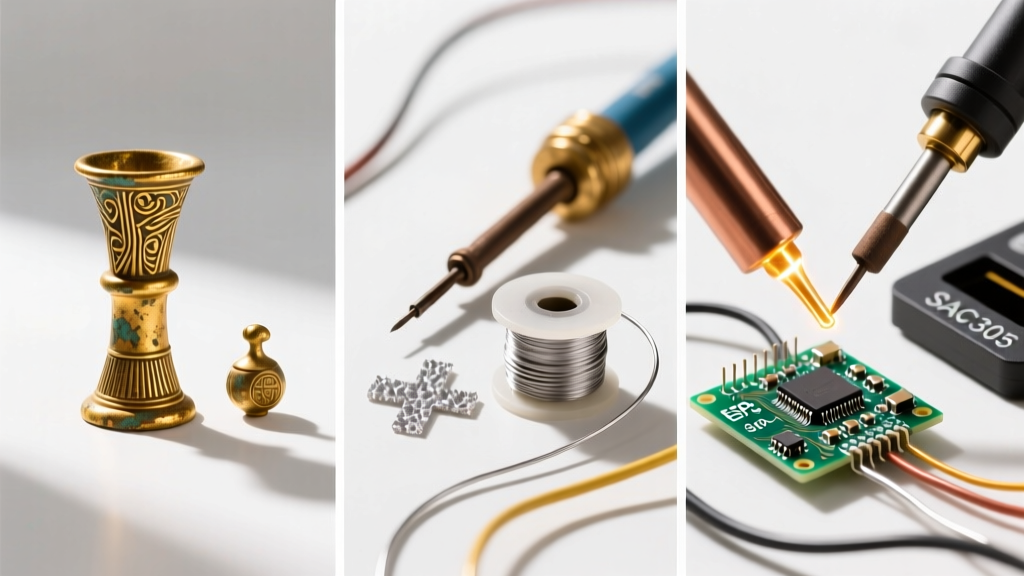
The earliest recorded use of soldering metal dates back to ancient Egypt around 3000 BC, where artisans used early tin-based alloys to join gold jewelry and craft intricate metalwork. However, it was the Romans who truly industrialized the process. According to historical metallurgical records documented by Britannica, Roman engineers utilized a primitive form of lead-tin solder to seal the joints of their massive lead aqueduct pipes.
These early soldering metals were far from the precise, flux-cored wires we use today. They were often simple mixtures of lead and tin, sometimes adulterated with antimony or copper, melted in open crucibles. The Romans recognized that adding tin to lead lowered the melting point and improved the wetting action on base metals, a fundamental principle of metallurgy that still governs solder alloy design today.
The Eutectic Breakthrough: The Reign of Sn63/Pb37
As the 20th century ushered in the era of radio, telecommunications, and eventually consumer electronics, the demands on soldering metal became exponentially more stringent. The industry needed an alloy that would transition from liquid to solid instantaneously to prevent "cold joints" caused by micro-movements during the cooling phase.
This led to the universal adoption of the Sn63/Pb37 (63% Tin, 37% Lead) alloy. This specific ratio is known as a eutectic mixture. Unlike non-eutectic alloys (such as the older 60/40 mix) which have a "pasty" or plastic range between their solidus and liquidus temperatures, eutectic Sn63/Pb37 melts and freezes at a single, precise temperature: 183°C (361°F).
Why Eutectic Sn63/Pb37 Dominated the 20th Century
- Instant Phase Change: Zero plastic range meant components could be released immediately upon cooling without risk of grain-boundary tearing.
- Low Thermal Stress: A melting point of 183°C was well below the glass transition temperature (Tg) of early FR-4 fiberglass PCBs, preventing board warping.
- Superior Wetting: Lead dramatically reduced the surface tension of molten tin, allowing it to flow effortlessly into plated through-holes (PTH).
The RoHS Paradigm Shift: The Elimination of Lead
For decades, Sn63/Pb37 was the undisputed king of electronics manufacturing. However, the toxic nature of lead (Pb) and its accumulation in landfills prompted a massive regulatory shift. The European Union's Restriction of Hazardous Substances (RoHS) Directive, which took full effect in 2006, effectively banned the use of lead in consumer electronics. As detailed by the European Commission's RoHS guidelines, this forced the global electronics industry to completely reinvent its primary soldering metal.
The transition was far from simple. Removing lead meant the industry had to find a replacement that maintained reliability without destroying components with excessive heat. The solution was the SAC (Tin-Silver-Copper) family of alloys, specifically SAC305 (96.5% Sn, 3.0% Ag, 0.5% Cu).
The Thermal and Metallurgical Challenges of SAC305
SAC305 became the global standard for lead-free soldering metal, but it introduced significant engineering hurdles:
- Higher Melting Point: SAC305 melts at 217°C to 220°C. This required reflow ovens to run hotter, pushing the thermal limits of IC packages and electrolytic capacitors.
- Increased Surface Tension: Without lead, molten SAC305 is more "sluggish." It does not wet copper pads as easily, requiring more aggressive, highly active flux formulations (like ROL1 or water-soluble organic acids) to prevent tombstoning and voiding.
- The Tin Whisker Phenomenon: Pure tin is prone to growing microscopic, conductive crystalline structures known as "tin whiskers" over time, which can cause short circuits. Lead historically suppressed this growth. Modern SAC alloys mitigate this through strict annealing processes and the addition of trace elements like bismuth or nickel.
Historical vs. Modern Soldering Metal Alloys: A Comparison
To understand how far soldering metal has evolved, review the metallurgical data below comparing legacy alloys with modern 2026 standards.
| Alloy Designation | Composition | Melting Point | Era of Dominance | Primary Application |
|---|---|---|---|---|
| Sn63/Pb37 | 63% Sn, 37% Pb | 183°C (Eutectic) | 1950s – 2006 | General electronics, aerospace (exempt) |
| SAC305 | 96.5% Sn, 3% Ag, 0.5% Cu | 217°C - 220°C | 2006 – Present | Standard RoHS SMT & Wave soldering |
| Sn42/Bi58 | 42% Sn, 58% Bi | 138°C (Eutectic) | 2015 – Present | Low-temp, heat-sensitive components |
| Sn96.5/Ag3.5 | 96.5% Sn, 3.5% Ag | 221°C | 1990s – 2000s | Early lead-free, high mechanical strength |
| Sn95/Sb5 | 95% Sn, 5% Sb | 235°C - 240°C | Niche / Ongoing | High-temp automotive, under-hood sensors |
The 2026 Frontier: Bismuth, Nano-Alloys, and Sustainability
As of 2026, the evolution of soldering metal is being driven by two major factors: energy efficiency and component miniaturization. The high reflow temperatures required by SAC305 (often peaking at 245°C on the board) consume massive amounts of electricity and degrade the lifespan of modern, ultra-thin BGA substrates.
According to metallurgical data from industry leaders like Indium Corporation, the industry is heavily pivoting toward Bismuth-doped alloys. Alloys like Sn42/Bi58 (melting at just 138°C) or SAC-Bi blends (like SAC405 with 2% Bismuth) are revolutionizing consumer electronics manufacturing. Bismuth drastically lowers the melting point and reduces the surface tension of the molten solder, improving wetting while allowing reflow ovens to operate at significantly lower temperatures, thereby reducing the carbon footprint of PCB assembly.
"The shift toward low-temperature bismuth and nano-doped soldering metals is not just an environmental imperative; it is a mechanical necessity for the flexible and wearable electronics dominating the 2026 market."
Practical Buyer Guide: Selecting Soldering Metal Today
With the historical context established, how should a modern DIYer, repair technician, or prototyping engineer select the right soldering metal wire or paste? Your choice must align with the IPC J-STD-006 requirements for electronic grade solder and your specific thermal constraints.
1. For General DIY, Prototyping, and Repair (Through-Hole & Large SMT)
If you are not legally bound by commercial RoHS compliance (e.g., hobbyist building, repairing vintage audio, or prototyping), Sn63/Pb37 with a 2% Rosin Core (Flux) remains the most forgiving and user-friendly soldering metal available. Its low melting point saves your copper pads from lifting, and the lead content naturally prevents tin whiskers. Cost: ~$25-$35 per 1lb spool.
2. For Commercial Production & Modern RoHS Compliance
If you are designing for commercial sale, you must use lead-free metal. SAC305 (No-Clean Flux Core) is the default. However, you must upgrade your soldering iron to a high-thermal-recovery station (like the JBC CD-2BQF or Hakko FX-951) capable of maintaining a tip temperature of 350°C+ without degrading the tip. Cost: ~$45-$60 per 1lb spool (silver content drives the price).
3. For Heat-Sensitive Components & Wearables
When working with RFID tags, flexible PCBs, or components with low thermal mass limits, utilize Sn42/Bi58. Be warned: Bismuth alloys are inherently brittle. They should never be used on boards that will experience mechanical shock or repeated bending unless paired with a specialized flexible epoxy underfill. Cost: ~$30-$40 per 1lb spool.
Conclusion
The history of soldering metal is a testament to human ingenuity in the face of evolving technological and environmental challenges. From the rudimentary lead-tin mixes of Roman aqueducts to the eutectic perfection of Sn63/Pb37, and finally to the complex, silver-doped, bismuth-laced nano-alloys of 2026, the filler metal we use is as critical as the silicon chips it connects. By understanding the metallurgical properties, melting points, and historical context of these alloys, you can make informed, precise decisions that ensure the longevity and reliability of every joint you create.