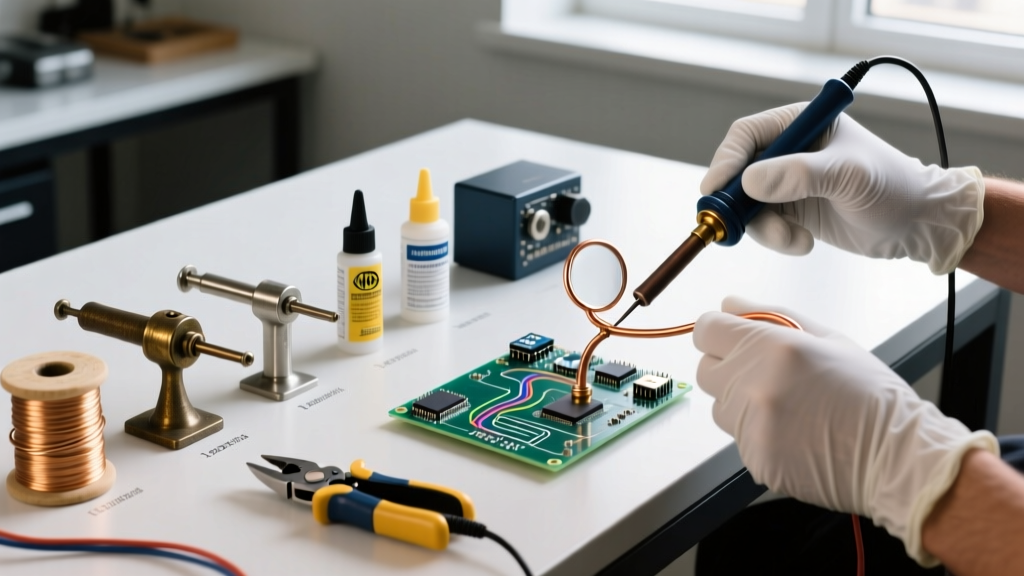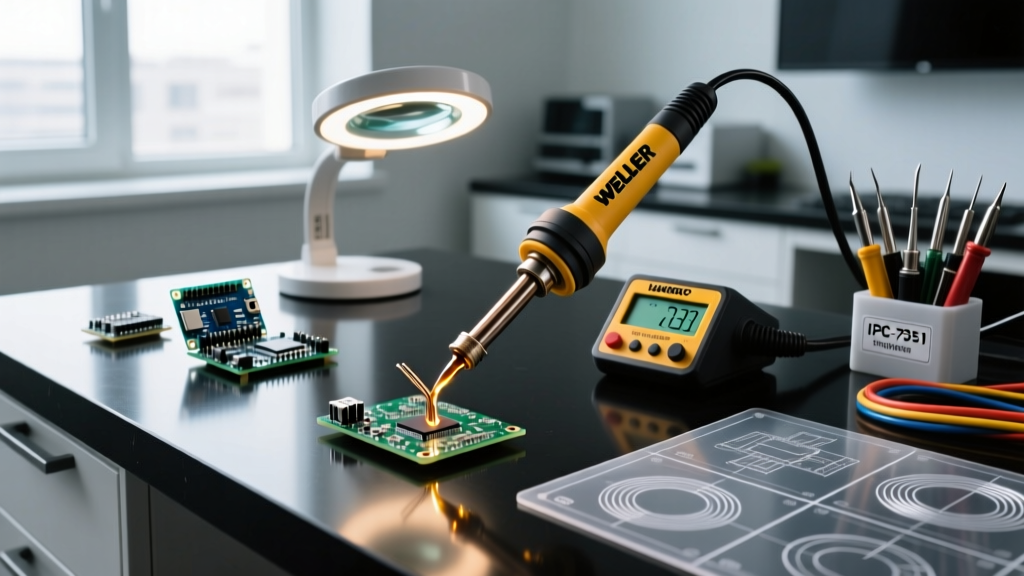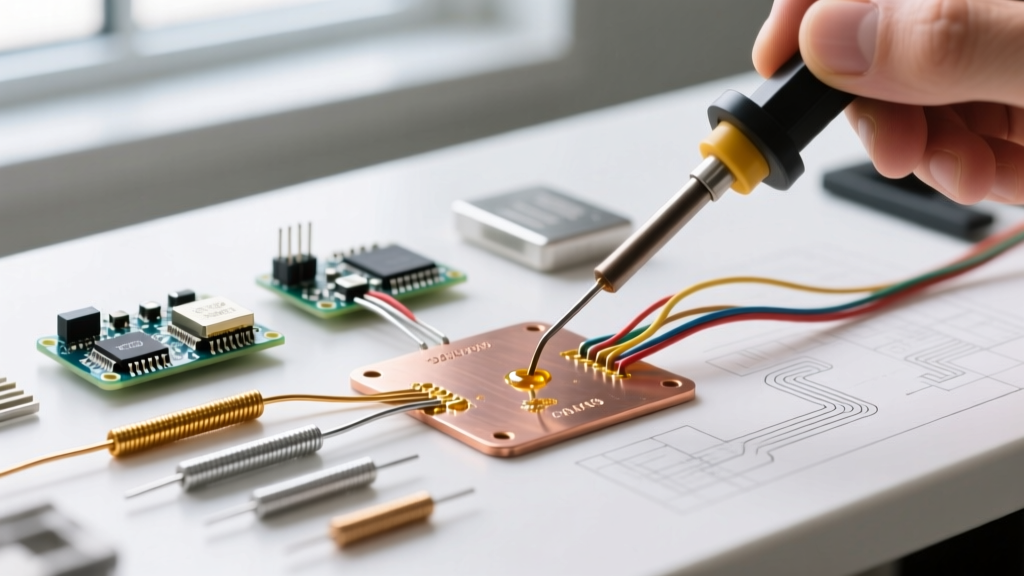

The Hidden Complexities of Lead Wire Soldering
While surface-mount technology dominates modern PCB assembly, lead wire soldering remains a critical skill for aerospace, automotive, industrial controls, and high-end DIY electronics. However, treating all wire soldering as a uniform process is a primary cause of field failures. A mismatch between the wire conductor, insulation material, solder alloy, and flux chemistry can result in brittle intermetallic compounds, insulation melt-back, or catastrophic solder wicking.
This material compatibility guide provides a deep-dive into the metallurgical and thermal realities of lead wire termination in 2026, referencing IPC J-STD-001 requirements and high-reliability aerospace standards.
Conductor Metallurgy & Solder Alloy Matrix
The base metal of your lead wire dictates the required solder alloy and thermal profile. Using the wrong alloy can lead to galvanic corrosion or weak intermetallic bonds. Below is the compatibility matrix for common wire conductors.
| Wire Conductor | Recommended Alloy | Melting Point | Iron Temp (Chisel Tip) | Max Dwell Time |
|---|---|---|---|---|
| Bare Copper (Stranded) | Sn63/Pb37 (Eutectic) | 183°C | 320°C - 340°C | 3 Seconds |
| Pre-Tinned Copper | SAC305 (Sn96.5/Ag3/Cu0.5) | 217°C | 350°C - 370°C | 4 Seconds |
| Silver-Plated Copper | Sn96.5/Ag3/Cu0.5 | 217°C | 340°C | 2 Seconds |
| Nichrome / High-Resist | Sn60/Pb40 + Acid Flux* | 183°C - 190°C | 380°C | 5 Seconds |
*Note: Acid flux must be thoroughly neutralized and cleaned post-soldering to prevent severe corrosion. Never use acid flux on standard electronics PCBs.
The Silver-Plating Leaching Problem
When soldering silver-plated lead wires (common in RF and aerospace applications), standard tin-lead solders will rapidly leach the silver plating into the solder joint, leaving a bare, easily oxidized copper core. According to the Indium Corporation Solder Alloy Guide, using a silver-bearing alloy like SAC305 or Sn62/Pb36/Ag2 saturates the molten solder with silver, drastically reducing the leaching effect and preserving the wire's structural integrity.
Insulation Thermal Limits & Melt-Back Prevention
The most common failure in manual lead wire soldering is insulation melt-back, where the heat from the iron or the molten solder travels up the wire via capillary action, melting the jacket and causing short circuits or loss of flexibility.
Insulation Material Thresholds
- PVC (Polyvinyl Chloride): Standard commercial wire. Melts/deforms between 105°C and 150°C. Highly susceptible to wicking. Requires strict 2-second dwell limits and heat-sinking techniques.
- Silicone: Common in high-temp DIY and RC electronics. Withstands up to 200°C. Does not melt easily but will char and emit white smoke if exposed to a 380°C iron tip directly.
- PTFE (Teflon): MIL-SPEC standard (e.g., MIL-W-16878/4). Withstands 350°C+ continuously. Immune to standard soldering iron melt-back, making it the gold standard for aerospace and high-density terminal blocks.
- Kapton (Polyimide): Used in extreme environments. Withstands 400°C. Excellent thermal stability but requires precision stripping tools as the insulation is incredibly tough.
Expert Tip: When working with PVC-insulated wires, apply a small bead of heat-sink paste or use a pair of hemostats clamped between the strip line and the terminal to absorb thermal energy and prevent the jacket from shrinking back.
Flux Chemistry Selection by Wire Type
Flux is the unsung hero of lead wire soldering. The wrong flux will either fail to remove heavy oxidation from bare copper or leave behind corrosive residues that degrade the joint over time.
| Flux Type | Best Application | Activation Temp | Post-Solder Cleaning |
|---|---|---|---|
| RMA (Rosin Mildly Activated) | Bare copper, heavy oxidation, turret terminals | 150°C - 180°C | Isopropyl Alcohol (IPA) |
| No-Clean (NC) | Pre-tinned wires, PCB pad soldering | 180°C - 210°C | None (Residue is benign) |
| Water-Soluble (OA) | Automotive, heavily soiled wires | 120°C - 150°C | Deionized Water (Mandatory) |
For high-reliability lead wire soldering, Kester 186 (RMA) remains the industry benchmark for bare copper wires due to its aggressive oxide removal and safe residue profile. For pre-tinned wires where speed is paramount, Amtech NC-559 No-Clean flux gel provides excellent wetting without the cleanup overhead.
Step-by-Step: IPC-Compliant Cup Terminal Termination
When terminating lead wires into solder cups (common in D-Sub connectors and circular MIL-SPEC connectors), follow these steps to meet NASA Technical Standards and IPC Class 3 requirements:
- Prep the Cup: Apply a microscopic amount of RMA flux to the inside of the solder cup. Touch the iron tip to the cup and feed solder until the cup is 50% filled. Remove the iron and let it solidify.
- Prep the Wire: Strip the wire to the exact depth of the cup (plus 1mm for the insulation clearance). Twist the stranded wire lightly—do not over-twist, as this prevents solder from wicking between the strands.
- Pre-Tin the Wire: Apply flux to the bare strands and pre-tin the wire. The solder should wick to the end of the strands but never touch the insulation.
- Final Mating: Insert the pre-tinned wire into the pre-filled cup. Apply the iron to the outside of the cup. When the solder flashes (melts), remove the iron immediately.
- Hold and Cool: Hold the wire perfectly still for 3-5 seconds until the solder transitions from a shiny liquid to a solid, frosty/matte finish (for lead-free) or bright silver (for Sn63).
Troubleshooting Edge Cases & Failure Modes
Solder Wicking Under Insulation
The Problem: Solder creeps up the wire strands beneath the PVC or Silicone jacket, creating a rigid, brittle section that snaps under vibration.
The Fix: Reduce iron temperature by 20°C. Use a wider chisel tip to transfer heat faster, reducing the overall time the wire is exposed to thermal energy. Ensure the wire is perfectly horizontal during cooling to prevent gravity-assisted wicking.
Intermetallic Compound (IMC) Embrittlement
The Problem: Excessive dwell times (over 5 seconds) cause the copper and tin to react excessively, forming a thick layer of Cu6Sn5 and Cu3Sn. This IMC layer is highly crystalline and brittle.
The Fix: Upgrade your soldering station. A high-thermal-recovery station like the Weller WX2021 or Hakko FX-951 maintains tip temperature during the joint formation, allowing you to complete the solder flow in under 2 seconds, keeping the IMC layer at the optimal 1-2 microns thickness.
Cold Joints on Large Gauge Wires (14 AWG - 10 AWG)
The Problem: The massive thermal mass of a 10 AWG copper wire acts as a giant heat sink, dropping the tip temperature below the solder's liquidus point, resulting in a dull, grainy cold joint.
The Fix: Do not simply turn the station up to 450°C; this will oxidize your tip and burn the flux. Instead, switch to a heavy-duty bevel or large chisel tip (e.g., Hakko T18-D32) to maximize surface contact area, and pre-heat the wire using a hot air gun set to 150°C before applying the iron.
Frequently Asked Questions (FAQ)
Can I use lead-free solder on vintage equipment wiring?
While possible, it is not recommended. Vintage wiring often features degraded tinning and brittle insulation that cannot withstand the 350°C+ temperatures required for SAC305 lead-free alloys. Stick to Sn63/Pb37 at 320°C for restoration work to preserve the integrity of 40-year-old PVC and cloth braiding.
Why does my solder ball up and refuse to stick to the wire?
This is almost always an oxidation or flux issue. If the bare copper has been exposed to air for more than a few weeks, a thick layer of copper oxide forms. Standard No-Clean fluxes lack the activators needed to penetrate this layer. Switch to a liquid RMA flux, scrub the wire lightly with a fiberglass scratch pen, and re-tin.
What is the ideal tip shape for soldering 22 AWG stranded wire?
A standard 'B' (conical) tip is actually the worst choice for lead wires, as it offers minimal surface area contact. A 'D' (chisel) tip, specifically 1.6mm to 2.4mm wide, provides the optimal thermal transfer surface to wrap around the cylindrical profile of a stranded wire.