
Beyond Copper: The Real Soldering Basics
Most tutorials covering soldering basics assume you are only ever joining bare copper wire to a tinned PCB pad. While that covers 80% of beginner electronics projects, the remaining 20%—where you need to solder stainless steel enclosures, aluminum heat sinks, or nickel-plated battery tabs—is where standard advice fails catastrophically. True mastery of soldering basics requires understanding metallurgy, specifically how different base metals interact with heat, flux chemistry, and solder alloys.
In 2026, with the continued dominance of RoHS-compliant lead-free alloys in commercial manufacturing and high-power DIY builds, knowing your material compatibility matrix is no longer optional. This guide bridges the gap between basic through-hole soldering and advanced multi-material fabrication.
The Material Compatibility Matrix
Before picking up your iron, identify your base metal. The table below outlines the exact parameters required for a reliable metallurgical bond. Data aligns with modern workmanship standards, including NASA-STD-8739.3 requirements for high-reliability soldered connections.
| Base Metal | Solderability | Required Flux Chemistry | Recommended Alloy | Iron Tip Temp (°C) |
|---|---|---|---|---|
| Copper / Bare PCB | Excellent | Rosin (RMA) or No-Clean | Sn63/Pb37 or SAC305 | 320°C - 350°C |
| Brass / Bronze | Good | Mild Organic Acid (OA) | Sn60/Pb40 | 340°C - 360°C |
| Nickel / Kovar | Fair / Poor | Activated Rosin / Mild OA | Sn96.5/Ag3.5 | 360°C - 380°C |
| Stainless Steel | Poor | Inorganic Acid (Zinc Chloride) | Sn60/Pb40 (with 2% Ag) | 380°C - 400°C |
| Aluminum | Very Poor | Specialized Fluoride/Zinc | Zn-Al or Sn-Zn | 400°C+ (or Ultrasonic) |
Deep Dive: Soldering the "Easy" Metals
Copper, Tin, and Silver
Copper is the gold standard for soldering. Its high thermal conductivity and lack of a stubborn passivation oxide layer make it highly receptive to standard rosin-based fluxes. For basic electronics, a Kester 245 No-Clean flux paired with a eutectic Sn63/Pb37 wire is ideal. If you are building commercial or RoHS-compliant gear, transition to SAC305 (Sn96.5/Ag3.0/Cu0.5). SAC305 requires higher thermal input; set your station to 360°C and use a chisel tip to maximize surface area contact.
Brass and Bronze
Brass contains zinc, which can oxidize rapidly under high heat, leading to de-wetting (where the solder balls up and refuses to flow). Standard rosin flux is often too weak to break through this oxidation. Upgrade to a mildly activated organic acid flux. Always pre-tin the brass component before attempting to join it to a wire.
Deep Dive: The "Hard" Metals
Stainless Steel and the Chromium Oxide Barrier
Stainless steel owes its corrosion resistance to a microscopic, self-healing layer of chromium oxide. Standard rosin flux cannot penetrate this layer. If you try, the solder will simply roll off the joint.
Metallurgy Rule #1: You cannot solder through a passive oxide layer without aggressive chemical or mechanical intervention. For stainless steel, chemical intervention via inorganic acid is mandatory.
The Solution: Use a Zinc Chloride-based liquid flux, such as La-Co Stay-Clean (approx. $12 for a 4 oz bottle). Apply it to the steel, heat with a high-wattage iron (minimum 60W), and feed a silver-bearing solder (like Sn62/Pb36/Ag2) which wets steel significantly better than standard tin-lead. Warning: Inorganic acid fluxes are highly corrosive and electrically conductive. You must neutralize and clean the joint with a baking soda solution and isopropyl alcohol immediately after soldering.
Nickel and Battery Tabs
Pure nickel strips, commonly used in DIY lithium-ion battery packs, are notoriously difficult to solder due to high thermal mass and poor wetting characteristics. According to Indium Corporation's technical data on solder alloys, adding silver to the solder alloy drastically improves wetting on nickel. Use a Sn96.5/Ag3.5 alloy and a high-capacity soldering station. Pre-scratching the nickel surface with fine-grit sandpaper (400-grit) immediately before applying flux can mechanically break the initial oxide layer, giving the flux a head start.
The Expert Tier: Aluminum
Soldering aluminum is the final boss of soldering basics. Aluminum oxide reforms within milliseconds of being exposed to air, even if you scrape it off. Standard soldering irons will fail here because the aluminum acts as a massive heat sink, dropping the tip temperature below the melting point of the solder before the joint reaches thermal equilibrium.
- Chemical Approach: Use a specialized aluminum soldering flux like MG Chemicals 8321 or a zinc-based paste. You must mechanically abrade the aluminum through the flux layer using a fiberglass scratch pen or a stainless steel brush to prevent air contact while breaking the oxide.
- Alloy Selection: Standard tin-lead will not bond. You must use a Zinc-Aluminum or Tin-Zinc alloy (e.g., Alusolder). These alloys melt at higher temperatures (around 380°C - 400°C).
- Ultrasonic Approach: In professional 2026 manufacturing, ultrasonic soldering irons are used. The high-frequency acoustic vibrations cavitate the molten solder, literally shattering the aluminum oxide layer without the need for chemical flux.
Thermal Mass Mismatches: The Hidden Failure Mode
A common failure in soldering basics is the "cold joint" caused by thermal mass mismatch. Imagine soldering a thin 22AWG wire to a massive copper ground lug. If you apply the iron to both simultaneously, the thin wire reaches 350°C in one second, while the lug remains at 40°C. The flux on the wire burns off, the wire oxidizes, and the solder refuses to flow onto the cold lug.
The Fix: Always pre-tin both surfaces independently. Apply flux and a small amount of solder to the wire. Then, apply flux and pre-tin the lug using a wide chisel tip (like the Hakko T18-D24) to maximize thermal transfer. Once both are pre-tinned, bring them together and apply the iron to the heavier component (the lug). The pre-tinned surfaces will alloy together seamlessly in seconds.
Essential Gear for Multi-Material Soldering
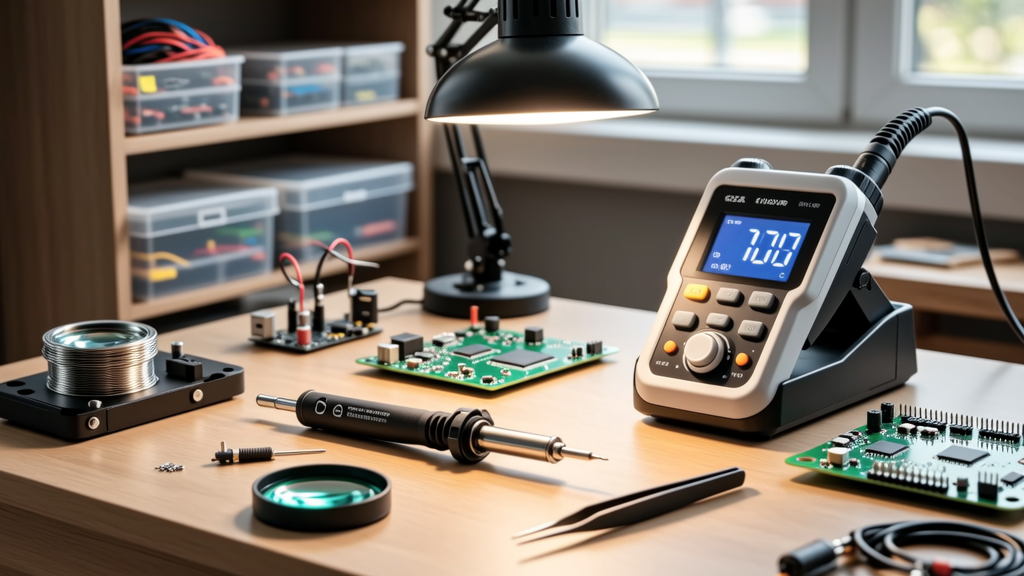
To execute the techniques above, a cheap 30W plug-in iron will not suffice. You need active temperature regulation and swappable tips.
- Soldering Station: The Hakko FX-888D (~$110) or Pinecil V2 (~$26) are excellent entry points. For heavy steel/aluminum work, the Weller WE1010NA (~$115) provides the 70W thermal recovery needed to prevent tip temperature collapse.
- Flux Arsenal: Keep a Kester 245 No-Clean Pen (~$9) for PCBs, and a bottle of La-Co Stay-Clean (~$12) for steel and brass. Never cross-contaminate your brushes.
- Tip Geometry: Ditch the conical tips. Conical tips have terrible thermal mass transfer. Use a Chisel (D-series) or Bevel (C-series) tip to ensure maximum surface area contact with the base metal.
Summary
Mastering soldering basics isn't just about melting metal; it's about managing surface chemistry and thermal dynamics. By matching your flux chemistry to the base metal's oxide layer, selecting the correct alloy for wetting, and respecting thermal mass, you can reliably join almost any metal in your workshop. Always refer to the Kester Flux Technical Documentation when experimenting with new chemical activators, and prioritize proper ventilation when using aggressive acid fluxes.