
The Gap Between Hobbyist and Industrial Soldering Skills
Transitioning from a home workbench to an industrial manufacturing floor requires a fundamental shift in methodology. While hobbyists prioritize basic electrical continuity, industrial environments demand absolute mechanical integrity, thermal resilience, and long-term reliability. Advanced industrial soldering skills are not merely about melting solder; they involve a deep understanding of metallurgy, flux chemistry, thermal profiling, and strict adherence to international quality standards. As of 2026, the miniaturization of components (down to 01005 imperial packages) and the rise of high-power electric vehicle (EV) electronics have made these specialized skills more critical—and lucrative—than ever.
The Regulatory Framework: IPC and NASA Standards
In the industrial sector, soldering skills are measured against rigorous, standardized benchmarks. The most universally recognized standard is the IPC-A-610 (Acceptability of Electronic Assemblies). Understanding the three classes of IPC compliance is the first step in mastering industrial applications:
- Class 1 (General Electronic Products): Focuses on basic functionality. Consumer electronics like toys or simple remote controls fall here. Minor cosmetic defects are acceptable if the board functions.
- Class 2 (Dedicated Service Electronic Products): Requires extended life and uninterrupted performance. Examples include commercial servers, telecommunications gear, and standard automotive electronics.
- Class 3 (High-Performance Electronic Products): Demands strict compliance with zero tolerance for failure. This includes life-support medical devices, aerospace flight controls, and military defense systems.
For aerospace and defense applications, operators must also master the requirements outlined in NASA-STD-8739.3 (Requirements for Soldered Electrical Connections). This standard dictates exact wetting angles, fillet shapes, and the prohibition of certain cleaning solvents, requiring a much higher degree of manual dexterity and process control than standard commercial assembly.
Metallurgy and Alloy Selection in Industry
Industrial soldering skills require the operator to select the correct alloy based on the operational environment of the final product. The days of universally using 60/40 tin-lead solder are over, though specific exemptions remain.
Lead-Free Alloys (SAC305 and SN100C)
Driven by RoHS (Restriction of Hazardous Substances) directives, SAC305 (96.5% Tin, 3.0% Silver, 0.5% Copper) is the industry standard for commercial and automotive electronics. It has a liquidus temperature of 217°C. However, SAC305 is prone to tin whisker growth and can be brittle under high mechanical shock. For high-vibration environments, operators are increasingly utilizing SN100C (Tin-Copper-Nobium), which offers superior drop-shock resistance and eliminates silver migration issues.
Leaded Alloys (Sn63Pb37) for Class 3 Applications
Despite environmental regulations, aerospace, military, and implantable medical devices retain exemptions to use eutectic Sn63Pb37 (63% Tin, 37% Lead). This alloy melts at a lower 183°C and forms a more ductile joint, which is critical for surviving the extreme thermal cycling of low-earth orbit or the mechanical vibration of a missile launch. Operators working in these sectors must possess the skills to prevent cross-contamination between leaded and lead-free assembly lines, as mixing the two creates brittle, high-resistance intermetallic compounds (IMCs).
Industrial Tooling: Active vs. Passive Thermal Recovery
You cannot execute high-level industrial soldering skills with a $40 passive ceramic heater iron. Industrial environments require stations with rapid thermal recovery to handle multi-layer PCBs with heavy ground planes that act as heat sinks.
| Tool Category | Industry Standard Models (2026) | Price Range | Best Application |
|---|---|---|---|
| Active Tip Systems | JBC RMVE / CD-2BQE with T245 handles | $650 - $850 | Precision SMD, 0201 to 0805, QFNs |
| High-Power Rework | Weller WX2021 with WXP120 iron | $700 - $900 | Through-hole, heavy ground planes, EV power modules |
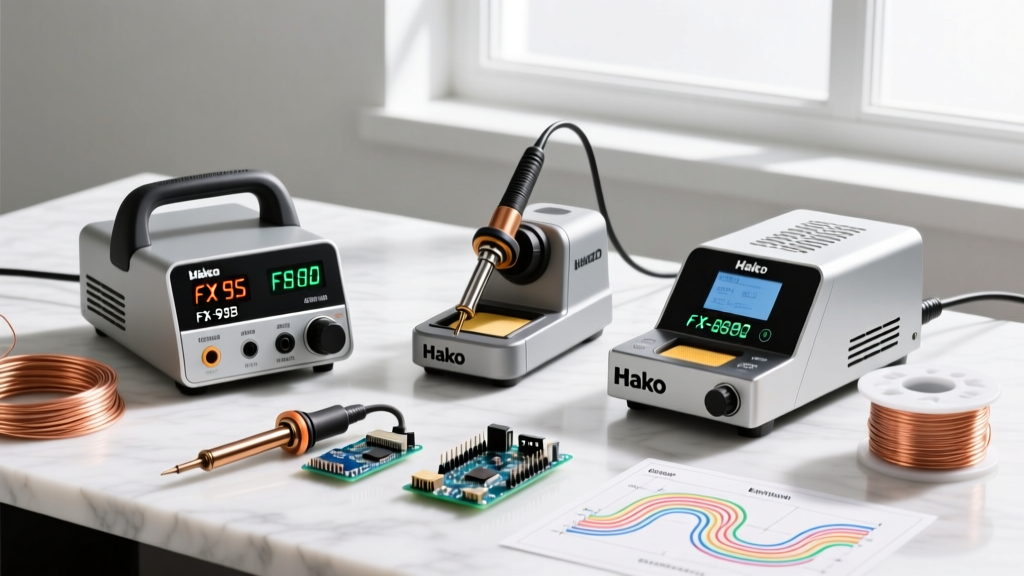
| Micro-Soldering | Hakko FX-951 with T12 micro-tips | $300 - $450 | Medical device repair, fine-pitch IC rework |
The JBC T245 system is currently the gold standard for high-reliability SMD work. Because the heating element is integrated directly into the tip cartridge, the thermal feedback loop is virtually instantaneous (under 1.5 seconds). This prevents the operator from dwelling on the pad, which is a primary cause of pad delamination and excessive IMC growth.
Flux Chemistry and Cleanliness Protocols
Amateur soldering often relies on the mild flux core inside the solder wire. Industrial soldering skills require the external application of specialized liquid or tacky fluxes to ensure complete deoxidation of the pads before the solder flows.
Expert Insight: In Class 3 medical assemblies, using a water-soluble (ORH1) flux requires mandatory ultrasonic or DI-water cleaning post-soldering. Any residual active flux left under a BGA or QFN component will absorb moisture and cause electrochemical migration (dendritic growth), leading to catastrophic field failure.
For standard commercial assemblies, No-Clean fluxes (ROS0 or ROL0) are preferred. However, operators must be skilled enough to manage the thermal profile; if a no-clean flux is not heated to its designed activation and volatilization temperature, the unburned activators remain corrosive. Furthermore, if a conformal coating is to be applied later, no-clean flux residues must be meticulously managed, as they can cause coating delamination.
Advanced Failure Modes and Troubleshooting
Industrial inspectors and rework technicians must be able to identify failure modes that are invisible to the naked eye. Mastery of industrial soldering skills includes understanding the microscopic physics of the solder joint.
Intermetallic Compound (IMC) Overgrowth
When solder wets a copper pad, an IMC layer (typically Cu6Sn5) forms. A healthy IMC layer is 1 to 3 micrometers thick. If an operator uses an iron set too high (e.g., 400°C) or dwells for more than 3 seconds, the IMC layer grows excessively thick. Thick IMC is highly brittle and will fracture under thermal expansion or mechanical vibration. Skilled operators keep tip temperatures strictly profiled—usually 320°C to 350°C for lead-free work—and limit contact time to under 2 seconds per joint.
Copper Dissolution and Pad Erosion
When working with high-tin lead-free alloys at elevated temperatures, the tin actively dissolves the copper from the PCB pad. This is particularly problematic when reworking thick copper boards used in power electronics. Operators must use specialized tips with advanced iron-plating to resist dissolution and must never use abrasive tip cleaners (like brass wire balls) which strip the protective plating off the iron tip.
Tombstoning and Wetting Imbalances
In automated reflow, tombstoning is a stencil or paste issue. In manual industrial rework, tombstoning of small passives (0402 or 0201) occurs when the operator heats one pad significantly more than the other, causing the surface tension of the molten solder to pull the component upright. The required skill is simultaneous, symmetrical heating using a pre-heater board set to 100°C beneath the PCB, combined with a micro-pencil tip to gently touch both pads at the exact same moment.
Health, Safety, and Fume Extraction
Industrial environments mandate strict adherence to safety protocols. According to OSHA guidelines on lead exposure, even trace amounts of lead dust from manual Sn63Pb37 soldering require specific handling, hand-washing protocols, and localized ventilation. Furthermore, the volatilization of rosin-based fluxes produces colophony fumes, which are known respiratory sensitizers and can cause occupational asthma. True industrial soldering skills encompass the discipline to always utilize localized HEPA and activated carbon fume extractors (such as the Weller Zero Smog series) positioned exactly two inches from the soldering joint.
Summary: The Path to Professional Certification
Acquiring industrial soldering skills is not an overnight process. It requires hundreds of hours of deliberate practice on IPC training kits, a deep respect for thermal dynamics, and an investment in precision tooling. For electronics professionals looking to move into aerospace, medical, or high-end automotive manufacturing, pursuing formal IPC-A-610 Certified IPC Specialist (CIS) training is the definitive way to validate your skills and command top-tier industry compensation.