
Why Your Soldering Stand Matters More Than You Think
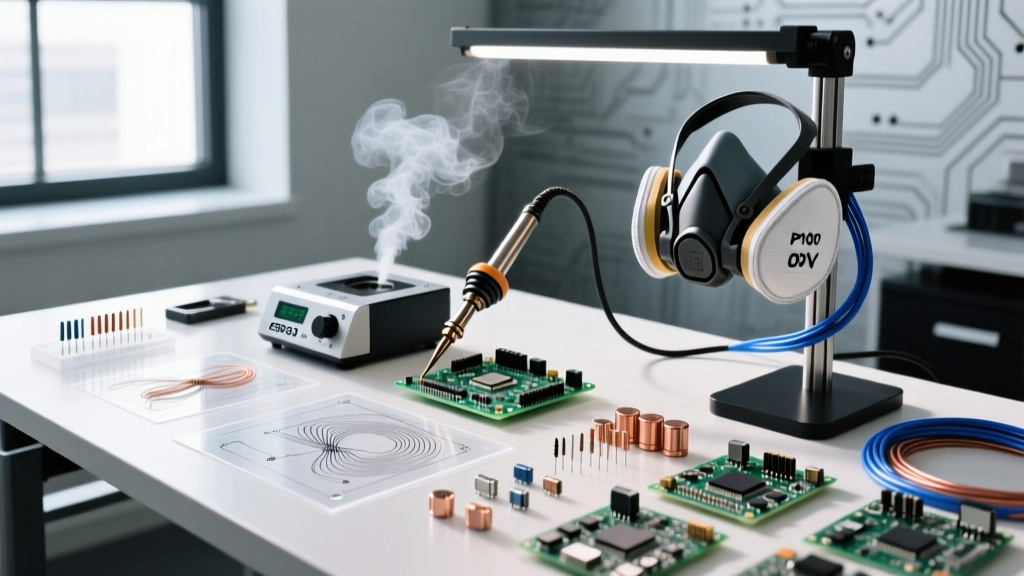
When building out a professional electronics workbench, hobbyists and even seasoned technicians often blow their budget on a high-end soldering station while treating the soldering stand as an afterthought. This is a critical mistake. A poorly designed stand accelerates tip oxidation, induces thermal shock, and fails to manage hazardous flux fumes. According to the Health and Safety Executive (HSE), localized extraction at the source is vital to prevent occupational asthma from colophony (rosin) fumes, making your stand's geometry just as important as its cleaning media.
To cut through the marketing noise, we convened a panel of three industry veterans—an IPC-certified aerospace trainer, a high-volume microsoldering repair tech, and a university prototyping lab director. We asked them to break down their exact soldering stand setups for 2026, including specific model numbers, failure modes, and the exact science behind their choices.
The Expert Panel
- Marcus Vance: IPC J-STD-001 Certified Trainer and aerospace rework specialist. Focuses on compliance, repeatability, and tip longevity.
- Elena Rostova: High-volume consumer electronics repair technician specializing in BGA rework and micro-jumpering. Prioritizes speed and thermal recovery.
- David Chen: Director of a university hardware prototyping lab. Manages 40+ bench stations and prioritizes safety, fume extraction, and modularity.
Expert Pick 1: The Aerospace Rework Standard
"In aerospace rework, a damaged tip means a scrapped $5,000 flight-control board. I don't use brass wool, and I don't use wet sponges. I use a heavy-base coil spring stand that lets the tip rest in ambient air, preserving the iron plating." — Marcus Vance
Setup Breakdown: Hakko 602 & 601 Combo
Marcus relies exclusively on the Hakko 602 soldering stand paired with the Hakko 601 brass wool cleaner. The Hakko 602 features a heavy cast-zinc alloy base weighing approximately 285 grams. This mass is critical; when you aggressively wipe a tip or holster a heavy handpiece like the Hakko T18 or FX-951, the stand must not slide across the ESD mat.
The Science of the Coil Spring: The 38mm diameter coil spring in the 602 is engineered so the soldering tip hovers 4mm above the bottom collection tray. Cheap stands allow the tip to rest directly in a pool of oxidized solder and baked flux residue. When a 350°C tip touches this acidic, hardened slag, the iron plating undergoes rapid galvanic corrosion, leading to pitting and tip death within weeks.
Pricing & Availability: The Hakko 602 retails for about $28, while the 601 brass wool insert is $12. Total setup: ~$40.
Failure Mode to Avoid: Pressing the tip too hard into the brass wool. The brass curls are highly abrasive. If you apply downward pressure, you will physically scrape off the microscopic iron plating on the tip, exposing the copper core to instant dissolution by molten tin.
Expert Pick 2: The High-Volume Repair Bench
"When I'm doing 40 HDMI port replacements a day, I don't have time to dig for a spring coil. I need a wide trough and a perfectly dampened cellulose sponge for instant bevel-tip cleaning." — Elena Rostova
Setup Breakdown: Weller WSA100 with Cellulose Media
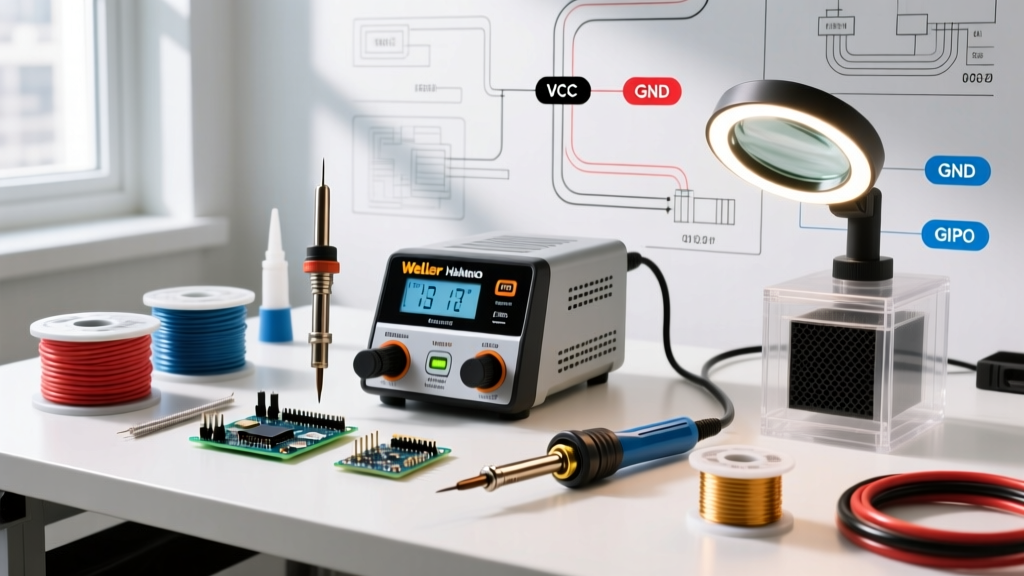
Elena's bench setup centers on the Weller WSA100. Unlike the heavy cast bases of aerospace stands, the WSA100 uses a stamped steel construction weighing just 155 grams. Elena secures it to her bench using a strip of 3M VHB tape on the bottom. Her secret weapon, however, is the cleaning media: genuine Weller ET series cellulose sponges.
Cellulose vs. Synthetic Sponges: Most generic stands ship with synthetic (polyurethane) sponges. These melt at high temperatures and pool water on the surface. When a 380°C chisel tip hits a synthetic puddle, the temperature drops by over 120°C in milliseconds, causing micro-fractures in the tip's chrome plating. Genuine Weller cellulose sponges absorb and hold water internally within their porous matrix, providing a damp surface that cleans oxidized flux without triggering severe thermal shock.
Pricing & Availability: The WSA100 stand is roughly $22. A 5-pack of genuine Weller cellulose sponges is $15. Total setup: ~$37.
Failure Mode to Avoid: Using tap water. The minerals in tap water will bake onto the tip and accelerate corrosion. Elena strictly uses distilled water with a single drop of glycerin to keep the cellulose pliable between shifts.
Expert Pick 3: The Modern Prototyping Lab
"Safety and modularity are my KPIs. I need stands that integrate local exhaust ventilation (LEV) without taking up a foot of bench space. Custom T12 extrusion stands are the only way to go in 2026." — David Chen
Setup Breakdown: Custom T12 Aluminum Extrusion Stands with PWM Fan Mounts
David manages a lab filled with Pine64 Pinecil and KSGER T12 stations. He has standardized on custom CNC-machined aluminum extrusion stands sourced from specialized lab suppliers. These stands feature a built-in 120mm PWM fan mount positioned exactly 4 inches from the holster, angled at 35 degrees to capture rising thermal fumes.
Fume Extraction Geometry: According to IPC J-STD-001 guidelines and general occupational safety standards, capturing fumes at the source is vastly superior to overhead snorkels. David's custom stands pull colophony fumes through a replaceable HEPA/Activated Carbon canister mounted directly beneath the bench, keeping the breathing zone completely clear.
Pricing & Availability: These modular aluminum stands typically cost between $35 and $45 from specialized 3D printing and CNC vendors online. Replacement 120mm Noctua PWM fans add another $20. Total setup: ~$60.
Failure Mode to Avoid: Using static-pressure fans instead of airflow (CFM) fans. Fume extraction at this proximity requires moving a high volume of air (CFM) rather than pushing against high static pressure. Using the wrong fan profile will result in fume blowback.
Head-to-Head Comparison Matrix
| Feature | Hakko 602 (Marcus) | Weller WSA100 (Elena) | Custom T12 Extrusion (David) |
|---|---|---|---|
| Base Material & Weight | Cast Zinc / 285g | Stamped Steel / 155g | CNC Aluminum / 210g |
| Cleaning Media | Brass Wool (Dry) | Cellulose Sponge (Wet) | Brass Wool + Integrated Fan |
| Thermal Shock Risk | None (Ambient Air) | Low (If properly dampened) | None (Ambient Air) |
| Best Tip Geometry | Conical & Fine Pitch | Chisel, Bevel & Knife | Universal (T12 Cartridges) |
| Estimated Cost (2026) | $40 | $37 | $60 |
Critical Buying Criteria: What the Experts Look For
If you are evaluating a soldering stand not mentioned in this roundup, run it through this expert checklist before purchasing:
- Spring Coil Pitch: The coils should be spaced at least 5mm apart. Tight coils will scrape the sides of your soldering tip as you insert and withdraw it, acting like a lathe and shaving off the protective iron layer.
- Footprint vs. Stability Ratio: A stand should have a footprint no larger than 80mm x 80mm to conserve bench space, but the center of gravity must be low enough that a 150-gram silicone cord pulling from the back won't tip it over.
- Media Replaceability: Avoid stands where the brass wool or sponge is permanently integrated. You must be able to swap the cleaning media every 3 to 6 months as it becomes saturated with carbonized flux.
Frequently Asked Questions
Is brass wool or a cellulose sponge better for lead-free solder?
Lead-free alloys (like SAC305) require higher operating temperatures (350°C - 380°C). At these temperatures, a wet cellulose sponge causes severe thermal shock, which can crack the iron plating on the tip. Therefore, brass wool is vastly superior for lead-free soldering as it cleans via mechanical friction without dropping the tip temperature.
How do I clean oxidized brass wool in my stand?
Do not wash brass wool with water; it will trap moisture and cause the brass to rust and degrade. Instead, remove the wool from the stand, take it outside, and use compressed air to blow out the carbonized flux dust and solder dross. If it is heavily caked, replace it—a fresh insert costs less than $10 and protects your $15 tips.
Can I use a damp paper towel instead of a sponge?
No. Paper towels contain clay fillers and binders that will instantly transfer to your hot soldering tip, creating an insulating layer that ruins thermal transfer. Furthermore, the paper will scorch and leave ash residue in your stand. Always use pure cellulose sponges or brass wire.
Final Verdict
Your soldering stand is the unsung hero of bench longevity. For strict compliance and maximum tip life, the Hakko 602 remains the undisputed champion in 2026. For high-speed chisel-tip work, the Weller WSA100 with genuine cellulose is unbeatable. And for modern labs prioritizing health and safety, investing in a custom T12 extrusion stand with LEV integration is non-negotiable. Stop treating your stand as an accessory; treat it as a critical thermal management tool.