
The Enterprise Challenge: High-Mass Motherboard Rework
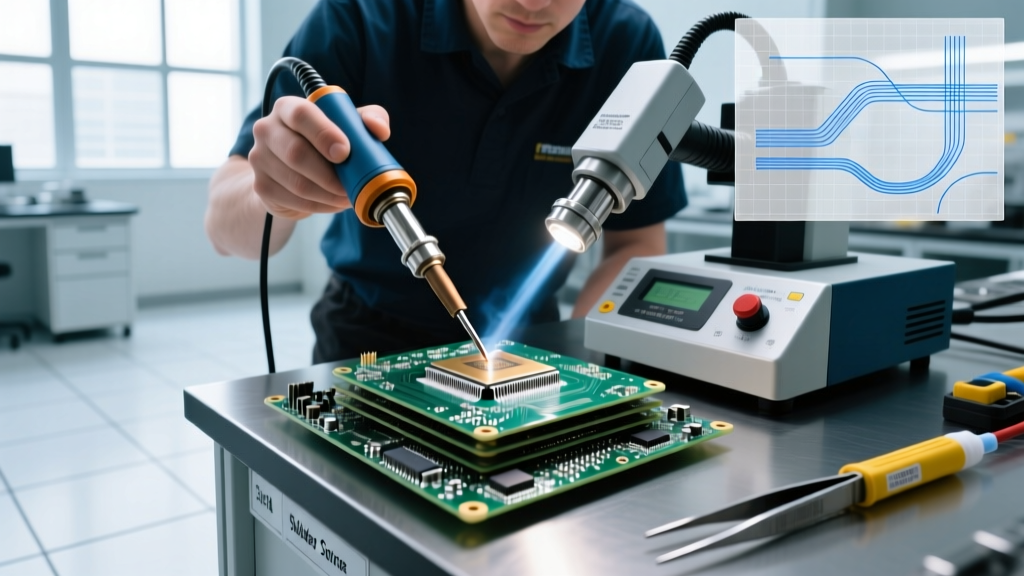
In the realm of data center maintenance, aerospace engineering, and industrial PC refurbishment, the stakes of component-level repair are exceptionally high. When professionals are soldering motherboard assemblies designed for enterprise servers or telecom infrastructure, they are not working with simple two-layer hobbyist boards. Modern 2026 enterprise architectures—driven by PCIe Gen 5 and Gen 6 signal integrity requirements—frequently utilize 14 to 24-layer PCBs with thicknesses ranging from 2.0mm to over 3.2mm. These high-mass boards act as massive heat sinks, making traditional hand soldering entirely ineffective for large Ball Grid Array (BGA) components like CPUs, GPUs, and Southbridge chipsets.
Successfully soldering motherboard components in an industrial setting requires a deep understanding of thermal dynamics, coefficient of thermal expansion (CTE) mismatches, and strict adherence to IPC-7095 standards for bottom termination components. This guide details the professional equipment, thermal profiling matrices, and metallurgical considerations required for high-reliability BGA and SMD rework.
Industry Insight: The Cost of Downtime
In hyperscale data centers, a single failed proprietary server motherboard can halt critical compute clusters. Replacing the entire board may cost upwards of $8,000 and incur weeks of lead time. Precision BGA rework allows facilities to replace a $150 chipset and restore the asset to IPC Class 3 compliance, saving thousands of dollars per incident while maintaining supply chain resilience.
Enterprise Rework Stations: Beyond the Soldering Iron
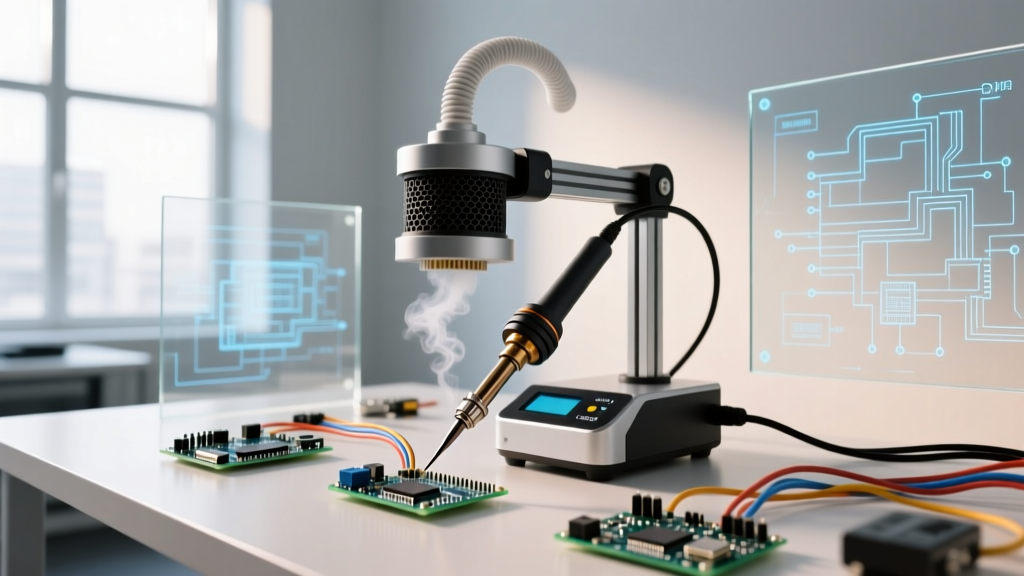
You cannot achieve reliable reflow on a 20-layer server board using a standard $300 hot air station. Industrial facilities invest in closed-loop, multi-zone rework systems that monitor the actual temperature of the component via thermocouples, adjusting top and bottom heat in real-time.
- JBC RMVE Advanced Rework System ($4,500 - $5,200): The gold standard for high-density BGA rework. It features a 1200W preheater and an intelligent top-heating module that extracts heat from the board the moment the target reflow temperature is reached, preventing thermal runaway. JBC's advanced rework systems are heavily favored in aerospace and medical device manufacturing.
- Hakko FR-830UW Preheater ($1,800 - $2,100): Often paired with high-end hot air pencils, this IR and hot-air hybrid preheater is essential for bringing the massive thermal mass of a server motherboard up to a baseline of 130°C before localized top-heat is applied.
- Weller WXHAP200 Hot Air Iron ($1,200 - $1,400): For peripheral SMD components surrounding the BGA (like high-density MLCC capacitors and power delivery MOSFETs), the WXHAP200 provides precise airflow control down to 10 liters per minute, preventing the displacement of microscopic 01005 components.
Thermal Profiling for Multi-Layer Server Boards
The most critical variable when soldering motherboard chipsets is the thermal profile. Applying too much top heat too quickly will cause the silicon die to crack or the substrate to delaminate. Applying too little bottom heat will result in cold solder joints or 'head-in-pillow' (HiP) defects, where the BGA sphere melts but fails to coalesce with the pad paste.
Below is a baseline thermal profile matrix for lead-free SAC305 (Sn96.5/Ag3.0/Cu0.5) rework on enterprise-grade FR4 and high-Tg (glass transition temperature) substrates.
| Board Thickness | Layer Count | Preheat Target | Soak Time | Peak Reflow | Max Ramp Rate |
|---|---|---|---|---|---|
| 1.6mm | 8 - 10 | 130°C | 90 - 120s | 245°C | < 3°C/sec |
| 2.4mm | 12 - 16 | 145°C | 120 - 150s | 250°C | < 2.5°C/sec |
| 3.2mm+ | 18 - 24 | 160°C | 180 - 240s | 255°C | < 2°C/sec |
Critical Warning: Never exceed a cooling rate of 4°C per second. Quenching a hot motherboard with compressed air or a cooling fan induces severe mechanical stress, leading to micro-fractures in the vias and immediate pad cratering upon the next thermal cycle.
Flux Chemistry and Solder Alloy Selection
In industrial applications, the choice of flux dictates both the success of the reflow and the long-term reliability of the board. For lead-free BGA rework, technicians must use high-tack, no-clean flux gels that maintain their viscosity through the extended soak times required for thick server boards.
Recommended Industrial Fluxes
- Amtech NC-559-V2-TF: A halide-free, no-clean flux designed specifically for BGA reballing and rework. It exhibits excellent wetting properties with SAC305 alloys and leaves a benign, high-SIR (Surface Insulation Resistance) residue that does not require washing, which is vital for avoiding moisture trapped under large BGA packages.
- Senju Eco-Solder Paste (M705): When reballing or applying paste via stencil, Senju's SAC305 formulation is the industry benchmark for consistent sphere collapse and minimal voiding (typically keeping X-ray voiding below 15%).
Nitrogen-Assisted Rework Environments
As enterprise boards transition to finer pitch BGAs (0.4mm and below) and require strict RoHS compliance, oxidation during the extended reflow window becomes a major enemy. Leading repair facilities now integrate localized nitrogen (N2) shrouds around the rework nozzle. By displacing oxygen, nitrogen prevents the formation of tin oxides on the molten SAC305 spheres, resulting in superior wetting, higher joint reliability, and a drastic reduction in 'grape-ing' (the phenomenon where individual solder balls fail to coalesce into a single joint).
Common Failure Modes in Industrial Motherboard Repair
Understanding how and why joints fail is a core tenet of NASA's workmanship standards for electronic assemblies, which heavily influence high-reliability commercial repair. When soldering motherboard components, technicians must actively mitigate the following failure modes:
- Pad Cratering: This occurs when the mechanical stress of CTE mismatch between the silicon die and the FR4 board literally rips the copper pad out of the laminate, leaving a crater. It is almost always caused by excessive top-heat ramp rates or mechanical shock while the solder is in a semi-solid state.
- Head-in-Pillow (HiP): A defect where the BGA sphere and the PCB pad paste both melt, but a layer of oxide prevents them from fusing. Once cooled, the joint looks like a head resting on a pillow. It is electrically open or highly resistive. HiP is mitigated by using highly active fluxes and ensuring adequate nitrogen shielding.
- Thermal Delamination: The internal layers of the motherboard separate due to trapped moisture expanding into steam (the 'popcorn effect'). Industrial boards must be baked in a convection oven at 125°C for 8 to 24 hours prior to any BGA rework to drive out ambient moisture.
Post-Rework: Underfill and Structural Integrity
The rework process does not end when the solder solidifies. In high-vibration or high-thermal-cycling environments (such as automotive ECUs or industrial robotics controllers), the BGA component must be mechanically reinforced.
Technicians apply a capillary underfill—such as Henkel Loctite UF 3810—to the edge of the cooled BGA package. The board is then heated to 80°C on a preheater to lower the viscosity of the epoxy, allowing it to wick entirely beneath the component via capillary action. Once cured at 130°C for 15 minutes, the underfill locks the BGA in place, distributing mechanical stress across the entire package rather than concentrating it on the fragile outer rows of solder balls.
Quality Assurance and X-Ray Inspection
Visual inspection is useless for verifying the internal joints of a BGA. Enterprise repair labs mandate 2D or 3D X-ray inspection post-rework. Technicians look for:
- Voiding Percentage: Must be strictly under 25% of the total joint area to ensure adequate thermal and electrical conductivity.
- Solder Bridging: Checking for microscopic shorts between adjacent 0.4mm pitch pads.
- Alignment: Ensuring the component did not drift more than 10% of the pad width during the liquidus phase of reflow.
Mastering the art of soldering motherboard assemblies at an industrial level is a synthesis of metallurgy, thermodynamics, and precision engineering. By investing in closed-loop rework systems, adhering to strict thermal profiles, and utilizing advanced flux chemistries, repair facilities can restore mission-critical hardware to factory-level reliability.