
The Origins: From Mouth Blowpipes to Pressurized Fuel
Long before the advent of modern electronics and precision temperature-controlled soldering stations, joining metals required raw, directed heat. The earliest iterations of soldering with a propane torch's ancestors date back to ancient Egypt and Mesopotamia, where artisans used hollow reeds as mouth blowpipes to concentrate the heat of charcoal fires onto small metal joints. This method was highly inconsistent, limited by human lung capacity and the relatively low thermal output of charcoal.
The first major leap occurred in 1881 when Carl Richard Lenz invented the gasoline blowtorch. While revolutionary, gasoline torches were notoriously dangerous, prone to flashbacks, and difficult to regulate. They were primarily used for large-scale industrial brazing rather than the delicate art of soft soldering. It wasn't until the commercialization of liquefied petroleum gases in the early 20th century that a safe, portable, and controllable flame became available to tradesmen.
The Propane Revolution: BernzOmatic and the Disposable Cylinder
The true democratization of torch soldering began in the 1940s. Before this era, workers had to haul heavy, refillable steel acetylene or propane tanks to job sites. The introduction of the disposable propane cylinder by BernzOmatic changed the landscape of field electrical work and plumbing forever. Suddenly, an electrician could carry a lightweight 14.1-ounce steel cylinder and a brass torch head in their tool belt, allowing them to sweat copper pipes and solder heavy-gauge electrical lugs in remote locations without external power sources.
Propane (C3H8) burns at approximately 3,600°F (1,982°C) when mixed with atmospheric air. While this is vastly hotter than the 370°F (188°C) melting point of traditional 60/40 tin-lead solder, the wide, relatively soft flame of a standard propane torch made it the perfect tool for heating large thermal masses—such as 2/0 AWG copper battery cables or 1-inch copper water mains—without instantly vaporizing the solder or scorching the surrounding insulation.
The MAPP to MAP-Pro Transition: Chasing Higher Temperatures
As electrical systems evolved to handle higher amperages and larger wire gauges, standard propane sometimes struggled to overcome the heat-sinking properties of massive copper conductors. In the 1980s, MAPP gas (a stabilized mixture of methylacetylene-propadiene) was introduced. Burning at 3,730°F in air, it provided a hotter, more concentrated flame that reduced the time required to bring heavy electrical lugs to soldering temperature, thereby minimizing the risk of heat damage to nearby wire insulation.
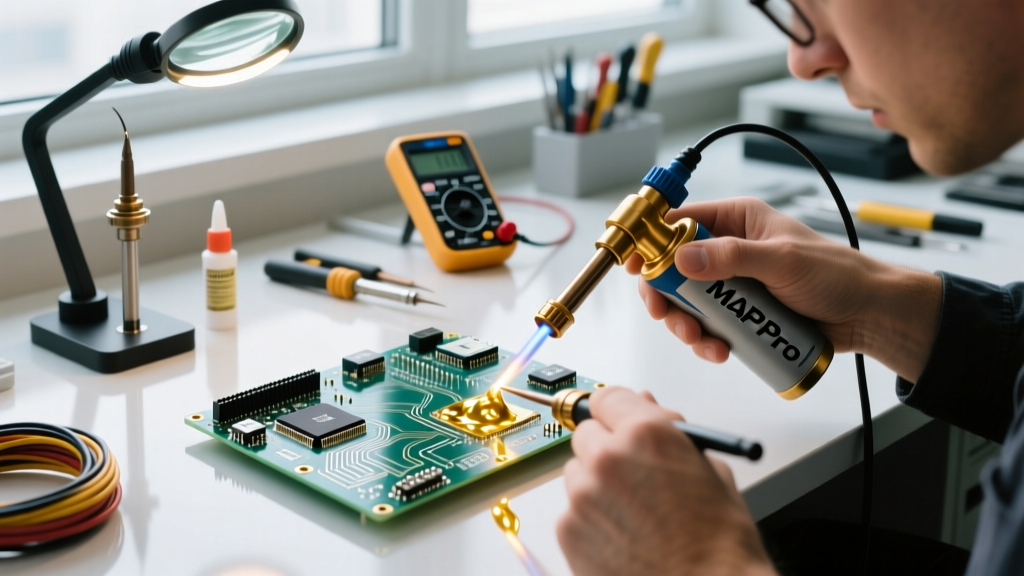
However, true MAPP gas production ceased in 2008 due to the closure of the world's only remaining production facility. The industry pivoted to MAP-Pro, which is chemically propylene. Propylene burns slightly hotter than propane (3,730°F vs 3,600°F) and delivers a more aggressive, localized heat transfer. Today, when professionals discuss soldering with a propane torch in heavy-duty contexts, they are frequently utilizing MAP-Pro cylinders (the yellow/blue tanks) paired with swirl-combustion torch heads like the Bernzomatic TS8000 to achieve rapid, localized heating.
Fuel Gas Comparison for Modern Soldering & Brazing
Understanding the thermal properties of modern fuel gases is critical for selecting the right tool for your specific electrical or plumbing application. The following matrix outlines the standard options available in 2026:
| Fuel Gas | Max Temp (in Air) | Avg Cylinder Cost (2026) | Best Application | Flame Characteristic |
|---|---|---|---|---|
| Butane | 2,400°F (1,315°C) | $4 - $6 | PCB rework, small gauge wires, jewelry | Soft, wide, low thermal mass |
| Propane | 3,600°F (1,982°C) | $6 - $9 | Copper plumbing, 4-10 AWG electrical lugs | Broad, bushy, high volume |
| MAP-Pro | 3,730°F (2,054°C) | $12 - $16 | 2/0 - 4/0 AWG heavy battery cables, brazing | Concentrated, swirl, high velocity |
| Acetylene | 4,700°F (2,593°C) | $50+ (Refillable only) | Heavy steel welding, large-scale silver brazing | Sharp, pinpoint, extremely aggressive |
Note: Data aligns with thermal output standards published by Lincoln Electric and current retail averages.
Practical Guide: Soldering 2/0 AWG Electrical Lugs with Propane
While modern electronics rely on wave soldering and reflow ovens, heavy-duty electrical work—such as building custom battery banks for solar arrays or marine applications—still heavily relies on torch soldering. Soldering a 2/0 AWG copper lug requires precise thermal management to ensure a low-resistance, high-vibration joint.
Step-by-Step Execution
- Mechanical Prep: Strip the 2/0 AWG cable and insert it into the copper lug barrel. Use a stainless steel wire brush to remove surface oxidation from both the wire strands and the inside of the lug.
- Flux Application: Inject a high-temperature, rosin-based paste flux (such as Kester 186 or Superior No. 30) into the barrel. Never use acid-core plumbing flux for electrical work, as the zinc chloride will cause severe galvanic corrosion and eventual short circuits.
- Thermal Targeting: Ignite your propane or MAP-Pro torch. Apply the outer envelope of the blue flame to the bottom of the lug barrel, opposite the side where you will feed the solder. Do not heat the wire directly.
- Capillary Feeding: Once the flux begins to bubble and the copper reaches approximately 450°F, touch your solder wire (preferably a 15% silver-bearing alloy like Harris Stay-Silv for high-vibration environments) to the top edge of the barrel. The solder should instantly melt and be drawn down into the wire strands via capillary action.
- Cooling: Remove the heat and allow the joint to air cool. Do not quench with water, as rapid cooling can cause micro-fractures in the solder crystalline structure.
The Chemistry of Flux Degradation Under High Heat
One of the most common failure modes when soldering with a propane torch is flux burn-off. Standard rosin flux activates at 350°F but begins to carbonize and lose its chemical efficacy if exposed to temperatures exceeding 600°F for more than a few seconds. Because a propane torch outputs heat at over 3,000°F, the margin for error is incredibly slim. If the torch is held in one spot for too long, the flux turns into a black, inert crust, preventing the molten solder from wetting the copper. This results in a 'cold joint'—a high-resistance connection that will generate excess heat under load and eventually fail.
Expert Insight: According to the IPC J-STD-001 standards for soldered electrical assemblies, proper wetting and fill are mandatory for structural integrity. When using open-flame torches on large thermal masses, always use a heavy-bodied, high-solids rosin paste flux rather than liquid fluxes, which flash-boil and evaporate before the copper core reaches the necessary melting temperature of the solder alloy.
Failure Modes and Edge Cases in Torch Soldering
Even experienced electricians encounter edge cases when relying on open-flame soldering. Understanding these failure modes is critical for quality control:
- Insulation Melt-Back: Propane's wide flame profile often scorches the PVC or XLPE insulation of the wire before the deep core of the copper strands reaches soldering temperature. Solution: Use a thermal barrier paste or wrap the wire 1 inch from the lug with damp fiberglass tape to absorb stray heat.
- Solder Starvation: In vertical orientations, gravity can pull the molten solder out of the lug barrel before it fully penetrates the wire strands. Solution: Always position the cable so the lug barrel is horizontal or slightly angled upward during the feed phase.
- Alloy Segregation: If using lead-free SAC305 solder (which melts at 430°F), the narrow plastic range between solidus and liquidus states requires the entire lug to be heated uniformly. Propane's bushy flame is actually superior to MAP-Pro's pinpoint flame for this specific alloy, as it wraps around the barrel and reduces thermal gradients.
The Future of Torch Soldering: Induction and Piezo Tech
As we move through 2026, the physical act of soldering with a propane torch remains largely unchanged from its mid-century peak, but the ignition and safety mechanisms have evolved. Modern torch heads feature integrated piezoelectric igniters, eliminating the need for external spark strikers, and built-in flame-lock mechanisms that prevent gas leaks if the torch is dropped.
However, in high-volume industrial electrical manufacturing, open-flame propane soldering is slowly being replaced by high-frequency induction heaters. Induction systems use electromagnetic fields to heat the copper lug directly from the inside out, completely eliminating the risk of insulation scorching and flux burn-off. Yet, for the field electrician, the marine mechanic, and the off-grid solar installer, the disposable propane cylinder and the brass torch head remain an indispensable, historically proven tool for creating bulletproof electrical connections.