
The Shift from Residential to Industrial Copper Pipe Soldering
When transitioning from residential DIY repairs to commercial and industrial applications, copper pipe soldering evolves from a simple leak-fixing skill into a highly regulated metallurgical discipline. In large-scale commercial plumbing, medical gas transport, and industrial HVAC rack systems, the margin for error is zero. A failed joint on a 4-inch Type K copper main or a commercial refrigeration suction line can result in catastrophic fluid loss, structural damage, or fatal gas exposure.
While the fundamental physics of capillary action remain unchanged, the tools, filler metals, and preparatory protocols required for heavy-duty applications are vastly different. This guide explores the advanced metallurgy, thermal management, and code-compliant techniques required for professional-grade copper pipe soldering in 2026.
Why Soldering Persists in Commercial Fluid Transport
Despite the rise of ProPress and mechanical grooved fittings, traditional soldering and brazing remain indispensable. Mechanical fittings require significant clearance for pressing jaws, making them impractical in dense commercial mechanical rooms or tight refrigeration rack manifolds. Furthermore, soldered and brazed joints offer superior long-term vibration resistance in high-pressure compressor discharge lines, a critical factor governed by Lucas-Milhaupt Brazing Fundamentals and ASHRAE piping standards.
Metallurgy Matters: Selecting the Right Filler Alloy
In the plumbing trade, the term "soldering" is often used colloquially to describe any capillary joining process. However, industrially, joining below 840°F (450°C) is soldering, while joining above 840°F is brazing. Selecting the correct alloy dictates the joint's tensile strength, fatigue resistance, and operating temperature limits.
| Alloy Designation | Composition | Solidus / Liquidus | Primary Industrial Application | Approx. Cost (2026) |
|---|---|---|---|---|
| Harris Sil-Fos 5 | 15% Ag, 80% Cu, 5% P | 1195°F / 1475°F | HVAC refrigeration, vibration-heavy suction lines | $115 - $130 / lb |
| Harris Stay-Brite 8 | 8% Ag, 92% Sn | 361°F / 460°F | Commercial plumbing, low-temp hydronics | $65 - $80 / lb |
| Oatey Lead-Free 95/5 | 95% Sn, 5% Sb | 452°F / 464°F | Potable water (Type L/M), standard commercial | $35 - $45 / lb |
| Phos-Copper (0%) | 93% Cu, 7% P | 1310°F / 1690°F | Basic HVAC, non-vibrating copper-to-copper | $40 - $50 / lb |
Expert Note: Never use phosphorus-bearing alloys (like Sil-Fos or Phos-Copper) on copper-to-brass or copper-to-steel transitions. The phosphorus reacts with the iron or nickel in the brass/steel to form brittle phosphides at the joint interface, leading to catastrophic failure under thermal cycling. Use a silver-cadmium or silver-zinc alloy with a separate white paste flux for dissimilar metals.
Thermal Management: Torch Selection for Large-Diameter Mains
Heating a 1/2-inch residential pipe requires minimal thermal mass management. Heating a 4-inch Type L copper main requires precise, high-BTU thermal input to ensure the flux activates and the filler metal flows via capillary action before the flux burns and carbonizes.
Oxy-Acetylene vs. Air-Propylene (MAP-Pro)
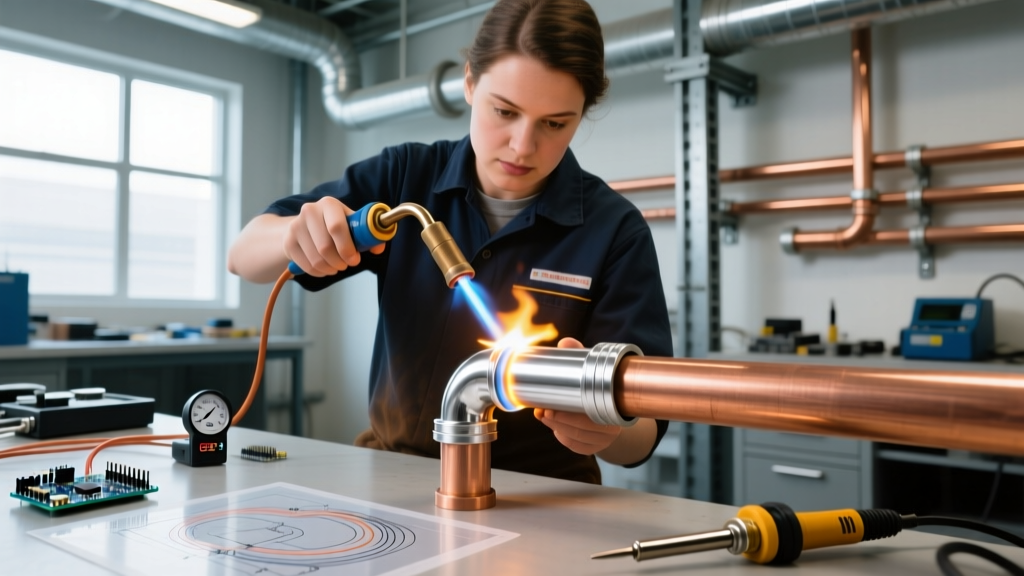
- Oxy-Acetylene (e.g., Victor Journeyman 250): Produces a flame temperature of approximately 5,600°F (3,100°C). This is mandatory for pipes 3 inches and larger, or when working in cold commercial environments where ambient heat sinks rapidly draw thermal energy from the copper.
- Air-Propylene (e.g., Bernzomatic TS8000): Burns at roughly 3,730°F (2,054°C). Propylene releases more heat per cubic foot than standard propane, making it the industry standard for pipes up to 1.5 inches in diameter. It is safer for indoor commercial retrofits where oxy-acetylene poses an explosive hazard.
- Induction Heating (2026 Standard): Flame-free induction tools (like the Rothenberger RoBraz series) use electromagnetic fields to heat the copper fitting directly from the inside out. This eliminates fire watch requirements in occupied commercial buildings and prevents accidental scorching of adjacent wire harnesses or insulation.
Capillary Action, Surface Prep, and Nitrogen Purging
The strength of a soldered joint does not come from the filler metal acting as a "glue." It comes from the metallurgical bond formed when the liquid alloy is drawn into the annular space between the pipe and fitting via capillary action. According to the Copper Development Association (CDA) Copper Tube Handbook, the optimal capillary gap is between 0.002 and 0.005 inches.
The Industrial Preparation Protocol
- Mechanical Abrasion: Use aluminum oxide emery cloth or garnet paper. Never use steel wool or carbon steel wire brushes. Embedded iron particles will cause galvanic corrosion and pinhole leaks within months.
- Chemical Degreasing: Commercial pipes often arrive with heavy drawing oils. Wipe the tube ends with isopropyl alcohol or a non-chlorinated HVAC degreaser before mechanical abrasion.
- Flux Application: Apply a thin, even layer of water-flushable paste flux (e.g., Oatey No. 5) immediately after cleaning to prevent flash oxidation. For phosphorus-copper alloys on copper-to-copper joints, flux is chemically unnecessary and should be omitted to prevent internal slag inclusion.
The Critical Role of Nitrogen Purging in HVAC
When soldering or brazing copper pipes for commercial refrigeration or VRF (Variable Refrigerant Flow) HVAC systems, an oxygen-free nitrogen (OFN) purge is non-negotiable. Heating copper in the presence of atmospheric oxygen creates cupric oxide scale on the inside of the pipe. Once the system is charged, this scale flakes off and destroys compressor scroll sets and expansion valves. Maintain a continuous nitrogen flow at 1 to 2 Standard Cubic Feet per Hour (SCFH) through the piping network throughout the entire heating and cooling cycle.
Code Compliance and Failure Modes in Commercial Builds
Industrial soldering is governed by strict building codes, notably ASME B31.9 (Building Services Piping) and local adaptations of the Uniform Plumbing Code (UPC). Inspectors in commercial builds frequently look for specific failure modes that indicate poor workmanship.
Common Commercial Failure Modes
- Flux Inclusion: Using too much flux and failing to heat the joint sufficiently to boil it out. The trapped flux creates a highly corrosive acid pocket that eats through the copper wall from the inside.
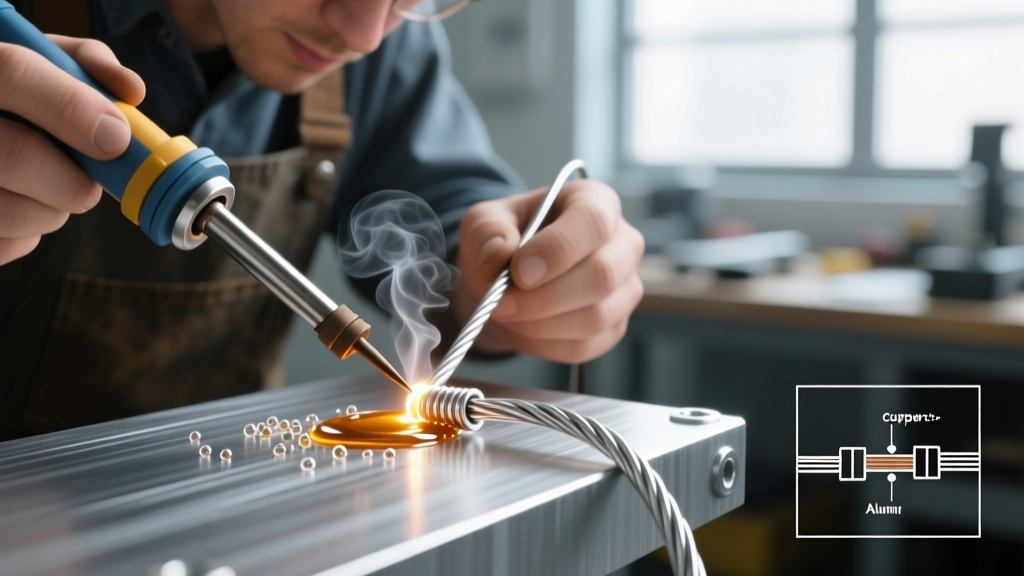
- Cold Joints (Solder Balling): Occurs when the heat is applied directly to the solder wire instead of the copper fitting. The solder melts but fails to reach the capillary gap, forming a convex bead on the outside of the joint that offers zero structural integrity.
- Overheating (Burnt Flux): Applying excessive BTU input causes the flux to carbonize into a hard, black glass-like barrier. This barrier breaks surface tension and completely blocks capillary flow, resulting in a hollow, leak-prone joint.
Frequently Asked Questions (Industry Focus)
Can I use standard 95/5 solder on high-pressure medical gas lines?
No. Medical gas lines (oxygen, nitrous oxide, medical air) typically require silver brazing (e.g., BAg series alloys) or specialized high-silver soldering to withstand high pressures and prevent joint degradation. Furthermore, medical gas piping requires strict certification and third-party testing per NFPA 99 standards.
How do I clean flux residue from tight commercial manifolds?
In dense commercial manifolds where wiping is impossible, use a pressurized spray bottle filled with hot water and a mild alkaline neutralizer. Follow this with a compressed air blow-off to prevent standing water from causing localized corrosion under insulation (CUI).
Is induction soldering code-compliant for commercial plumbing?
Yes. As of 2026, induction heating is fully recognized by major plumbing codes as a valid thermal source for capillary joining, provided the correct filler alloys and fluxes are used and the joint achieves the necessary visual solder ring at the fitting edge.
Mastering heavy-duty copper pipe soldering requires moving beyond basic techniques and embracing the metallurgical and thermal sciences. By selecting the precise alloy for the operating environment, managing thermal mass with appropriate torches or induction tools, and strictly adhering to nitrogen purging and surface prep protocols, industrial technicians ensure piping networks that perform flawlessly for decades. For further reading on safety protocols regarding metallic fumes, consult the CDC NIOSH Welding and Brazing Safety Guidelines.