
The Cultural Metallurgy of Soldering Memes
In the DIY electronics and hardware engineering communities, humor is a coping mechanism for thermal frustration. Soldering memes are not just internet jokes; they are a crowdsourced, satirical buyer’s guide. Over the last two decades, the evolution of these memes has perfectly mirrored the technological shifts in soldering equipment, alloy metallurgy, and community purchasing habits. To understand the history of soldering memes is to understand the exact failure modes of cheap gear and the technical triumphs of modern open-source hardware.
As a buyer navigating the 2026 market for soldering stations, understanding these cultural touchstones provides genuine insight into what gear actually survives contact with a ground plane. Let us trace the evolution of soldering humor from the early forum days to the modern era of USB-C PD 3.1 irons and AI-assisted visual inspection jokes.
Era 1: The Forum Days and the "Magic Smoke" (2005–2012)
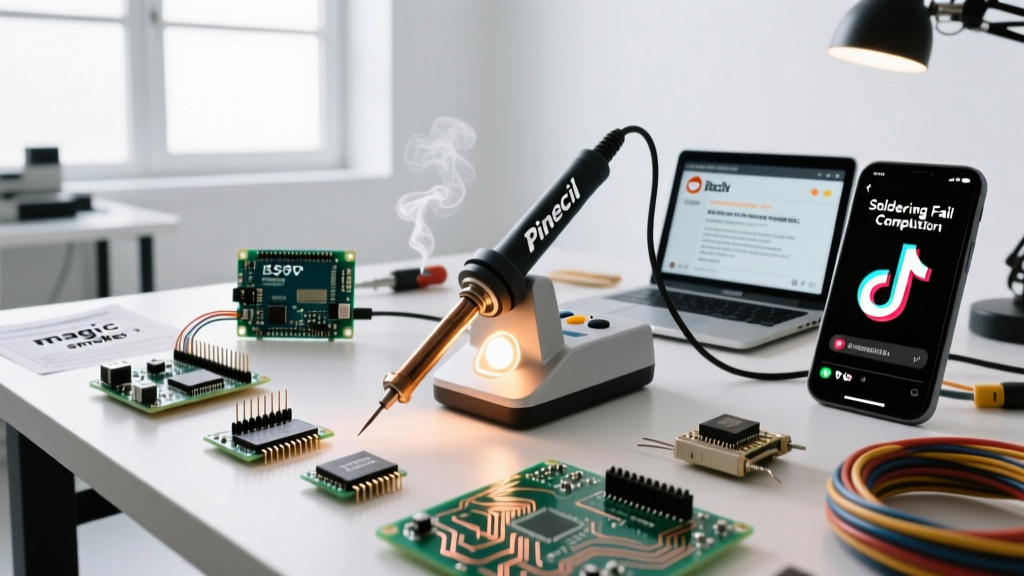
Before the algorithmic feeds of TikTok and Instagram, electronics humor lived on niche message boards, Usenet groups, and early subreddits. The undisputed king of this era was the "Magic Smoke" meme.
"Electronics work on magic smoke. You can't put the magic smoke back in once it escapes." — EEVblog Beginners Forum
The Technical Root Cause
The joke stems from the catastrophic failure of integrated circuits when subjected to thermal runaway or reverse polarity. When an IC exceeds its absolute maximum junction temperature (often around 150°C for standard silicon, though packaging can withstand brief 260°C reflow profiles), the internal epoxy resins, dopants, and silicon dies delaminate and vaporize, releasing a distinct, acrid white smoke.
During this era, the buying landscape was dominated by the Weller WES51 (a 50W analog analog PID station) and the Hakko 936. Memes frequently targeted hobbyists who attempted to solder heavy 14-AWG wires to large copper pours using unregulated, transformer-less 40W "wall-wart" irons. The community used the magic smoke meme to enforce a strict buying rule: never use an unregulated iron on a populated PCB.
Era 2: The "Amazon Special" Roasts (2013–2018)
As e-commerce exploded, so did the availability of suspiciously cheap, drop-shipped soldering irons. This birthed the "Soldering with a Cold Spoon" and "Spaghetti Joint" memes.
The Metallurgy of a Bad Joint
The classic meme image features a dull, gray, lumpy blob of solder bridging a header pin, universally mocked as a "cold joint." The technical reality behind this meme is a failure of thermal recovery. Cheap $12 adjustable irons from online marketplaces often use a triac-based power control with a low-mass thermistor placed far from the tip. When the tip touches a multi-layer PCB with a thermal via, the tip temperature plummets from 350°C to 180°C in seconds.
If you are using Sn63Pb37 (a eutectic alloy that melts and freezes sharply at 183°C), a temperature drop below the liquidus phase while the joint is being disturbed results in a fractured, grainy crystalline structure. The memes mocking these "cold spoons" drove a massive community migration toward the Hakko FX-888D ($105 at the time), which utilized a ceramic heater and a dedicated digital PID loop to maintain thermal stability.
Era 3: The Open-Source Iron Cult (2019–2023)
The introduction of the Miniware TS100 and later the Pine64 Pinecil fundamentally disrupted the market. These irons utilized STM32 microcontrollers and open-source firmware (IronOS), sparking a new genre of highly technical soldering memes.
- The "BOOT0 Brick" Meme: To flash custom firmware on early TS100 models, users had to open the chassis and short the BOOT0 pin to 3.3V while plugging in the DC barrel jack. Memes depicting users weeping over bricked $50 irons because they slipped with a pair of tweezers became a rite of passage.
- The "OLED Thumb Burn" Meme: Early smart irons lacked reliable sleep-mode accelerometers. Users would set the iron down, forget about it, and later grab it near the exposed metal shaft or hot OLED screen, resulting in memes about "branding" your thumb with the IronOS logo.
- The USB-C PD Negotiation War: As the Pinecil V2 adopted USB-C Power Delivery, memes emerged about plugging the iron into a laptop charger, only for the iron to display a "PD Negotiation Failed" error because the charger only supported 5V/3A and not the 20V/3.25A required for 65W operation.
For buyers, this era proved that the community valued hackability and rapid heat-up times over sheer thermal mass. The TS100 and Pinecil could reach 320°C in under 15 seconds, a metric that traditional stations couldn't touch, making them the darlings of Hackaday's soldering archives.
Era 4: Short-Form Video, SMD, and the JBC Flex (2024–2026)
Today, soldering memes have migrated to TikTok, YouTube Shorts, and Instagram Reels. The humor has shifted toward ASMR rework, SMD (Surface Mount Device) reflow, and high-end professional gear flexing.
The "Hot Air Tornado" Meme
With the rise of 0402 and 0201 metric passive components, hot air rework is a necessity. A prevalent meme format involves setting a cheap hot air station to 400°C with the airflow maxed out, only to blow a $0.01 capacitor across the room at Mach 2, never to be found again. The buyer’s takeaway? Invest in a station with precise, brushless airflow control (like the Quick 861DW) rather than relying on the diaphragm pumps found in budget clones.
The JBC Active-Tip Flex
In professional and high-end hobbyist circles, the JBC CD-2BQF station (retailing around $450+) has become a meme status symbol. Because JBC uses active-tip technology where the heating element is integrated directly into the cartridge, the thermal recovery is practically instantaneous. Memes frequently depict JBC users casually dragging through massive ground planes while Hakko and Weller users are shown pre-heating their boards with a heat gun just to get the solder to flow.
Meme Trope vs. Technical Reality: A Buyer's Matrix
To translate internet humor into actionable purchasing decisions, we have mapped the most common soldering memes to their underlying technical failures and the community-approved gear solutions.
| Meme Trope | Technical Root Cause | The "Meme-Approved" Buyer Solution |
|---|---|---|
| "Releasing the Magic Smoke" | Thermal runaway; exceeding IC max junction temp due to poor heat sinking or lack of temp control. | ESD-safe stations with closed-loop PID sensors (e.g., Weller WE1010). |
| "The Grainy Spaghetti Joint" | Pasty-state disturbance; non-eutectic alloys or severe tip temp drop during wetting phase. | Use Sn63Pb37 eutectic solder and tips with high copper core mass (e.g., Hakko T18-D24). |
| "Flux Fume High" | Burning rosin-based flux (RMA) at 400°C, releasing colophony and aliphatic aldehydes. | Lower temp profiles (320°C) and dedicated HEPA/Carbon fume extractors (e.g., Hakko FA-400). |
| "Where did my 0402 cap go?" | Turbulent, unregulated airflow from cheap diaphragm-based hot air rework stations. | Brushless fan stations with digital flow control (e.g., Quick 861DW). |
| "The Cold Spoon" | Triac-chopped power delivery failing to recover when touching high-thermal-mass vias. | Direct DC-driven smart irons (Pinecil V2) or active-tip cartridges (JBC C245). |
The Lead-Free vs. Leaded Religious War
No discussion of soldering memes is complete without addressing the eternal flame war between RoHS-compliant lead-free solder (like SAC305) and traditional leaded solder (Sn63Pb37).
Memes often depict lead-free solder as a stubborn, gray paste that requires a blowtorch to melt, while Sn63Pb37 is depicted as liquid butter. There is genuine metallurgical truth here. SAC305 has a higher melting point (217°C–220°C) and a higher surface tension, resulting in poorer wetting characteristics. It requires highly activated, no-clean fluxes (like Amtech NC-559-V2-TF) to break the oxides. For hobbyists and DIY repair technicians not bound by EU RoHS directives, the community universally memed—and enforced—the rule: stick to 63/37 for through-hole and general SMD work to save your tips and your sanity.
Conclusion: Humor as a Hardware Heuristic
While Reddit's r/soldering community and other forums may seem like echo chambers of inside jokes, these memes serve a vital educational purpose. They distill complex thermodynamic failures, metallurgical phase transitions, and firmware bricking risks into easily digestible, shareable warnings.
When you see a meme mocking a specific $15 soldering iron, it is rarely just elitism; it is a community consensus that the iron's thermal mass is insufficient for anything beyond 22-AWG wire. When you see a meme praising a $60 open-source USB-C iron, it is a testament to the superiority of direct DC heating over cheap AC transformers. In 2026, if you want to know what gear is actually worth your money, do not just read the spec sheet. Read the memes.