
The Foundation: Choosing Your Soldering Station
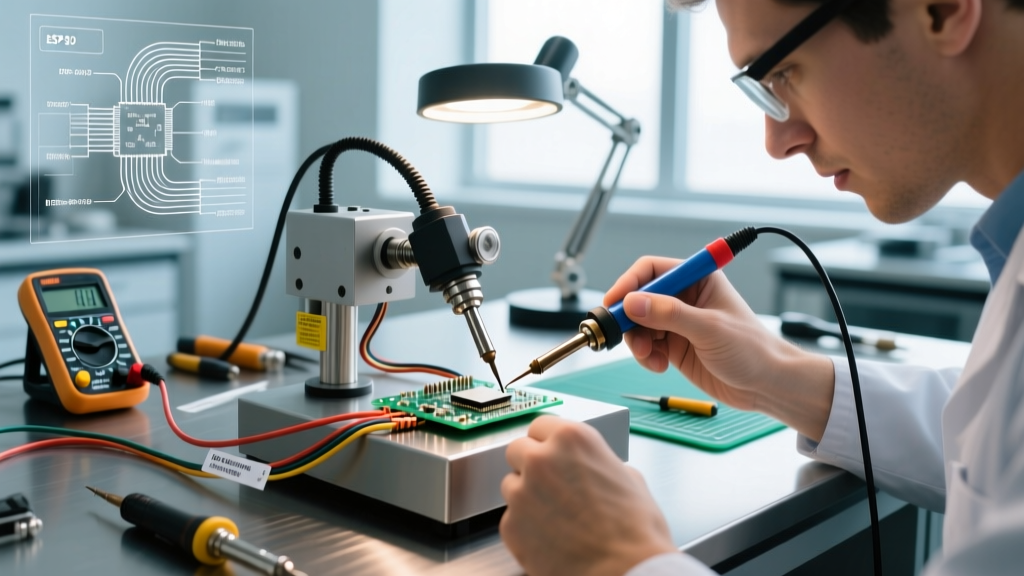
When assembling printed circuit boards (PCBs) or repairing micro-solder joints, the thermal recovery rate and tip geometry of your iron dictate success. In 2026, the market for soldering tools for electronics is split between ultra-portable open-source smart irons and traditional benchtop ESD-safe stations. Understanding the thermal mass requirements of your specific projects is the first step in building a reliable toolkit.
Budget & Open-Source: Pine64 Pinecil V2 ($26 - $35)
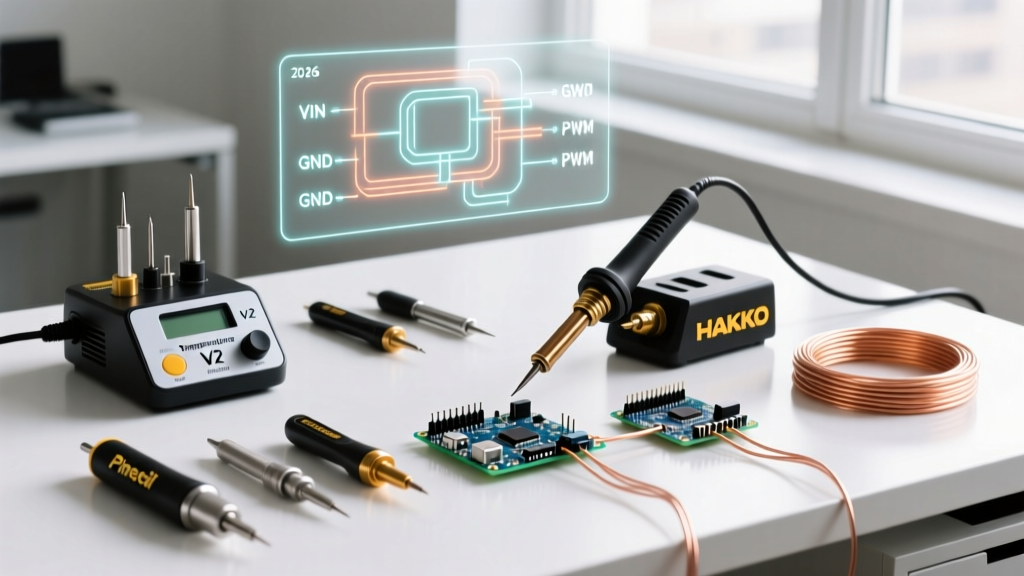
The Pinecil V2 has completely disrupted the entry-level market. Powered by a RISC-V BL602 chip, this smart iron supports USB-C Power Delivery (PD 3.1) up to 24V/3A, delivering 65W of heating power. Real-world performance: It reaches 250°C in roughly 12 seconds. It uses standard Hakko T12-style tips, making replacements cheap and accessible. However, it lacks the heavy thermal mass required for continuous soldering of large ground planes.
The Industry Workhorse: Hakko FX-888D ($110 - $130)
For dedicated benchtop work, the Hakko FX-888D remains the gold standard for hobbyists and light commercial repair. It features a 70W ceramic heating element and uses the T18 tip series. The digital interface allows precise temperature locking, preventing unauthorized adjustments in shared lab environments. While its heat-up time (approx. 20-25 seconds to 300°C) is slower than direct-drive smart irons, its continuous thermal recovery on multi-layer PCBs is vastly superior. Replacement parts and official support via Hakko USA ensure long-term viability.
Professional Grade: Weller WE1010NA ($120 - $140)
Weller’s WE1010NA offers 70W of power with a slightly more ergonomic handpiece design than the Hakko, utilizing the ET series tips. It features a built-in standby function and an LCD display with intuitive navigation. For users transitioning from hobbyist to professional prototyping, the ESD-safe grounding and rapid tip-change mechanism justify the premium price point.
Advanced Rework: Hot Air Stations and Preheaters
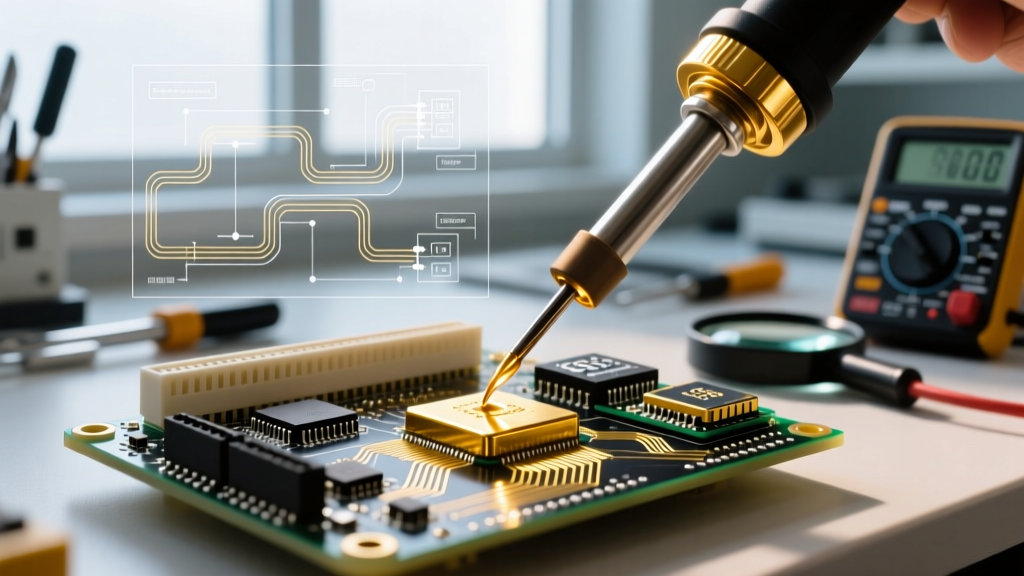
As modern electronics shrink, through-hole soldering is increasingly replaced by surface-mount technology (SMT). For reworking QFN chips, BGAs, or multi-layer shielding cans, a standard iron is insufficient. You need convective heat.
Quick 861DW Hot Air Rework Station ($220 - $250)
The Quick 861DW is a dual-channel powerhouse featuring 1000W of heating capacity. Its brushless fan ensures stable airflow without the vibration typical of cheaper diaphragm pumps. When removing a 10x10mm QFN chip, set the temperature to 360°C with an airflow rate of 40 (on a 1-100 scale). Apply Chip Quik low-temperature solder (Sn42Bi58) to the existing joints first; this lowers the overall melting point of the factory lead-free solder, preventing PCB pad delamination during removal.
PCB Preheaters (e.g., Aoyue 853A)
For large boards with heavy copper ground planes, top-down hot air often fails because the copper acts as a massive heat sink. An infrared or quartz PCB preheater brings the entire board to 150°C from underneath. This reduces the thermal delta, allowing your hot air station to reflow the top joints at a much lower, safer temperature, preserving the integrity of surrounding plastic connectors and electrolytic capacitors.
Consumables: Solder Alloys and Flux Chemistry
No discussion of soldering tools for electronics is complete without addressing the metallurgy of the solder itself. The IPC J-STD-001 standard outlines the stringent requirements for soldered electrical and electronic assemblies, heavily emphasizing the correct alloy and flux combination for reliability IPC J-STD-001 Standards.
Expert Insight: While the RoHS directive pushed the industry toward lead-free alloys, Sn63Pb37 (63% Tin / 37% Lead) remains the undisputed champion for DIY electronics and prototyping due to its eutectic properties. It melts and solidifies at a single temperature (183°C), eliminating the plastic range that causes cold solder joints during cooling.
Wire Gauge and Flux Core Selection
- 0.5mm to 0.8mm (Sn63Pb37): Ideal for through-hole components, standard 0.1 inch header pins, and general wire tinning. Always choose a 2% to 3% no-clean rosin core.
- 0.3mm to 0.4mm (Sn63Pb37): Mandatory for surface mount device (SMD) soldering, specifically for 0805, 0603, and SOIC packages.
- SAC305 (Lead-Free): If you must comply with commercial RoHS manufacturing, use SAC305 (96.5% Sn, 3% Ag, 0.5% Cu). Be aware that its melting point is higher (217°C - 220°C), requiring a station capable of sustaining 350°C+ without oxidizing the tip rapidly.
Flux and Post-Soldering Cleanup
Flux is the chemical agent that removes oxidation and promotes wetting. While no-clean fluxes are popular, they can leave a sticky, slightly conductive residue in high-humidity environments if not fully activated. For critical RF circuits or high-impedance analog sensors, post-soldering cleaning is mandatory.
- Isopropyl Alcohol (IPA): Use 99%+ purity IPA (not 70% drugstore rubbing alcohol, which contains water and leaves mineral deposits). Apply with a lint-free swab or a dedicated PCB cleaning brush.
- Amtech NC-559-V2-TF: The industry-standard tacky flux for BGA reballing and drag-soldering fine-pitch QFP chips. Its high viscosity prevents components from floating out of alignment during heating.
- Ultrasonic Cleaners: For batch production, an ultrasonic bath using a specialized saponifier removes flux residue from under tight-clearance components where brushes cannot reach.
The Unsung Heroes: Hand Tools and Preparation
A $150 soldering station is useless if your preparation tools damage the PCB pads. Invest in these specific accessories:
- Flush Cutters (e.g., Hakko CHP-170): Essential for trimming component leads flush to the board. Do not use standard diagonal cutters, as they leave sharp protrusions that can short circuits or puncture enclosures.
- ESD-Safe Tweezers (e.g., Vetus ST-15): Curved, anti-magnetic stainless steel tweezers are critical for placing 0603 SMD components and holding heat-sensitive wires.
- Desoldering Braid (e.g., Chemtronics 4-10L): Copper wick soaked in flux is mandatory for cleaning up solder bridges on QFP and SOIC IC pins. A 2.0mm width is the most versatile for general electronics.
- Brass Wire Tip Cleaner: Never use a wet sponge. A wet sponge causes rapid thermal shock, leading to micro-fractures in the iron plating. A dry brass wire ball cleans oxidation without dropping the tip temperature.
2026 Soldering Tools Comparison Matrix
| Tool / Station | Best For | Power / Temp Range | Estimated 2026 Cost |
|---|---|---|---|
| Pine64 Pinecil V2 | Field repair, drones, portability | 65W / 100°C - 450°C | $26 - $35 |
| Hakko FX-888D | Benchtop prototyping, heavy ground planes | 70W / 100°C - 480°C | $110 - $130 |
| Weller WE1010NA | Professional labs, ESD-sensitive environments | 70W / 100°C - 450°C | $120 - $140 |
| Quick 861DW | SMD rework, BGA, QFN removal | 1000W / 100°C - 500°C | $220 - $250 |
| Chip Quik SMD291AX | SMD rework, stencil paste application | Sn63Pb37 Tacky Flux | $20 (10g syringe) |
Safety First: Fume Extraction and ESD Protection
Soldering generates colophony (rosin) fumes, which are classified as a respiratory sensitizer and can lead to occupational asthma if inhaled chronically. The Centers for Disease Control and Prevention (CDC) and NIOSH strongly recommend local exhaust ventilation for all soldering operations NIOSH Workplace Safety Guidelines.
Actionable Setup: Do not rely on a simple desk fan blowing fumes across your face. Invest in a localized fume extractor like the Hakko FA-400 ($60-$80) equipped with an activated carbon HEPA filter, positioned exactly 4 to 6 inches from the solder joint. For high-volume labs, a dedicated benchtop BOFA extraction system is required.
Frequently Asked Questions (FAQ)
How often should I tin my soldering iron tip?
You should tin your tip every single time you place the iron back into its holder. Leaving a tip bare at 350°C causes rapid oxidation of the iron plating, leading to non-wetting tips that refuse to transfer heat. A thick layer of solder acts as a sacrificial barrier against oxygen.
Can I use plumbing flux for electronics?
Absolutely not. Plumbing fluxes are highly acidic (often containing zinc chloride or hydrochloric acid) and will aggressively corrode copper traces and component leads, eventually causing catastrophic circuit failure. Always use rosin-based (RMA) or no-clean fluxes specifically formulated for electronics, which remain inert after activation.
Why is my solder balling up and refusing to stick to the pad?
This is a classic symptom of either an oxidized tip or insufficient heat transfer to the pad. First, clean the tip with brass wool and apply fresh tip tinner (e.g., Hakko 599B). Second, ensure you are heating the pad and the component lead simultaneously for 1-2 seconds before introducing the solder wire to the joint, not directly to the iron tip.
Building a comprehensive kit of soldering tools for electronics is an investment in your project's reliability. By prioritizing thermal recovery, precise metallurgy, and proper safety extraction, you will achieve factory-grade joints right on your home workbench.