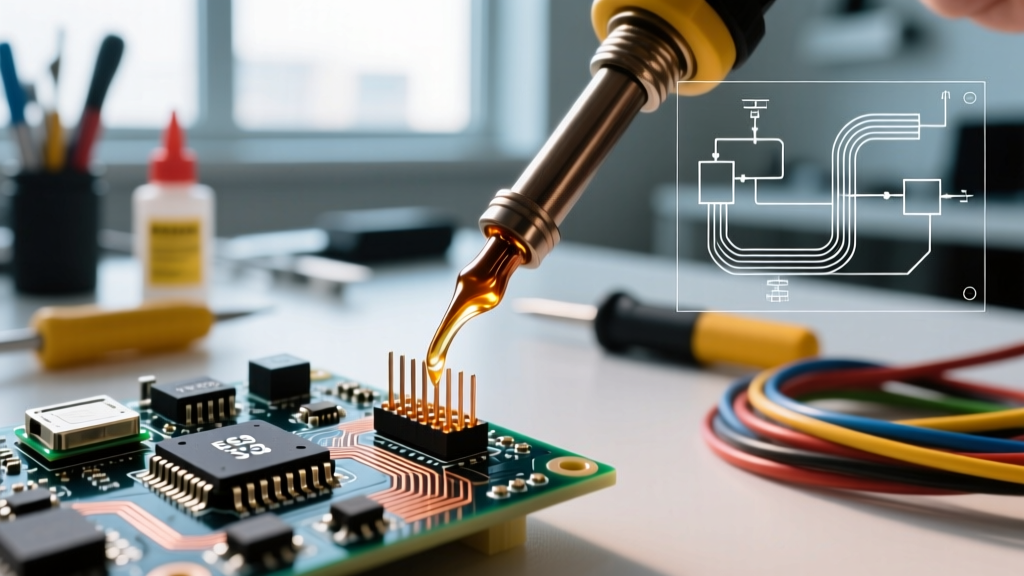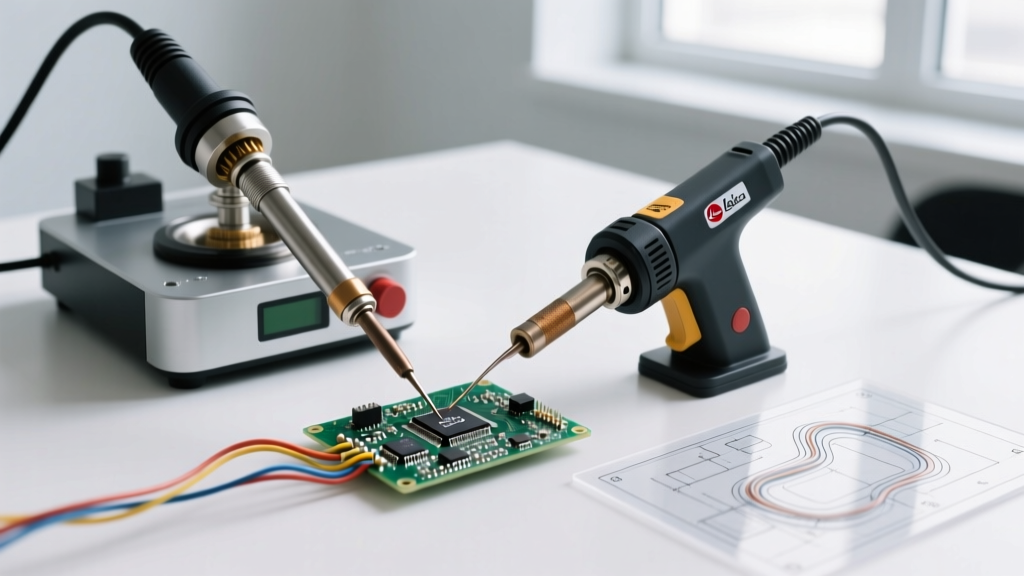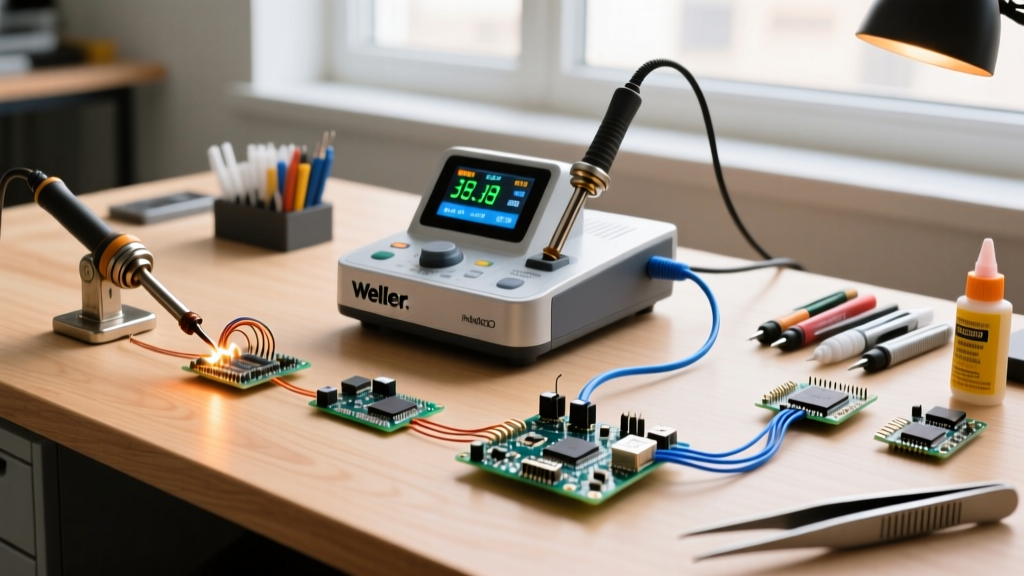

From Plumbers to PCBs: The Metallurgical Journey
When you sit down at your workbench in 2026 to begin soldering a circuit, you are participating in a metallurgical tradition that spans millennia. While the Romans used early tin-lead alloys to seal water pipes, the application of solder to electrical circuits didn't truly begin until the dawn of the radio age in the 1920s. Today, the transition from crude point-to-point wiring to multi-layer surface-mount PCBs has fundamentally changed the tools, alloys, and fluxes we use. Understanding this historical evolution is not just an academic exercise; it is the key to making informed buying decisions for your soldering station, wire solder, and flux chemistry today.
The Eutectic Breakthrough: Why 63/37 Ruled the 20th Century
For decades, the undisputed king of electronics assembly was Sn60Pb40 (60% tin, 40% lead). However, as aerospace and military electronics demanded higher reliability in the 1960s, engineers realized a critical flaw in this alloy: it had a "plastic phase." Between 183°C and 190°C, Sn60Pb40 exists in a semi-solid state. If a component was bumped while cooling through this 7-degree window, it resulted in a "disturbed joint"—a grainy, high-resistance connection prone to failure.
The solution was the Sn63Pb37 eutectic alloy. By shifting the ratio to 63/37, the alloy melts and freezes at a single, precise temperature of 183°C (361°F) with zero plastic phase. This historical breakthrough virtually eliminated disturbed joints and became the global standard for IPC certified electronics assembly for the next forty years. If you are still buying cheap 60/40 solder for precision PCB work today, you are ignoring one of the most important metallurgical lessons of the 20th century.
The Thermal Shock: RoHS and the Shift to Lead-Free
In 2006, the European Union's Restriction of Hazardous Substances (RoHS) directive forced a massive, painful evolution in how we approach soldering a circuit. Lead was banned, and the industry scrambled to adopt SAC305 (96.5% Tin, 3.0% Silver, 0.5% Copper).
This shift was a nightmare for early adopters. SAC305 melts at 217°C–220°C, requiring significantly more thermal energy. Older transformer-based soldering irons simply couldn't transfer heat fast enough, leading to cold joints, pad delamination, and scorched flux. Furthermore, the high-tin content of lead-free alloys introduced a new failure mode: tin whiskers. According to extensive research by the NASA Electronic Parts and Packaging (NEPP) Program, these microscopic, conductive crystalline structures can grow from tin-plated surfaces and cause catastrophic short circuits in satellites and medical devices.
Alloy Comparison Matrix for Modern Builders
| Alloy Designation | Composition | Melting Point | Wetting Speed | 2026 Cost (per 500g) | Best Application |
|---|---|---|---|---|---|
| Sn63Pb37 | 63% Sn / 37% Pb | 183°C (Eutectic) | Excellent | $25 - $35 | Hobbyist, vintage repair, non-RoHS prototyping |
| SAC305 | 96.5% Sn / 3% Ag / 0.5% Cu | 217°C - 220°C | Good | $60 - $85 | Commercial RoHS-compliant SMT & through-hole |
| Sn99.3Cu0.7 | 99.3% Sn / 0.7% Cu | 227°C | Fair (Sluggish) | $30 - $45 | Wave soldering, budget RoHS hand-soldering |
| Sn42Bi57Ag1 | 42% Sn / 57% Bi / 1% Ag | 138°C - 140°C | Excellent | $90 - $120 | Low-temp step-soldering, heat-sensitive RF components |
The Iron Evolution: From Magnastats to USB-C PD
The tools used for soldering a circuit have evolved just as drastically as the alloys. In the 1970s and 80s, the Weller WTCPN Magnastat series dominated. These irons used a brilliant mechanical trick: a magnetic tip that lost its ferromagnetism at the Curie point (e.g., 350°C), physically breaking a switch to cut power. It was elegant, but slow to recover heat when soldering large ground planes.
The 1990s brought the Hakko 936, introducing PID-controlled ceramic heating elements. This allowed users to dial in exact temperatures, but the thermal mass of the separate tip and heater meant recovery times still lagged during heavy thermal loads.
Today, in 2026, we are in the era of Integrated Cartridge Tips and Smart PD Irons. Brands like JBC pioneered the integrated heater-sensor-tip (e.g., the C245 series), where the heating element is millimeters from the pad, offering 2-second recovery times. Meanwhile, the maker movement has democratized this technology via USB-C Power Delivery. The Pinecil V2 (powered by a RISC-V chip) and the FNIRSI HS-01 can deliver 65W to 100W of instantaneous thermal recovery from a pocket-sized GaN charger, completely disrupting the traditional $300+ benchtop station market.
Expert Insight: Never judge a soldering iron by its maximum wattage alone. A 40W JBC T245 cartridge will outperform a cheap 60W ceramic iron because the thermal transfer efficiency and closed-loop PID sampling rate (often 20+ times per second) prevent the tip temperature from collapsing when it touches a copper ground plane.
Flux Chemistry: The Unsung Hero of the Joint
You cannot discuss the history of soldering a circuit without addressing flux. Early plumbers used acidic, corrosive fluxes that would destroy electronics. The industry shifted to Rosin-based fluxes (derived from pine tree sap), but natural rosin is inconsistent. Modern synthetic fluxes are categorized under the IPC J-STD-004B standard, which classifies flux by composition (Rosin [RO], Resin [RE], Organic [OR], Inorganic [IN]) and activity level (L, M, H) alongside halide content.
- ROL0 / ROL1 (Rosin, Low Activity): The standard for "no-clean" assembly. Leaves a hard, non-conductive residue that is safe to leave on the board. Ideal for 90% of hobbyist and commercial SMT work.
- ORM0 / ORM1 (Organic, Mild Activity): Water-soluble fluxes. They provide incredible wetting and shine on difficult pads but must be cleaned with heated DI water post-soldering, or they will cause electrochemical migration (dendrite growth) and short the circuit over time.
- REH1 (Resin, High Activity, Halides): Used only for heavily oxidized, vintage, or industrial boards. Highly corrosive; requires aggressive chemical cleaning.
Buyer's Matrix: Choosing Your 2026 Setup Based on Historical Lessons
History teaches us that there is no universal "best" setup for soldering a circuit; the right choice depends entirely on your thermal requirements and compliance needs. Use this decision matrix to guide your purchasing in 2026:
1. The Hobbyist & Prototyper
Recommended Iron: Pinecil V2 or Miniware TS101 ($25 - $45)
Recommended Alloy: Sn63Pb37 with 2% ROL0 Flux ($30)
Why: You do not need RoHS compliance for personal projects. Leaded eutectic solder at 320°C is vastly easier to work with, saves your tips from rapid oxidation, and produces shiny, reliable joints with minimal thermal stress on your components.
2. The Professional Repair Technician
Recommended Iron: Hakko FX-951 or JBC CD-2BQE ($350 - $550)
Recommended Alloy: SAC305 or Sn96.5Ag3.0Cu0.5 Wire ($75)
Why: Repairing modern commercial electronics requires matching the factory's lead-free metallurgy to avoid mixed-metal brittle joints. You need the instantaneous thermal recovery of an integrated cartridge tip to handle multi-layer PCB ground planes without lingering and causing pad lift.
3. The Heat-Sensitive RF & Aerospace Builder
Recommended Iron: Metcal MX-500 (Induction/RF Heating) ($600+)
Recommended Alloy: Sn42Bi57Ag1 Low-Temp ($110)
Why: When soldering a circuit with expensive, heat-sensitive RF modules or flexible PCBs, low-temperature bismuth alloys prevent substrate warping. Metcal's SmartHeat induction technology adjusts power based on the exact magnetic permeability of the tip, ensuring you never exceed your thermal ceiling.
Conclusion
The act of soldering a circuit has evolved from a rudimentary mechanical bond into a highly controlled metallurgical process. By understanding the shift from eutectic lead-tin to lead-free SAC alloys, the transition from Magnastat switches to RISC-V controlled USB-C irons, and the strict IPC classifications of modern fluxes, you can stop guessing and start engineering your solder joints. Equip your bench with the right chemistry and the right thermal delivery system, and you will achieve factory-grade reliability on every board you touch.