
The Truth About Using a Heat Gun for Soldering
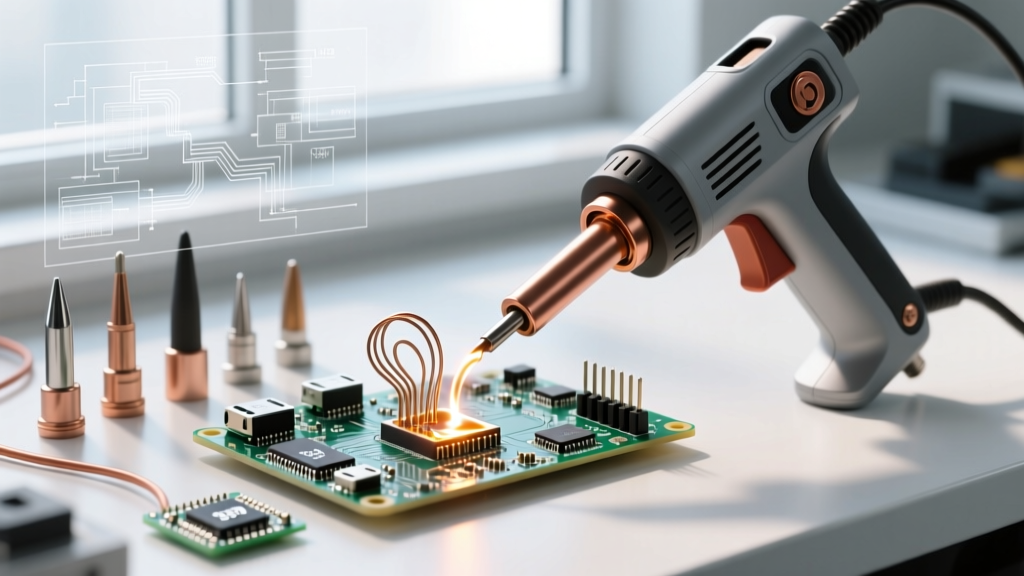
When makers and junior technicians search for a heat gun for soldering, they are usually referring to a precision hot air rework station. Using a standard hardware store heat gun—designed for stripping paint or shrinking tubing—on a printed circuit board (PCB) is a recipe for disaster. Hardware heat guns lack precise temperature control, localized airflow, and proper nozzle sizing, often resulting in melted connectors, delaminated boards, and destroyed silicon. In 2026, modern surface-mount device (SMD) rework demands exact thermal profiling, especially when dealing with dense multilayer boards and lead-free solder pastes.
This comprehensive FAQ and troubleshooting guide bridges the gap between beginner mistakes and professional IPC-certified rework techniques. Whether you are replacing a tiny 0402 capacitor or reflowing a massive Ball Grid Array (BGA) chip, understanding the thermodynamics of hot air soldering is critical.
Frequently Asked Questions (FAQ)
1. What is the difference between a heat gun and a hot air rework station?
A standard heat gun outputs massive volumes of air at unregulated temperatures (often exceeding 500°C), which will instantly scorch a PCB's FR4 substrate and melt plastic component housings. A hot air rework station (like the Quick 861DW or Hakko FR-810B) uses a brushless micro-fan and a closed-loop thermocouple to deliver precise temperatures (±2°C) and adjustable airflow (measured in liters per minute). This allows you to target a specific 5mm area without disturbing surrounding components.
2. What temperature and airflow settings should I use for lead-free solder?
Lead-free solder alloys, such as SAC305 (Tin/Silver/Copper), have a melting point of 217°C. However, hot air loses thermal energy as it travels from the nozzle to the board. Therefore, your station must be set higher than the alloy's liquidus point.
- Target Nozzle Temperature: 320°C to 350°C.
- Airflow Rate: 30 to 50 L/min for standard SOIC and QFP chips; 15 to 25 L/min for micro-components (0402/0603) to prevent them from blowing off the pads.
- Nozzle Distance: Keep the nozzle 5mm to 10mm above the component.
Pro Tip: Always use a board preheater (such as the Weller WHP3000) set to 120°C–150°C when working on boards with heavy ground planes. Ground planes act as massive heat sinks, pulling thermal energy away from your target pads and causing cold joints if you rely on the hot air gun alone.
3. Why do my SMD components 'tombstone' during reflow?
Tombstoning occurs when a small component (like a resistor or capacitor) stands up on one end during the soldering process. This is caused by uneven heating. If the solder paste on one pad reaches its liquidus state before the other, the surface tension of the molten solder pulls the component upright. To prevent this, apply heat in a slow, circular motion to ensure both pads reach the reflow temperature simultaneously, and use a high-quality tacky flux like Amtech NC-559-V2-TF to hold the part in place.
4. Can I use a heat gun for soldering wires and connectors?
Yes, but with extreme caution. For soldering large-gauge wires (e.g., 10 AWG or 8 AWG silicone wires in RC or automotive applications) into XT90 or bullet connectors, a hot air station set to 380°C with a wide 10mm nozzle works exceptionally well. The hot air heats the copper barrel evenly, allowing rosin-core solder to wick into the strands via capillary action. However, you must wrap the connector in a damp cloth or use a thermal heat-sink clip to prevent the plastic housing from melting.
Troubleshooting Matrix: Common Hot Air Rework Failures
Even experienced engineers encounter defects when using a heat gun for soldering. Below is a diagnostic matrix based on IPC Standards for Electronics Assembly to help you identify and correct rework failures.
| Symptom / Defect | Root Cause | Corrective Action |
|---|---|---|
| Pad Lifting (Copper trace peels off the fiberglass substrate) | Excessive dwell time (holding hot air in one spot for >45 seconds) or mechanical prying while solder is semi-solid. | Reduce temperature by 20°C. Apply generous liquid flux to lower surface tension. Never pry a component; let surface tension release it naturally. |
| IC 'Popcorn' Cracking (Micro-fractures inside black epoxy ICs) | Moisture trapped inside the IC package turns to steam when hit with 350°C air, expanding and cracking the silicon die. | Bake Moisture Sensitive Devices (MSL 3 or higher) in a convection oven at 125°C for 24 hours before rework. |
| Solder Balling / Splattering | Moisture in the solder paste or heating the board too rapidly, causing flux solvents to boil explosively. | Preheat the board to 100°C to slowly evaporate flux volatiles before applying high-temperature reflow air. |
| Bridging (Solder shorts between fine-pitch QFP pins) | Excessive solder paste applied, or airflow too low to blow molten solder back into the pad joints. | Increase airflow to 60 L/min to create a 'wind-sweeping' effect. Use copper desoldering wick (Goot Wick) with isopropyl alcohol to clean up bridges. |
| Component Displacement (Parts blow off the board) | Airflow pressure (L/min) is too high for the mass of the component, or flux has dried out and lost tackiness. | Drop airflow to 15 L/min for 0402 parts. Apply fresh no-clean tacky flux before applying hot air. |
Top Hot Air Rework Stations for 2026
If you are upgrading from a makeshift heat gun for soldering to a professional setup, these are the current industry benchmarks:
Quick 861DW (Best Overall for Advanced Hobbyists & Labs)
Priced around $260, the Quick 861DW remains the undisputed king of mid-tier rework. It features a 1000W ceramic heater, a brushless microcomputer-controlled fan, and the ability to store three programmable thermal profiles. The auto-sleep feature drops the temperature to 150°C when the handpiece is placed in the magnetic cradle, extending heater life and preventing accidental board scorching.
Hakko FR-810B (Professional Industrial Standard)
At $650, the Hakko FR-810B is built for high-volume manufacturing and repair centers. It features digital airflow regulation and a specialized auto-cooling mode that blows ambient air after the heater shuts off, rapidly cooling the heating element and preventing internal handpiece melting. According to Hakko USA Hot Air Rework Stations documentation, the FR-810B's closed-loop sensor is located directly inside the nozzle, providing true real-time air temperature readings rather than just heater core estimates.
Step-by-Step SMD IC Replacement Workflow
To achieve professional results, follow this exact sequence when replacing a multi-pin integrated circuit using a hot air station. For deeper foundational knowledge, refer to SparkFun's Hot Air Rework Tutorial.
- Preparation: Clean the area with 99% isopropyl alcohol (IPA). Apply Kapton tape (polyimide) to shield adjacent sensitive components, especially plastic connectors and electrolytic capacitors.
- Flux Application: Inject a moderate amount of tacky flux under the IC pins. Flux is non-negotiable; it prevents oxidation and promotes even heat transfer.
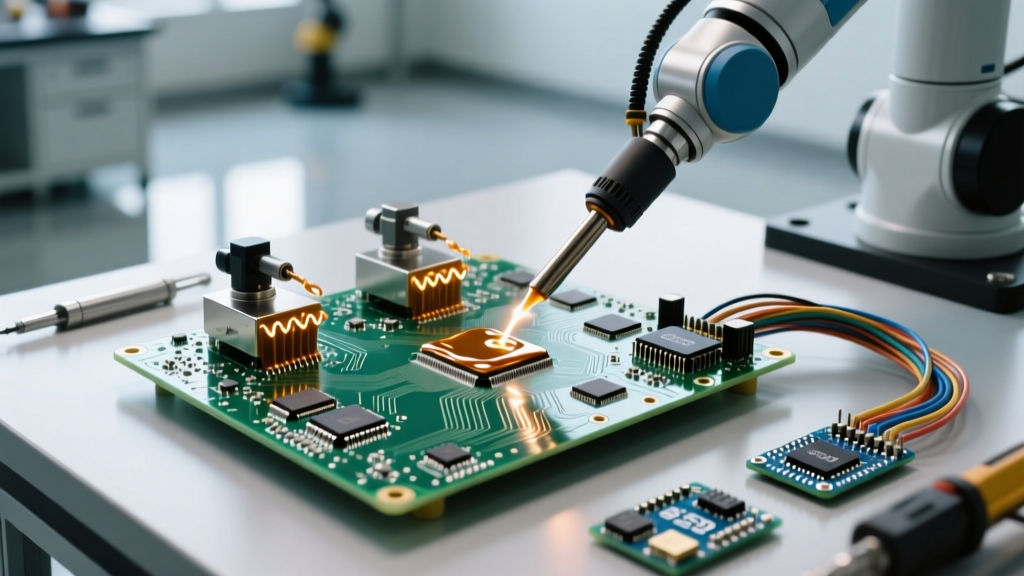
- Removal: Set your station to 340°C and 40 L/min. Heat the IC in a continuous circular motion. Once the solder turns shiny and liquid, lift the IC straight up with vacuum tweezers or fine ceramic forceps. Never drag the IC across the pads.
- Cleanup: Apply liquid flux to the bare pads and drag a 2.0mm copper desoldering wick over them with a standard soldering iron to remove old solder. Clean again with IPA and a lint-free swab.
- Paste and Placement: Apply a thin, even layer of SAC305 solder paste to the pads. Align the new IC using a fine-tipped tool, ensuring pin 1 matches the board silkscreen.
- Reflow: Drop the hot air temperature to 320°C and airflow to 30 L/min. Heat evenly until the solder paste flashes from dull grey to shiny silver, indicating a successful metallurgical bond. Allow the board to cool naturally; do not use compressed air to force-cool it, as thermal shock can crack the ceramic capacitors.
Final Thoughts on Thermal Management
Mastering the use of a heat gun for soldering is less about raw heat and more about thermal management. Understanding the thermal mass of your PCB, the specific melting points of your solder alloys, and the moisture sensitivity of your silicon will separate amateur hacks from professional, reliable repairs. Always prioritize flux, respect the dwell time limits of FR4 fiberglass, and invest in a station that offers true closed-loop temperature feedback.