
The 2026 Landscape: What Drives a Soldering Technician Salary?
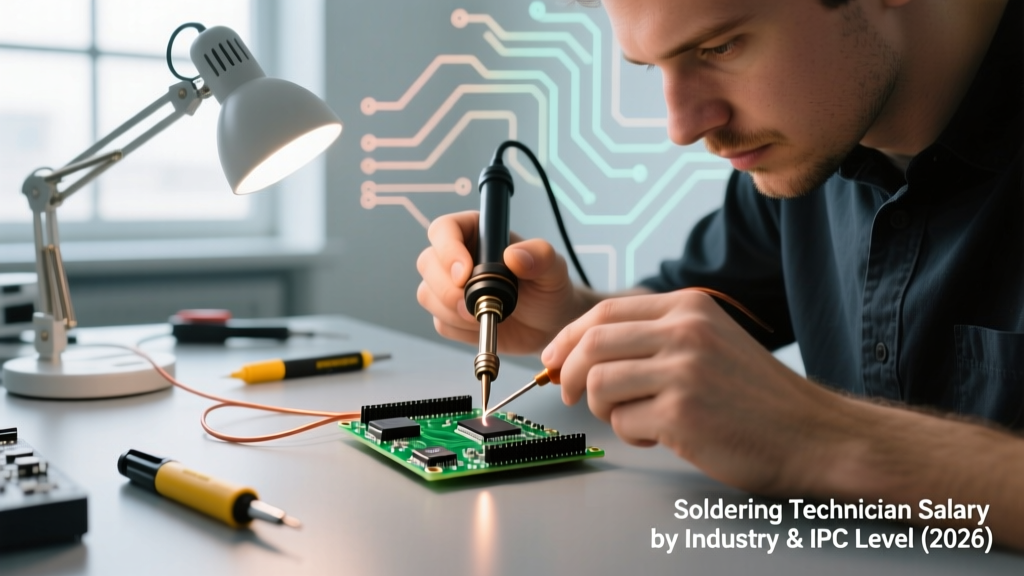
When evaluating a soldering technician salary in 2026, it is critical to understand that the electronics manufacturing sector no longer treats soldering as a monolithic trade. The days of a flat hourly rate for anyone holding a 60W iron are over. Today, compensation is strictly bifurcated by industry application, component miniaturization requirements, and verifiable IPC certifications. According to the U.S. Bureau of Labor Statistics, the median pay for electrical and electronic equipment assemblers hovers around $40,000 to $45,000 annually. However, this baseline figure heavily skews toward high-volume, low-complexity consumer electronics. Technicians specializing in high-reliability (Hi-Rel) sectors routinely command salaries between $65,000 and $95,000, driven by the severe cost of failure in their respective fields.
At ElectricalFlux, we analyze buyer trends and industry compensation to help professionals and lab managers understand the true ROI of advanced soldering gear and training. Below is a comprehensive breakdown of how your industry application dictates your earning ceiling.
Salary Breakdown by Industry Application
The primary determinant of a soldering technician's pay grade is the IPC-A-610 Acceptability Class required by their employer. Class 1 (General Electronic Products) yields the lowest compensation, while Class 3 (High-Performance Electronic Products) demands premium pay due to the stringent zero-defect tolerances.
| Industry Sector | IPC Class | 2026 Avg. Salary Range | Standard Tooling Profile | Environment |
|---|---|---|---|---|
| Consumer Electronics / Toys | Class 1 | $36,000 - $44,000 | Hakko FX-888D, Weller WE1010 | Standard ESD Bench |
| Automotive / Industrial Controls | Class 2 | $48,000 - $62,000 | Weller WX2021, JBC CD-2BE | Climate-Controlled ESD |
| Medical Devices (Implantable) | Class 3 | $68,000 - $85,000 | JBC Nano T245, Micro-Soldering Rigs | ISO 7 Cleanroom |
| Aerospace, Defense & Space | Class 3 | $72,000 - $95,000+ | Metcal MX-5200 (SmartHeat), Pace ADS200 | Strict ESD / FOD Controlled |
Aerospace & Defense: The Pinnacle of Hi-Rel Soldering
In the aerospace and defense sectors, a solder joint failure can result in catastrophic loss of life or multi-million-dollar mission failures. Technicians here must adhere not only to IPC J-STD-001 Class 3 but often to supplemental NASA workmanship standards (NASA-STD-8739.3). Because of these extreme liabilities, the soldering technician salary in this sector is the highest in the industry.
Technicians in this field routinely work with exotic alloys, polyimide-insulated wires, and complex RF shielding. They utilize advanced RF-induction soldering systems like the Metcal MX-5200. Metcal’s SmartHeat technology adjusts power delivery in real-time based on the thermal load of the pad, preventing thermal damage to sensitive aerospace-grade BGAs and QFNs. Mastery of these specific, $1,200+ soldering stations is a direct lever for salary negotiation in the defense sector.
Medical Devices: Micro-Soldering and Biocompatibility
Medical electronics, particularly implantable devices like pacemakers, neurostimulators, and continuous glucose monitors, require extreme miniaturization. Technicians in this sector are frequently soldering 0201 and 01005 imperial SMD components, as well as micro-coaxial cables under high-magnification microscopes.
The salary premium here (often $10,000 to $15,000 above automotive baseline) is paid for precision and traceability. Medical soldering techs must use lead-free, rosin-core solders that meet strict biocompatibility and outgassing standards. Tooling relies heavily on ultra-fast thermal recovery micro-handles, such as the JBC T245 paired with C245-008 nano-tips. If you are looking to break into the $80k+ medical soldering bracket, building a portfolio demonstrating flawless, void-free micro-BGA rework and 01005 component placement is mandatory.
Consumer Electronics and High-Volume Prototyping
While consumer electronics offer the highest volume of jobs, they generally yield the lowest soldering technician salary. The focus here is on throughput and basic functional reliability (IPC Class 1 or 2). Technicians often manage automated selective soldering machines or perform basic through-hole and large-pitch SMD touch-ups using reliable but mid-tier stations like the Hakko FX-951. Advancement in this sector typically requires transitioning from bench technician to SMT Process Engineer, where salaries jump from the $45k range to $85k+ by focusing on machine programming, reflow oven profiling, and stencil design rather than hand soldering.
The ROI of IPC Certifications on Your Paycheck
You cannot discuss soldering compensation without addressing the IPC certification ecosystem. Holding an active certification is the single most effective way to artificially inflate your baseline salary. However, not all certifications yield the same return on investment.
Crucial Distinction for Technicians: IPC J-STD-001 certifies your process and technique (how to solder). IPC-A-610 certifies your inspection capabilities (how to judge a solder joint). High-paying aerospace and medical employers typically require J-STD-001 for bench techs, and IPC-A-610 for QA inspectors. Holding both (often called a "Dual Cert") can increase your market value by 12% to 18%.
Certification Costs vs. Salary Bumps
- IPC J-STD-001 (CIS - Certified IPC Specialist): Costs between $1,600 and $2,200 for a 4-day course. Requires recertification every 24 months. Yields an average immediate salary bump of $4,000 to $7,000 annually.
- IPC-7711/7721 (Rework, Modification, and Repair): Costs around $1,800. This is the golden ticket for repair depots and prototype labs. Techs with this cert can command $65,000+ because they can salvage $5,000 PCB assemblies rather than scrapping them.
- IPC-A-610 (CIS): Costs roughly $1,500. Essential for moving off the bench and into Quality Assurance roles, where base salaries start at $60,000 with significantly less physical strain.
Geographic Variances and the Remote Soldering Myth
Unlike software engineering, hand soldering is an inherently physical discipline, meaning your salary is heavily tethered to local manufacturing hubs. In 2026, the highest concentrations of high-paying Hi-Rel soldering jobs remain clustered in specific geographic nodes:
- Southern California (Orange County / San Diego): Massive defense and medical device presence. Salaries range from $70k to $90k, though cost of living adjustments (COLA) eat into net gains.
- Minnesota (Twin Cities / Rochester): A hidden gem for medical electronics (anchored by companies like Medtronic). Salaries range from $65k to $80k with a vastly superior cost-of-living ratio compared to coastal hubs.
- Texas (Austin / Dallas-Fort Worth): Rapidly growing aerospace and semiconductor testing hubs. Techs here are seeing aggressive signing bonuses ($3,000 - $5,000) to meet the demand for Class 3 satellite and EV avionics assembly.
While "remote work" is impossible for the physical act of hand soldering, a growing niche in 2026 is remote soldering instruction and QA video review. Senior techs are increasingly being hired by decentralized hardware startups to review high-definition macro-video of contract manufacturer solder joints, providing remote IPC-A-610 sign-offs. These hybrid roles often push senior tech salaries past the $100,000 mark.
Actionable Steps to Maximize Your Soldering Earnings in 2026
If you are currently capping out at a $45,000 salary and want to transition into the $75,000+ Hi-Rel tier, follow this exact progression path:
- Upgrade Your Visual Documentation: Buy a digital inspection microscope (like an AmScope SE400-Z or a Plugable USB microscope). Begin taking macro-photos of your finest 0402 and QFP pitch joints. A visual portfolio of flawless wetting, proper fillet concavity, and zero flux residue speaks louder than a resume.
- Master Lead-Free Thermal Profiles: The transition to SAC305 and newer low-temperature alloys (like Sn42/Bi57) requires precise thermal management. Document your experience tuning Weller and JBC profiles to prevent tombstoning on lead-free micro-passives.
- Get Company-Sponsored Training: Do not pay for IPC J-STD-001 out of pocket if you can avoid it. Negotiate with your current employer to fund your certification in exchange for a 12-month retention agreement. If they refuse, use this as leverage to jump to a Class 3 contract manufacturer who views training as a baseline operational expense.
Frequently Asked Questions
Is a soldering technician career future-proof against automation?
High-volume, simple through-hole and large SMD soldering is rapidly being automated by selective soldering robots and advanced AOI (Automated Optical Inspection) systems. However, high-mix, low-volume sectors (aerospace prototyping, custom medical devices, and complex rework) cannot be easily automated due to the variability of the assemblies. Technicians who specialize in micro-soldering, BGA rework, and IPC Class 3 compliance are highly insulated from automation.
How much does a freelance micro-soldering technician make?
Freelance micro-soldering techs who specialize in component-level board repair (e.g., fixing traces on expensive industrial PLCs, automotive ECUs, or high-end data recovery boards) do not earn a traditional salary. Instead, they charge per job. A skilled freelancer with a JBC nano-soldering rig and a thermal camera can easily gross $120,000 to $150,000 annually, though this requires significant business development and specialized diagnostic skills beyond just applying solder.
Does knowing conformal coating increase my salary?
Yes. In aerospace and automotive sectors, applying and curing conformal coatings (like acrylics, silicones, or parylene) after the soldering process is a critical step. Technicians certified in IPC-CC-830 (Conformal Coating) and IPC-A-610 often command a 5% to 8% premium over bench techs who only handle the initial soldering, as coating requires specialized masking, UV-curing, and thickness measurement skills.