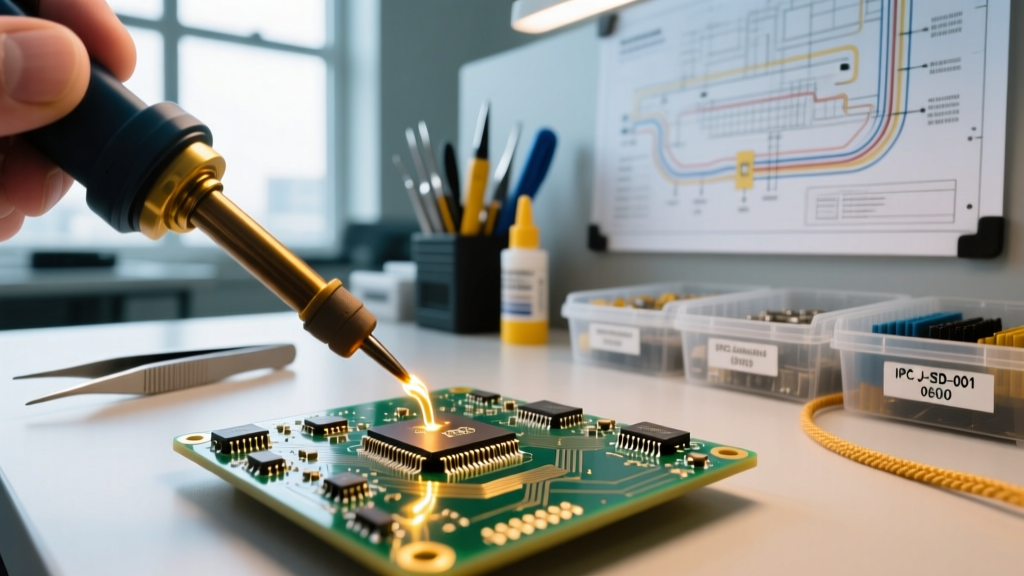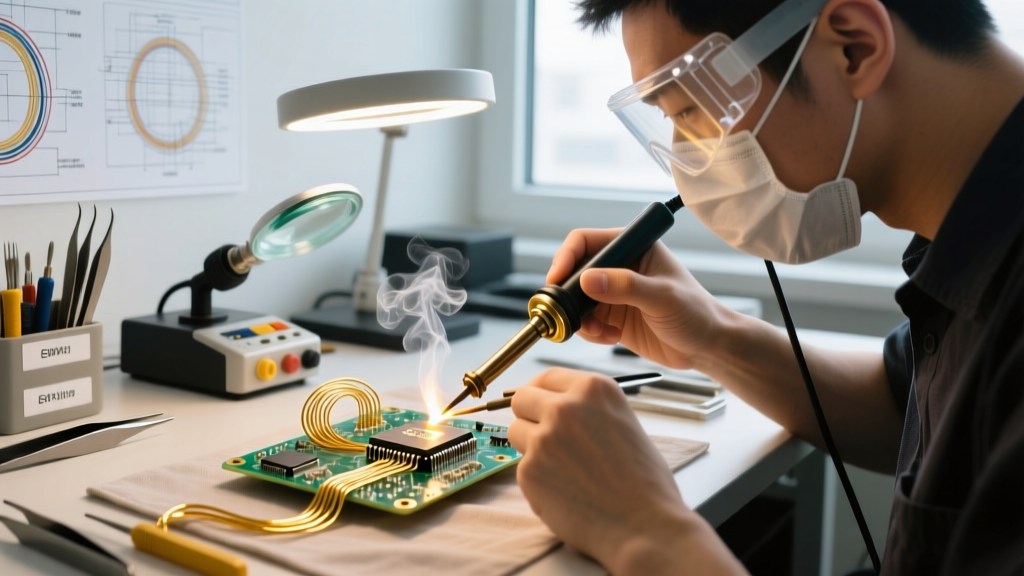

The Dual Threat in Gold Soldering
When technicians and engineers approach gold soldering, the immediate safety concern is often operator health—specifically, avoiding burns and inhaling flux fumes. However, in the realm of high-reliability electronics, aerospace, and RF engineering, 'safety' extends far beyond the workbench. It encompasses the structural integrity and long-term reliability of the solder joint itself. Gold-plated contacts, edge connectors, and thick-film RF substrates present unique metallurgical hazards that can lead to catastrophic joint failure if mishandled.
In this comprehensive guide, we break down the two pillars of gold soldering safety: metallurgical safety (preventing gold embrittlement and Kirkendall voiding) and operator safety (managing toxic alloy particulates and colophony fumes). By adhering to the protocols outlined below, you will ensure your assemblies meet stringent IPC J-STD-001 standards while protecting your respiratory health.
Metallurgical Safety: The AuSn4 Embrittlement Phenomenon
The most pervasive failure mode in gold soldering is the formation of brittle gold-tin intermetallic compounds (IMCs). When molten tin-based solder contacts a gold surface, the gold rapidly dissolves into the solder pool. As the joint cools, the gold precipitates out as AuSn4 crystals. If the gold concentration in the joint exceeds 3% to 5% by weight, the solder matrix becomes severely embrittled, leading to micro-fractures under thermal cycling or mechanical vibration.
Why Gold Dissolves and Weakens Joints
Gold does not alloy with tin in a ductile manner; it forms needle-like intermetallic structures that act as stress concentrators. Furthermore, the rapid dissolution of gold into the solder can leave behind microscopic voids at the interface—a phenomenon known as Kirkendall voiding. These voids drastically reduce the thermal and electrical conductivity of the joint, creating localized hotspots in high-current applications.
Critical Threshold: According to NASA Electronic Parts and Packaging (NEPP) workmanship guidelines, gold must be physically removed from the soldering surface prior to the final structural connection to prevent catastrophic embrittlement in mission-critical hardware.
Alloy Selection Matrix for Gold Substrates
Choosing the correct solder alloy is your first line of defense. While standard tin-lead or SAC alloys require rigorous gold-removal prep steps, specialized alloys can mitigate leaching rates. Below is a 2026 market and performance matrix for gold-compatible solders:
| Alloy Designation | Composition | Gold Leach Rate | Approx. Cost (2026) | Best Use Case |
|---|---|---|---|---|
| SAC305 | 96.5Sn / 3Ag / 0.5Cu | High | $45 / lb | General PCB (Avoid for thick gold without prep) |
| Sn63/Pb37 | 63Sn / 37Pb | Moderate | $35 / lb | Legacy/Aerospace (Requires double-tinning) |
| Indalloy 290 | 95In / 5Sn | Extremely Low | $240 / lb | RF components, thick gold plating, cryogenic |
| Sn96.5/Ag3.5 | 96.5Sn / 3.5Ag | High | $52 / lb | High-temp step soldering (Silver slows gold leaching slightly) |
Note: Indium-based alloys like Indalloy 290 are the gold standard for direct gold soldering because indium does not readily form brittle intermetallics with gold. However, the high material cost restricts its use to high-value RF and medical devices.
Operator Safety: Mitigating Fume and Heavy Metal Exposure
Beyond joint reliability, the physical act of soldering gold components introduces distinct occupational hazards. The intersection of high-temperature fluxes and specific gold alloys requires rigorous environmental controls.
Colophony and Flux Particulates
To break down the oxidation on gold-plated pads (and the underlying nickel barrier layers), technicians often reach for aggressive Rosin Mildly Activated (RMA) or water-soluble fluxes. When heated to typical iron tip temperatures of 350°C–380°C, these fluxes vaporize into colophony fumes. Prolonged inhalation of colophony is a known occupational asthmagen. The CDC NIOSH guidelines on soldering fumes mandate the use of local exhaust ventilation (LEV) positioned no more than 2 inches from the soldering arc to capture particulates before they enter the operator's breathing zone.
The Cadmium Warning in Legacy and Jewelry Gold Alloys
While modern electronics gold plating is typically pure (hard gold with trace cobalt or nickel), technicians who also cross over into electromechanical jewelry or legacy aerospace connectors must be wary of Cadmium-bearing gold solders. Cadmium is sometimes added to gold alloys to lower the melting point. When vaporized, cadmium oxide fumes are highly toxic and can cause severe pulmonary edema. Never solder unknown gold alloys without verifying the material safety data sheet (MSDS) for cadmium content.
IPC-Compliant Gold Removal Protocol (Step-by-Step)
To satisfy IPC J-STD-001 requirements for Class 3 (high-reliability) assemblies, you cannot simply apply solder directly to a gold-plated pad. You must perform a 'gold removal' or 'tinning' process. Follow this precise sequence to ensure metallurgical safety:
- Prep the Surface: Clean the gold-plated lead or pad with 99% isopropyl alcohol (IPA) to remove surface organics. Do not use abrasive Scotch-Brite pads, as this embeds particulates into the soft gold layer.
- Apply Flux: Apply a thin layer of RMA tack flux to the gold surface.
- The First Tinning (Gold Scavenging): Using a pre-tinned soldering iron tip and fresh Sn63/Pb37 or SAC305 solder, melt a generous bead of solder onto the gold surface. Dwell for exactly 2 to 3 seconds. The gold will rapidly dissolve into this solder bead.
- Wick the Contaminated Solder: Immediately use high-quality desoldering braid (e.g., Chemtronics 80-10) to wick away the molten solder. This physically removes the gold-laden AuSn4 intermetallics from the pad.
- Inspect and Repeat: Under a 10x microscope, inspect the pad. If a shiny, silver/gold hue remains, repeat steps 3 and 4. The pad should look dull and matte, indicating the gold is gone and the underlying nickel or copper barrier is exposed.
- Final Structural Soldering: Clean the pad with IPA, apply fresh flux, and perform your final component attachment using clean solder. The resulting joint will be ductile and free of embrittling gold crystals.
2026 Equipment Buyer Recommendations for Safe Gold Work
Executing the above protocols safely requires specialized bench equipment. Here are the top-tier investments for labs handling frequent gold soldering tasks:
- Metcal MX-AE Advanced Fume Extractor (~$950): Features a multi-stage HEPA and activated carbon filtration system specifically calibrated to capture sub-micron colophony particulates and volatile organic compounds (VOCs) generated by aggressive gold-wetting fluxes.
- Hakko FX-951 with T18-D24 Tip (~$280): Rapid thermal recovery is crucial when wicking gold. The FX-951 maintains tip temperature during the high-thermal-mass wicking step, preventing the cold-joint defects that occur when technicians linger too long on gold pads.
- Chemtronics Soder-Wick Rosin Braid (~$12/spool): Essential for the gold-scavenging step. The rosin coating aids in rapid heat transfer, minimizing the dwell time required to pull gold into the braid.
Frequently Asked Questions
Can I use a dedicated solder pot for gold-plated through-hole components?
Yes, but it requires strict maintenance. Gold will accumulate in the solder pot over time. Once the gold concentration in the pot reaches 3% by weight, the entire pot becomes embrittled. Labs must regularly test pot chemistry via XRF (X-ray fluorescence) analysis and skim the surface dross daily, as gold tends to migrate to the surface and dross layers.
Is it safe to use lead-free solder directly on ENIG (Electroless Nickel Immersion Gold) pads?
ENIG pads feature an ultra-thin layer of immersion gold (typically 2-4 microinches) designed solely to protect the underlying nickel from oxidation. During standard reflow or wave soldering, this microscopic gold layer dissolves instantly and safely into the bulk solder without reaching the 3% embrittlement threshold. The gold removal protocol is primarily required for thick hard-gold plating (e.g., edge connectors, RF cans, and thick-film substrates) where gold exceeds 30 microinches.
What tip temperature is safest for gold soldering?
Keep your tip temperature between 330°C and 350°C. Exceeding 380°C accelerates the degradation of your iron tip's plating (gold will aggressively alloy with and pit the iron plating on your tip) and drastically increases the vaporization rate of hazardous flux fumes.