
Defining the Process: What Is a Soldering Material?
When engineers and hobbyists ask what is a soldering material, they are typically referring to the fusible filler metal alloy used to create a permanent, electrically conductive, and mechanically stable bond between two base metals. Unlike welding, which melts the base metals themselves, soldering relies on capillary action and metallurgical wetting to fuse a lower-melting-point alloy to the surface of the workpiece.
In 2026, the landscape of soldering materials has evolved significantly. Driven by the extreme thermal density of AI server motherboards and the strict environmental mandates of the RoHS Directive, material compatibility is no longer just about making a joint stick—it is about managing intermetallic compound (IMC) growth, preventing thermal warpage, and mitigating long-term reliability failures like tin whiskers or gold embrittlement.
The Metallurgy of the Joint: Intermetallic Compounds (IMC)
To understand material compatibility, you must understand the Intermetallic Compound (IMC) layer. When molten solder contacts a copper pad, a metallurgical reaction occurs. The tin (Sn) in the solder reacts with the copper (Cu) to form two distinct layers:
- Cu6Sn5 (Eta phase): Forms closest to the solder bulk. It is relatively ductile and essential for a strong bond.
- Cu3Sn (Epsilon phase): Forms between the Cu6Sn5 and the base copper. It is brittle and prone to micro-voiding (Kirkendall voids) if subjected to prolonged high-temperature aging.
Expert Insight: An ideal IMC layer thickness is between 1.0 and 3.0 micrometers (μm). If your soldering iron dwell time is too long, or if the assembly undergoes extreme thermal cycling, the IMC layer can exceed 5.0 μm, transforming a ductile joint into a brittle one that will fracture under mechanical shock.
Base Metal Compatibility Matrix
Not all metals accept solder equally. The surface oxide layer, thermal conductivity, and metallurgical affinity of the base metal dictate which alloy and flux chemistry you must use. Below is a compatibility matrix for common electronics and fabrication metals.
| Base Metal | Wetting Difficulty | Recommended Alloy | Required Flux Chemistry | Typical Iron Temp (°C) |
|---|---|---|---|---|
| Copper (Cu) | Very Easy | Sn63/Pb37, SAC305 | ROL0, ROL1 (Rosin) | 320 - 350 |
| Brass / Bronze | Easy | Sn60/Pb40, SAC305 | ROL1, REL1 (Mild Activated) | 330 - 360 |
| Nickel / Kovar | Moderate | Sn96.5/Ag3.0/Cu0.5 | REL1, ORL0 (Organic) | 350 - 380 |
| Stainless Steel | Hard | Sn95/Sb5, Sn63/Pb37 | ORH1 (Highly Activated Acid) | 380 - 410 |
| Aluminum (Al) | Extreme | Indium-Tin, Zn-Al | Fluoroaluminate or Ultrasonic | 250 - 300 (Specialized) |
Deep Dive: Soldering Aluminum and Stainless Steel
Standard rosin fluxes are entirely ineffective on aluminum and stainless steel due to their tenacious, self-healing oxide layers. Aluminum forms an oxide layer (Al2O3) within milliseconds of being exposed to air, and this layer melts at over 2,000°C—far above the melting point of any solder. To solder aluminum, you must either use ultrasonic soldering (which uses acoustic cavitation to shatter the oxide layer in real-time) or highly aggressive fluoroaluminate fluxes that require meticulous post-solder cleaning to prevent galvanic corrosion.
Alloy Selection Guide for 2026 Applications
Choosing the right filler metal is critical. Here is a breakdown of the most prevalent alloys used in modern electrical and DIY fabrication.
1. Sn63/Pb37 (Leaded Eutectic)
Despite global pushback, leaded solder remains the gold standard for aerospace, medical, and prototyping applications due to its exemption status in specific high-reliability sectors. It is a eutectic alloy, meaning it transitions from solid to liquid at a single, precise temperature: 183°C. This eliminates the "plastic" (semi-solid) phase, drastically reducing the risk of cold or disturbed joints during cooling. It costs approximately $35–$45 per pound in 2026.
2. SAC305 (Lead-Free Standard)
Composed of 96.5% Tin, 3.0% Silver, and 0.5% Copper, SAC305 is the workhorse of commercial electronics. It melts at 217°C. Because it is non-eutectic, it has a pasty range of about 4°C. The addition of silver improves thermal fatigue resistance, but SAC305 is notoriously prone to tin whisker growth—microscopic crystalline structures that can cause short circuits in high-impedance circuits.
3. Sn42/Bi57/Ag1 (Low-Temperature Lead-Free)
As AI accelerators and dense BGA (Ball Grid Array) components dominate 2026 PCB designs, thermal warpage during reflow has become a critical failure mode. Bismuth-based alloys melt at a mere 138°C, allowing manufacturers to solder complex boards without warping the fiberglass substrate. However, Bismuth is brittle; these alloys should never be used in high-vibration environments or on connectors subject to mechanical stress.
4. Indium-Based Alloys (e.g., In97/Ag3)
Indium is a specialty alloy used for two primary reasons: cryogenic stability and gold compatibility. Indium remains ductile at temperatures near absolute zero, making it essential for quantum computing and aerospace sensors. Furthermore, unlike tin-based solders, indium does not rapidly leach gold from plated surfaces, preventing the catastrophic failure mode known as gold embrittlement.
Flux Chemistry: The Unsung Hero of Compatibility
You cannot discuss soldering materials without addressing flux. Flux removes surface oxides and prevents re-oxidation during heating. According to the IPC J-STD-001 and IPC J-STD-004B standards, fluxes are categorized by material and activity level:
- RO (Rosin): Derived from pine sap. Excellent for general copper PCB work. ROL0 (Low activity, no halides) is standard for no-clean consumer electronics.
- RE (Resin): Synthetic rosins. Offers better thermal stability for multi-layer boards requiring prolonged heat exposure.
- OR (Organic): Water-soluble organic acids. Highly active, used for stubborn oxides on brass or nickel, but must be cleaned with DI water post-soldering to prevent electrochemical migration.
- IN (Inorganic): Strong acids (e.g., Zinc Chloride). Used strictly for plumbing and heavy metal fabrication. Never use on PCBs.
Critical Failure Modes from Material Mismatch
Ignoring material compatibility leads to distinct, diagnosable failure modes. Understanding these is crucial for troubleshooting and adhering to rigorous NASA Workmanship Standards for high-reliability builds.
Gold Embrittlement
When standard tin-based solder (like SAC305) is applied to thick gold-plated surfaces (such as RF connectors or edge fingers), the tin rapidly dissolves the gold, forming AuSn4 intermetallic compounds. If the gold concentration in the joint exceeds 3% to 5% by weight, the joint becomes glass-like and will shatter under minimal mechanical stress. Solution: Use Indium-based solder, or perform a "tinning and wiping" step to remove the bulk gold before making the final connection.
De-Wetting vs. Non-Wetting
Non-wetting occurs when the solder refuses to adhere to the base metal at all, usually due to an inadequate flux or an impenetrable oxide layer (common on aluminum or heavily oxidized copper). De-wetting occurs when the solder initially coats the surface but then pulls back into isolated islands as it cools, exposing the base metal. This is typically caused by metallurgical contamination, such as attempting to solder a nickel-plated surface with a flux designed only for bare copper.
Tin Whisker Mitigation
Pure tin and high-tin lead-free alloys (like SAC305) are susceptible to spontaneous tin whisker growth, which can bridge adjacent traces and cause catastrophic short circuits. To mitigate this in mission-critical DIY or commercial projects, apply a conformal coating (such as acrylic or urethane) over the soldered joints, or use a tin-bismuth alloy, as the presence of bismuth disrupts the crystalline lattice structure required for whisker formation.
Summary: Matching the Alloy to the Application
Understanding what is a soldering material in the context of metallurgy transforms how you approach electrical work. For standard DIY copper wiring and prototyping, Sn63/Pb37 with a ROL1 rosin flux remains unbeatable for ease of use and joint reliability. For commercial, RoHS-compliant electronics, SAC305 is mandatory, provided you manage the higher thermal profiles (350°C+ tip temperatures). For specialized applications involving gold plating, cryogenic environments, or dense AI server boards, specialty alloys like Indium-Silver or Bismuth-Tin are not just alternatives—they are engineering necessities.
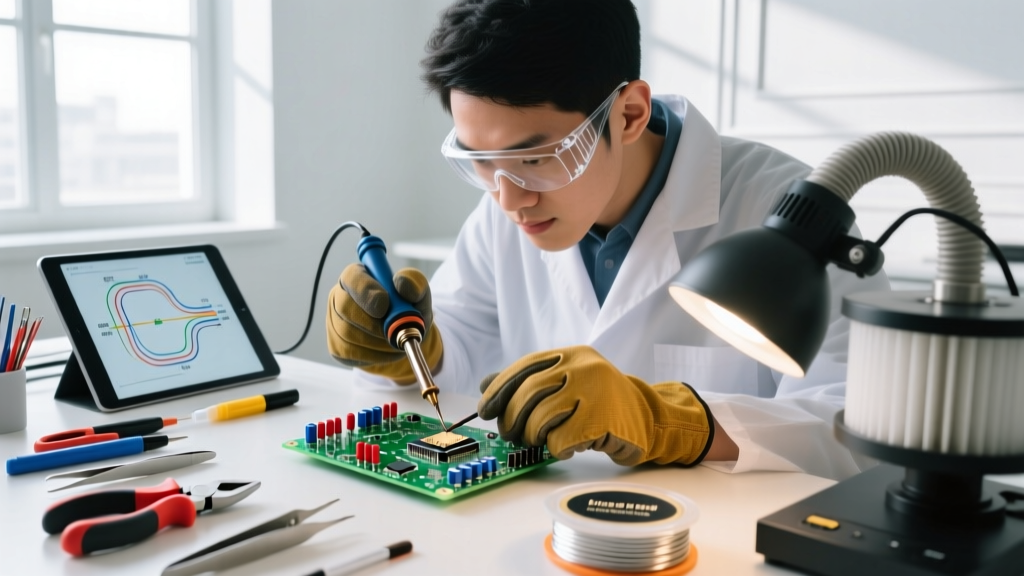
Always prioritize proper ventilation and adhere to OSHA Lead Safety Guidelines when working with leaded alloys, and ensure your flux chemistry aligns perfectly with your base metal to guarantee a joint that will last decades.