
The Genesis of Automation in Electronics Assembly
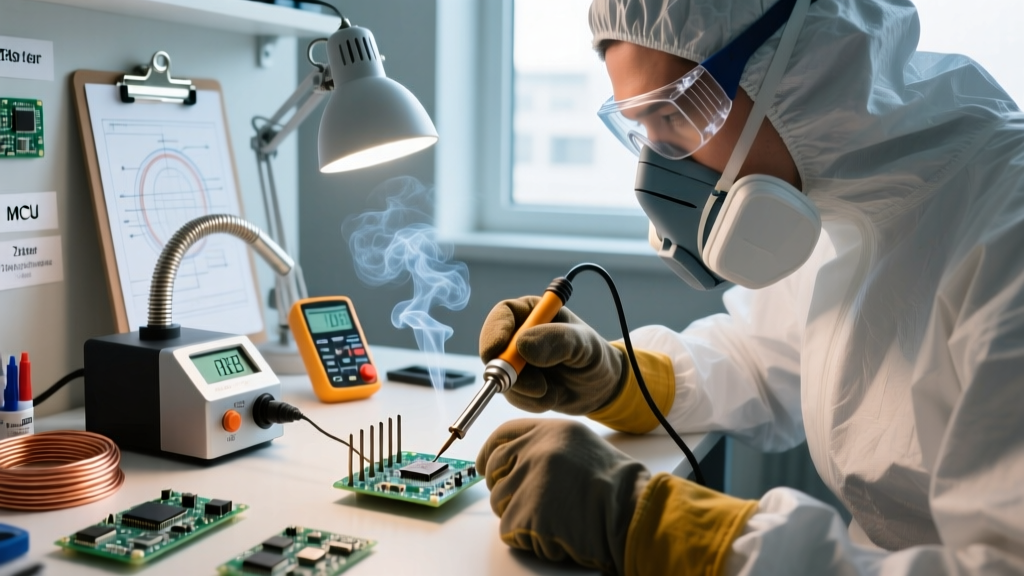
The transition from manual hand soldering to fully automated production lines represents one of the most critical leaps in modern electronics manufacturing. While a technician with a high-end iron like the Weller WE1010 can achieve incredible precision on low-volume prototypes, scaling to thousands of PCB assemblies per hour requires industrial automation. Today, the automated soldering machine is not just a mechanical arm or a heated bath; it is a highly calibrated, sensor-driven ecosystem. Understanding the historical evolution of these systems is crucial for production managers and engineers looking to invest in modern SMT (Surface Mount Technology) and THT (Through-Hole Technology) assembly lines in 2026.
"The history of automated soldering is essentially the history of thermal management and flux chemistry. Every leap in machine design was driven by the need to protect increasingly heat-sensitive micro-components."
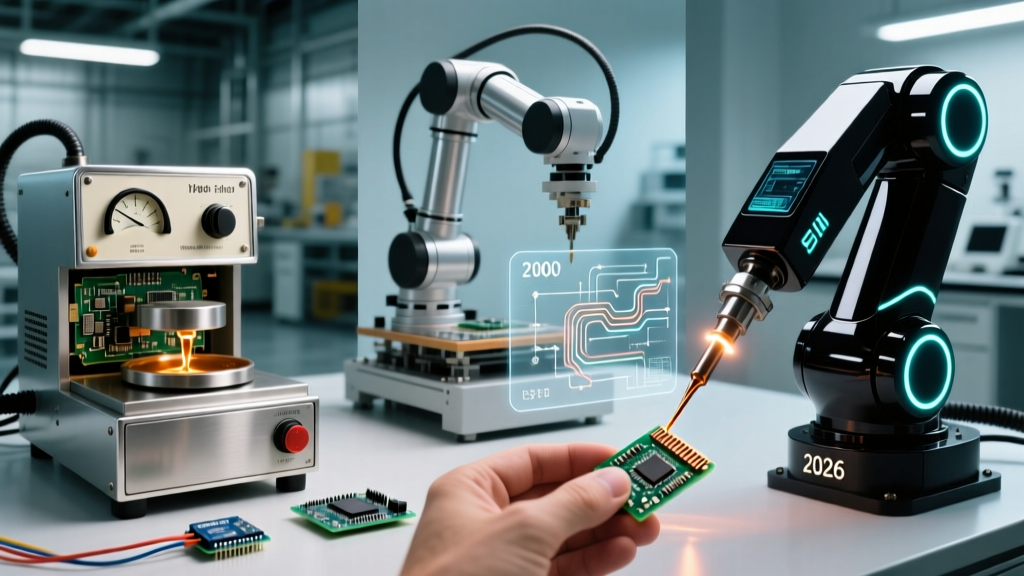
Timeline: How Automated Soldering Machines Evolved
| Era | Dominant Technology | Key Milestone | Common Failure Mode |
|---|---|---|---|
| 1960s–1970s | Wave Soldering | Invention of the pumped solder wave | Solder bridging and icicles |
| 1980s–1990s | Vapor Phase & Reflow | Mass adoption of SMT components | Tombstoning and solder balling |
| 2000s–2010s | Selective Wave Soldering | RoHS compliance and SAC305 alloys | Thermal shock to adjacent SMT parts |
| 2016–2026 | AI Laser & Robotic Soldering | Closed-loop thermal vision systems | Fiber optic degradation and AI misclassification |
Era 1: Wave Soldering and Through-Hole Dominance (1960s–1980s)
The earliest automated soldering machines were wave soldering systems. As documented in early manufacturing archives, the process involved pumping molten tin-lead (Sn63/Pb37) solder through a nozzle to create a standing wave. PCBs were passed over this wave on a conveyor belt. While revolutionary for its time, early wave soldering was a brute-force thermal process. Boards were subjected to massive preheat zones and prolonged contact with 250°C molten solder.
According to the Ersa corporate archives, early pioneers in the 1960s struggled with flux application. Early machines used foam fluxers, which resulted in excessive, uncontrolled flux residue. This necessitated the use of harsh CFC-based solvents for cleaning, a practice that was eventually outlawed due to ozone depletion. The evolution of the automated wave machine in the 1980s introduced ultrasonic spray nozzles, allowing for precise, micro-dosed application of rosin-based fluxes, drastically reducing post-solder cleaning requirements.
Era 2: The SMT Reflow Revolution (1990s)
As components shrank and leadless packages like QFNs and BGAs emerged, wave soldering became obsolete for the primary assembly stage. The 1990s saw the rise of the automated reflow oven. Instead of exposing the board to molten solder, machines began using precisely controlled convection heating zones to melt solder paste that had been stenciled onto the pads.
This era introduced the concept of the thermal profile. Engineers had to program the automated machine to navigate specific temperature ramps, soaking phases, and peak temperatures. The goal was to achieve a Time Above Liquidus (TAL) of exactly 45 to 90 seconds for standard eutectic pastes. Failure to calibrate these early reflow machines resulted in the dreaded "tombstoning" effect, where unequal surface tension on small passive components pulled them upright during the liquidus phase.
Era 3: Selective Soldering and the RoHS Catalyst (2000s–2015)
The mid-2000s brought a massive disruption: the Restriction of Hazardous Substances (RoHS) directive. The industry was forced to transition from tin-lead to lead-free alloys like SAC305 (Sn96.5/Ag3.0/Cu0.5). SAC305 required higher melting temperatures (around 217°C liquidus, with peak wave temperatures pushing 270°C) and exhibited poor wetting characteristics compared to legacy leaded solder.
Running high-thermal-mass mixed-technology boards through a standard wave machine at these new temperatures caused severe delamination and thermal damage to sensitive SMT components on the secondary side. The solution was the automated selective soldering machine. Systems like the Ersa POWERFLOW utilized programmable drop-jet fluxers and miniature solder nozzles to target only specific through-hole pins, avoiding adjacent heat-sensitive SMT parts entirely. This era also saw the strict enforcement of IPC J-STD-001 standards, which dictated the exact wetting angles and barrel-fill requirements for automated Class 3 aerospace and medical assemblies.
Era 4: AI, Laser Diodes, and IoT Integration (2016–2026)
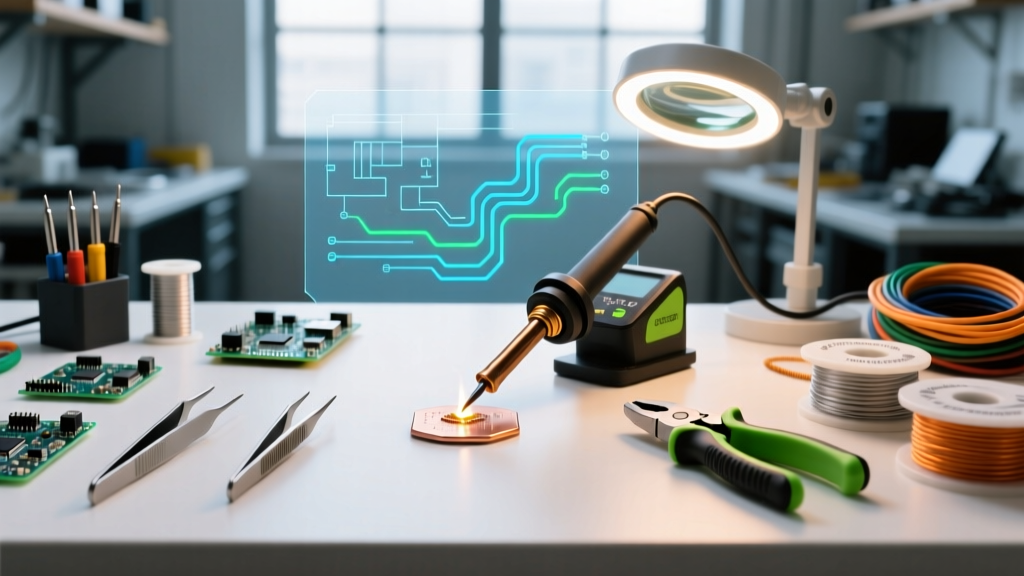
As of 2026, the cutting edge of the automated soldering machine relies on non-contact laser technology and machine learning. Modern manufacturing environments demand high-mix, low-volume production runs where retooling a selective wave machine is economically unviable. Enter robotic laser soldering systems.
The Architecture of a 2026 Laser Soldering Cell
- 980nm Diode Lasers: Modern systems utilize high-power infrared diode lasers that heat the solder joint and component lead directly without transferring thermal energy to the FR4 substrate or adjacent micro-passives.
- Coaxial Pyrometers: Unlike legacy systems that relied on blind timer-based heating, 2026 models feature inline pyrometers that read the thermal emissivity of the joint in real-time, shutting off the laser the millisecond the target reflow temperature is reached.
- AI Vision Inspection: Post-solder, high-resolution cameras paired with edge-computing AI algorithms inspect the fillet for IPC-A-610 Class 3 compliance, checking for voiding, dewetting, and flux splatter without requiring a separate AOI (Automated Optical Inspection) machine.
A prime example of this modern evolution is the JBC RSA Robotic System, which integrates automated wire-feeding, precise thermal profiling, and tip-wear analytics into a single enclosed cell, drastically reducing the mean time between failures (MTBF) associated with traditional automated iron tips.
2026 Buyer’s Framework: Choosing Your Automated System
When procuring an automated soldering machine today, buyers must align their capital expenditure with their production topology. The market has segmented into three distinct tiers based on throughput and thermal sensitivity requirements.
Tiered Cost & ROI Breakdown
| System Tier | Technology Type | Estimated 2026 CapEx | Best Use Case |
|---|---|---|---|
| Entry-Level | Desktop Robotic Iron (e.g., Quick TR-5000) | $12,000 – $25,000 | Prototyping, low-volume wire harnesses, simple THT |
| Mid-Volume | Inline Selective Wave (e.g., Ersa VERSAFLOW) | $85,000 – $140,000 | Automotive ECUs, high-reliability power supplies |
| High-Mix/Precision | Multi-Axis Laser Cell (e.g., JBC RSA / Hakko FX-942) | $130,000 – $220,000+ | RF shielding, medical implants, dense micro-BGA adjacencies |
Critical Specifications to Audit Before Purchase
- Flux Delivery System: Ensure the machine uses a piezoelectric drop-jet or ultrasonic nozzle capable of applying ORL0 (no-clean) flux in micro-droplets (10-20 microliters). Avoid legacy spray systems that cause overspray and require frequent maintenance.
- Nitrogen Inerting Capability: For lead-free SAC305 or SnCuNi alloys, an integrated nitrogen generator (achieving <50 ppm O2 at the nozzle) is non-negotiable to prevent dross formation and ensure proper wetting.
- Software & IoT Traceability: Modern machines must support MES (Manufacturing Execution System) integration via MQTT or SECS/GEM protocols, logging the exact thermal profile and flux volume for every individual PCB serial number.
Final Verdict for Production Managers
The automated soldering machine has evolved from a blunt thermal instrument into a precision mechatronic system. While wave and reflow technologies remain the backbone of high-volume consumer electronics, the 2026 landscape heavily favors selective and laser-based automation for high-reliability sectors. By understanding the historical limitations of older thermal processes, engineering teams can justify the ROI of modern, closed-loop laser systems that guarantee IPC compliance, eliminate thermal collateral damage, and seamlessly integrate into smart factory ecosystems.