
The Evolution of Wire Soldering Automation in 2026
As the electronics manufacturing sector faces persistent skilled-labor shortages and increasingly stringent reliability standards, the transition from manual soldering to automated wire soldering machines has accelerated. In 2026, modern wire termination and harness assembly demand strict adherence to IPC J-STD-001 requirements, particularly for Class 3 high-reliability products like aerospace and medical devices. A dedicated wire soldering machine eliminates human variability in dwell time, tip temperature, and flux application, ensuring consistent intermetallic compound (IMC) formation across thousands of joints.
This comprehensive buyer's guide dissects the three primary categories of wire soldering machinery available today: Desktop Robotic Systems, Hot Bar (Pulse Reflow) Machines, and Induction Soldering Systems. We will explore exact model capabilities, real-world pricing, and critical failure modes to help production managers and process engineers make an informed capital expenditure.
Comparison Matrix: Wire Soldering Machine Technologies
| Technology Type | Best Application | Typical Price Range (2026) | Average Cycle Time | Wire Gauge Compatibility |
|---|---|---|---|---|
| Desktop Robotic (Iron) | Wire-to-PCB, Wire-to-Connector | $3,500 - $12,000 | 3.0 - 6.0 seconds | AWG 30 to AWG 16 |
| Hot Bar (Pulse Reflow) | Wire-to-FPC, Fine-Pitch Pads | $15,000 - $28,000 | 1.5 - 3.5 seconds | AWG 32 to AWG 24 |
| Induction Soldering | Heavy Harness, Lugs, AWG 8+ | $8,000 - $20,000 | 2.0 - 5.0 seconds | AWG 12 to AWG 2/0 |
Deep Dive: Choosing the Right Machine Architecture
1. Desktop Robotic Soldering Systems
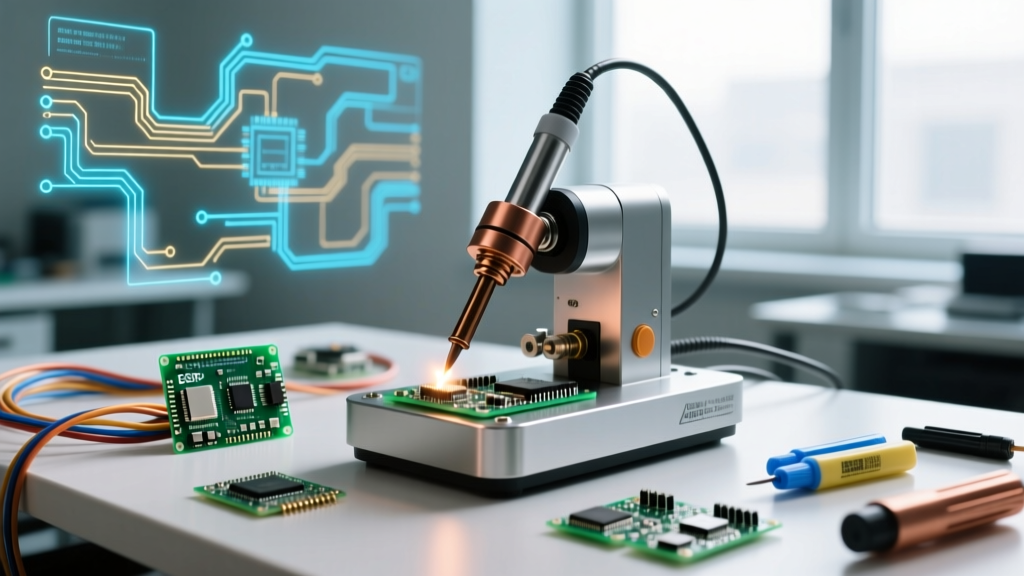
Robotic soldering arms replicate the manual process using programmable XYZ (and sometimes rotary) axes. They are ideal for standard wire-to-through-hole or wire-to-surface-mount pad applications. In 2026, leading models like the Hakko FA-6000 series and the Quick 938A dominate the mid-tier market.
- Key Specs: The Quick 938A offers a 400x400mm work envelope and integrated CCD vision systems for fiducial mark alignment, compensating for minor PCB warpage. Pricing sits around $4,200.
- Advanced Features: Modern units feature auto-tip cleaners with brass wire brushes and integrated nitrogen purging. Supplying 99.99% pure N2 gas locally reduces tip oxidation by up to 80%, extending tip life and improving wetting on lead-free SAC305 alloys.
- Limitation: Robotic arms struggle with flexible printed circuits (FPCs). The downward Z-axis pressure of a standard iron tip can easily crush delicate polyimide substrates before the solder reflows.
2. Hot Bar (Pulse Reflow) Soldering Machines
When terminating ultra-fine magnet wire or stranded harnesses to flexible circuits (FPC) or glass substrates, a Hot Bar system is mandatory. Instead of a traditional iron, these machines use a thermode (heating element) that applies simultaneous, highly calibrated heat and pressure.
According to Amada Miyachi's soldering application guidelines, pulse reflow is the only viable method for ensuring coplanarity on multi-wire FPC connections. The Amada Miyachi PH-20 is an industry benchmark, priced between $18,000 and $22,000 depending on the force actuator and vision package.
- Thermode Materials: Molybdenum is standard for its rapid heating and cooling curves, but Titanium Carbide (TiC) coated thermodes are required for 2026 high-volume runs to prevent solder alloy adhesion to the bar itself.
- Process Control: The PH-20 allows closed-loop temperature feedback at a rate of 4,000 samples per second. For SAC305 (melting point 217°C), the thermode is typically ramped to 320°C for exactly 2.5 seconds under 3 Newtons of force.
3. Induction Soldering Systems
For heavy-gauge automotive or industrial battery cables (AWG 8 through 2/0), thermal mass becomes the enemy. A standard iron cannot overcome the heat-sinking effect of a heavy copper lug. Induction soldering machines use high-frequency electromagnetic fields to heat the wire and terminal directly from the inside out, without physical contact.
- Advantage: Non-contact heating eliminates tip wear entirely. It also prevents flux entrapment inside heavy crimp barrels, as the heat is generated within the metal itself, driving flux vapors outward.
- Pricing & Footprint: Systems like the Miller 1000 series or specialized high-frequency units cost between $10,000 and $18,000. They require specialized water-cooling chillers, adding roughly $2,500 to the initial setup cost.
Critical Process Variables and Edge Cases
Purchasing the machine is only 30% of the battle. Process engineering dictates the remaining 70% of yield. Below are the most common failure modes encountered when programming wire soldering machines, and how to resolve them.
Expert Insight: 'The most frequent cause of field failure in automated wire soldering is not a cold joint, but thermal shock-induced pad cratering. Engineers often maximize Z-axis force and temperature to guarantee wetting, inadvertently fracturing the copper-to-FRP bond beneath the pad.' — Process Engineering Lead, Tier 1 Automotive Supplier.
Troubleshooting Guide
- Pad Lift-Off / Cratering (Hot Bar Systems): Caused by excessive downward force (>6N) combined with rapid thermal expansion. Solution: Reduce force to the 2-4N range and introduce a 0.5-second 'pre-heat' dwell step at 150°C before ramping to full reflow temperature.
- Solder Wicking (Robotic Systems): Solder travels up the wire insulation instead of staying on the pad. Solution: This is a wire preparation issue. Ensure the wire is stripped exactly 1.5x the pad length. Implement a robotic pre-tinning step or use a flux with higher viscosity to act as a thermal barrier.
- Flux Splatter / Beading: Occurs when the iron tip hits the flux too rapidly, causing the solvents to boil explosively. Solution: Program a 'hover' delay. Bring the tip to 1mm above the joint for 0.8 seconds to gently evaporate the volatile organic compounds (VOCs) before making physical contact.
Flux Delivery and Atmosphere Control
In 2026, integrated flux dispensing is a non-negotiable feature for high-end wire soldering machines. Manual flux application introduces severe variability. Look for machines equipped with drop-jet or piezoelectric flux dispensers. These systems spray micro-droplets (measured in nanoliters) of no-clean flux directly onto the target pad milliseconds before the iron descends. This prevents flux from drying out and ensures exact volume control, which is critical for passing IPC-A-610 cleanliness and residue standards.
Furthermore, if your facility runs high-reliability medical or aerospace harnesses, ensure the machine chassis supports local nitrogen shrouding. Flooding the immediate soldering zone with N2 reduces the oxygen concentration below 100 PPM, virtually eliminating dross formation and allowing for lower process temperatures (dropping tip temps from 380°C to 340°C), which drastically extends tip and pad lifespan.
ROI Analysis: Manual vs. Automated
Is a $15,000 wire soldering machine justifiable? Consider the math for a mid-volume harness shop producing 500,000 wire-to-board joints annually.
- Manual Labor: A skilled IPC-certified soldering technician costs roughly $55,000/year (fully burdened). At an average pace of 15 seconds per joint (including fluxing and inspection), one operator handles about 80,000 joints a year. You would need 6+ operators to hit 500,000 units.
- Automated: Two Hakko FA-6000 robotic cells ($19,000 total capital cost) running at 4.5 seconds per joint can process over 600,000 joints annually on a single shift. The ROI is typically achieved in under 7 months when factoring in reduced scrap rates (which typically drop from 2.5% manual to 0.1% automated).
Frequently Asked Questions (FAQ)
Can a wire soldering machine handle both leaded and lead-free alloys?
Yes, but with caveats. Switching from Sn63/Pb37 to SAC305 requires changing the solder wire spool, purging the automatic feed mechanism, and swapping the iron tip. SAC305 requires higher thermal capacity; ensure your machine's heater element can sustain 400°C without triggering thermal cut-offs. Dedicated machines for lead-free are recommended to avoid cross-contamination, which violates RoHS compliance.
Do I need a specialized machine for enameled magnet wire?
Yes. Standard wire stripping damages fine magnet wire. You must use a Hot Bar system or a specialized resistance soldering machine that burns through the polyurethane or polyimide enamel coating simultaneously as it solders the wire to the terminal.
What maintenance is required for automatic wire feeders?
The feed rollers and guide tubes accumulate flux residue and metallic dust. In a 24/7 production environment, the PTFE guide tubes must be replaced every 3 months, and the feed rollers cleaned with isopropyl alcohol weekly to prevent solder wire jamming or inconsistent feed lengths.
Final Verdict for Production Managers
Selecting the right wire soldering machine hinges entirely on your substrate and wire gauge. For standard rigid PCBs and connectors, a desktop robotic arm like the Quick 938A offers the best balance of cost and flexibility. For delicate FPCs and micro-wires, invest in a Hot Bar system like the Amada Miyachi PH-20. For heavy battery lugs, induction is the only viable path. By matching the machine architecture to your specific thermal and mechanical constraints, you will secure IPC-compliant yields and a rapid return on investment.