
The Great Workbench Debate: Iron vs. Gun
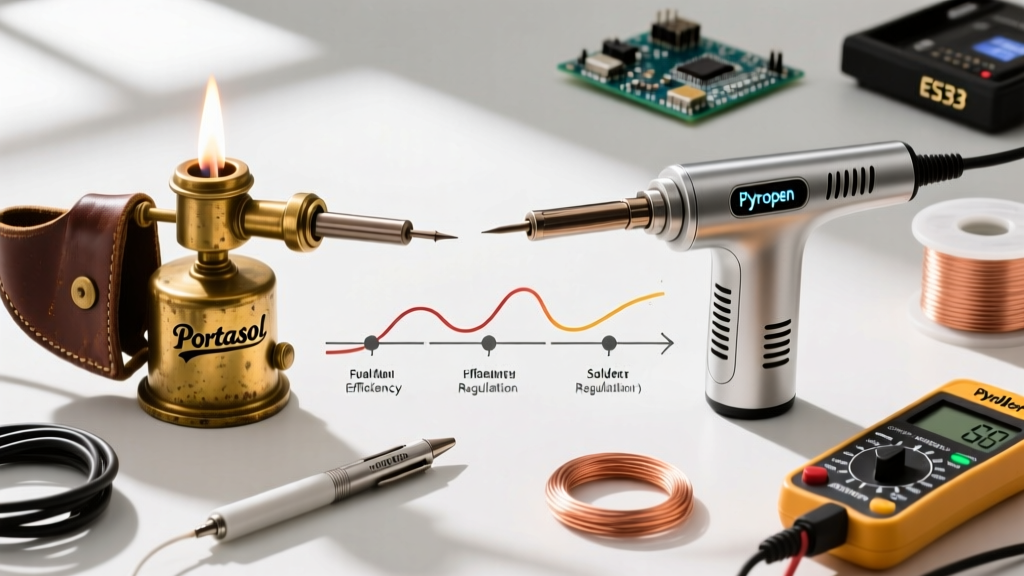
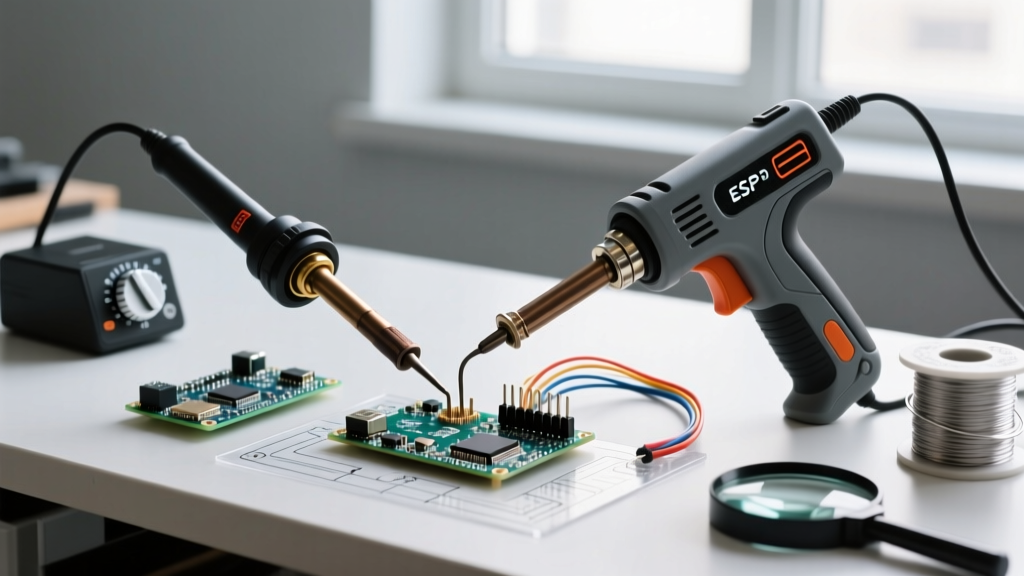
When outfitting an electronics lab or DIY workbench in 2026, the foundational choice of your primary joining tool dictates the ceiling of your project capabilities. While beginners often mistype 'soldering iro' into search engines when building their first kit, selecting the correct tool requires a deep understanding of thermal dynamics, not just semantics. The two dominant manual methods—the precision soldering iron and the heavy-duty soldering gun—operate on fundamentally different physical principles. One relies on conductive thermal transfer via a resistive ceramic element, while the other utilizes electromagnetic induction and high-current resistive heating. This guide breaks down the engineering, practical applications, and exact market pricing of both methods to help you make an informed investment.
Method 1: The Precision Soldering Iron
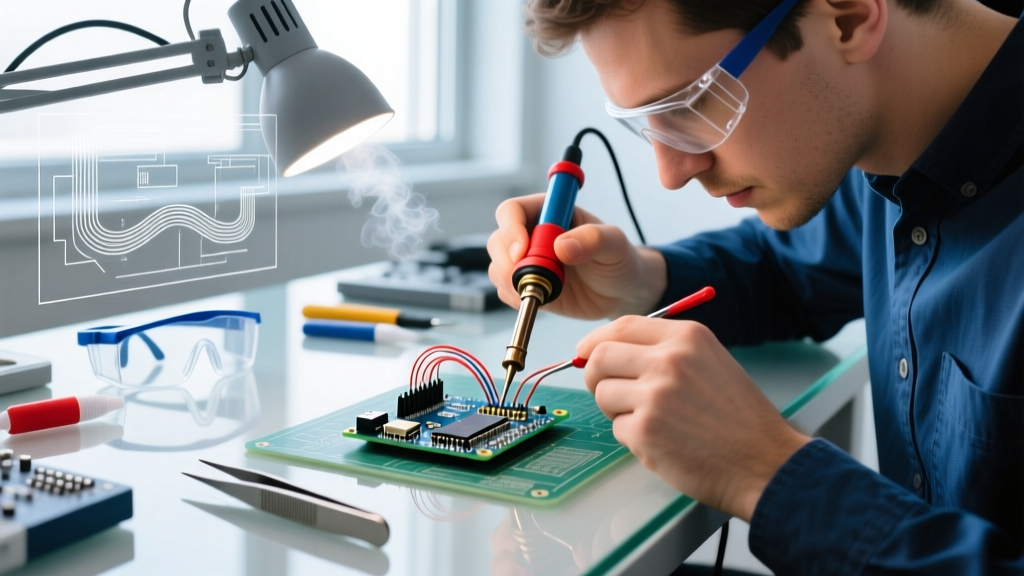
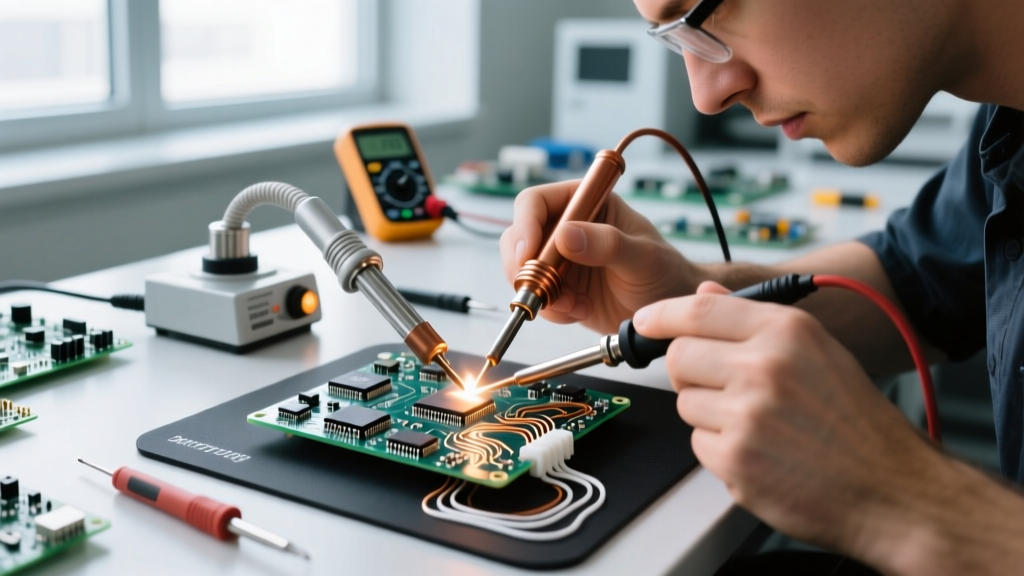
Modern soldering irons are the undisputed champions of printed circuit board (PCB) assembly and fine-pitch surface mount device (SMD) work. In 2026, the market standard for professional and serious hobbyist irons involves digitally controlled, closed-loop PID (Proportional-Integral-Derivative) temperature systems. These systems use a thermocouple embedded directly in the tip to monitor thermal load and adjust power delivery in milliseconds.
Top 2026 Models and Market Pricing
- Hakko FX-888D: Priced around $115, this 70W station remains a workbench staple. It features a digital interface and uses T18 tips. Its thermal recovery time from 200°C to 350°C is approximately 20 seconds, making it ideal for continuous through-hole and 0805 SMD work.
- Weller WE1010NA: Retailing for about $110, this 70W unit offers a slightly more ergonomic handpiece and a broader range of ETA tip geometries. It excels in maintaining strict thermal profiles required by IPC J-STD-001 standards for Class 2 and Class 3 electronic assemblies.
- Pinecil V2: For portable or budget-conscious users, this $26 smart iron runs on RISC-V architecture, supports USB-C PD (Power Delivery) up to 65W, and integrates seamlessly with BLE-enabled smartphones for custom thermal curves.
Best Use Cases
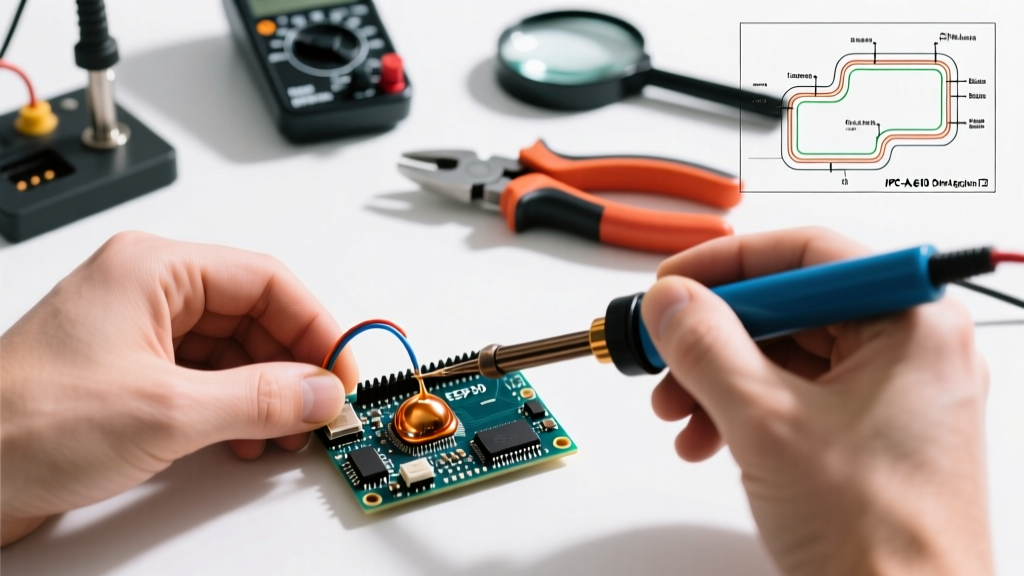
Soldering irons are mandatory for any work involving delicate PCB traces, microcontrollers (like ESP32 or Arduino clones), and heat-sensitive components such as electrolytic capacitors and Hall-effect sensors. The low thermal mass of conical and micro-chisel tips allows for precise heat application without risking pad delamination.
Method 2: The Heavy-Duty Soldering Gun
Soldering guns are essentially step-down transformers shaped like a pistol. When the trigger is pulled, mains voltage is stepped down to a very low voltage (typically under 1 volt) but at a massive current (often exceeding 150 amps). The soldering tip itself acts as the secondary winding of the transformer. Because the tip has a specific electrical resistance, this massive current generates instant heat via I²R (Joule) heating. There is no active temperature feedback loop; the tip simply gets hotter the longer you hold the trigger.
Top 2026 Models and Market Pricing
- Weller D550PK: A classic 120W/260W dual-trigger gun available for roughly $55. It reaches soldering temperatures in under 6 seconds. However, the tip is thick and entirely unsuited for modern PCB work.
- Milwaukee M12 Cordless Soldering Iron/Gun: Priced at $149 (bare tool), this hybrid utilizes a high-current battery discharge to mimic the rapid heat-up of a transformer gun while maintaining a traditional iron form factor, offering up to 400 joints per charge on 14 AWG wire.
Best Use Cases
Guns are strictly for heavy electrical work: soldering 10 AWG to 4 AWG battery cables, joining thick copper grounding straps, and sealing heavy-duty coaxial connectors. The massive thermal mass of a gun tip prevents 'thermal droop' when touching thick copper, which would otherwise act as a giant heatsink and freeze the solder into a cold, brittle joint.
Head-to-Head Comparison Matrix
| Feature | Precision Soldering Iron (e.g., Hakko FX-888D) | Transformer Soldering Gun (e.g., Weller D550) |
|---|---|---|
| Heating Mechanism | Ceramic resistive element with PID feedback | Step-down transformer (I²R secondary heating) |
| Heat-Up Time | 20 to 40 seconds to reach 350°C | 3 to 6 seconds to reach melting point |
| Temperature Control | Exact digital control (±2°C) | None (Variable based on trigger hold time) |
| Magnetic Interference | Negligible | High (Can damage unshielded sensors) |
| Best Material Target | PCB pads, 28-18 AWG wire, SMD components | Heavy gauge wire (14-4 AWG), metal chassis lugs |
| Average Cost (2026) | $25 (Smart Irons) to $120 (Stations) | $45 to $150 |
Thermal Dynamics and Failure Modes
Understanding how each method fails is just as critical as knowing how it works. According to the NASA Workmanship Standards for Soldering, thermal damage to PCBs is one of the most common causes of latent field failures.
The Soldering Gun's Hidden Danger: Magnetic Fields
Because a soldering gun operates as an unshielded transformer, the tip generates a localized, high-intensity alternating magnetic field. If you use a soldering gun near an unshielded inductor, a sensitive audio amplifier circuit, or a Hall-effect sensor, the induced electromagnetic force (EMF) can permanently alter magnetic components or induce voltage spikes that fry adjacent silicon. Furthermore, the lack of temperature regulation makes it incredibly easy to exceed the 260°C threshold for more than 10 seconds, leading to immediate pad delamination and via-barrel cracking.
The Soldering Iron's Limitation: Thermal Droop
Conversely, attempting to solder a 10 AWG silicone wire to a heavy brass XT90 connector using a standard 70W soldering iron will result in thermal droop. The massive copper mass of the wire absorbs heat faster than the iron's ceramic element can replenish it. The result is a 'cold joint'—a grainy, dull, high-resistance connection that will eventually melt under high-current loads, posing a severe fire hazard in RC models and solar setups.
Expert Insight: Never use a soldering gun on a populated printed circuit board. The combination of uncontrolled thermal spikes and electromagnetic interference will compromise both the mechanical integrity of the FR4 fiberglass and the logical integrity of the microchips.
Tip Maintenance and Oxidation Prevention
Regardless of the method you choose, tip longevity in 2026 relies heavily on managing oxidation, especially with the industry-wide shift to lead-free SAC305 (Sn96.5/Ag3.0/Cu0.5) alloys, which require higher operating temperatures (around 360°C) and are highly corrosive to iron plating.
- Tinning is Mandatory: Always leave a thick blob of solder on the tip before turning the tool off. This sacrificial layer oxidizes instead of the iron plating.
- Avoid Abrasives: Never use sandpaper or a steel file to clean a modern tip. You will strip the microscopic iron plating, exposing the copper core to rapid dissolution by the molten solder.
- Use Brass Wool: For soldering irons, a damp cellulose sponge or a dry brass wool ball is the only safe way to remove carbonized flux residue during operation.
Decision Framework: Which Should You Buy?
Your purchasing decision should be dictated entirely by the physical mass of the materials you intend to join.
- Buy a Soldering Iron Station if: You are building drones, repairing consumer electronics, wiring microcontrollers, or working with anything smaller than 16 AWG wire. The Hakko FX-888D or Weller WE1010NA will serve you for a decade with proper tip care.
- Buy a Soldering Gun if: You are an automotive technician, an RC hobbyist building high-amperage battery packs, or an electrician terminating heavy-gauge ground wires where a standard iron simply cannot overcome the thermal mass of the copper.
- The Ultimate Combo: For a fully capable 2026 electronics workbench, keep a $115 digital iron station for 90% of your precision work, and supplement it with a $55 transformer gun kept in a drawer strictly for heavy-duty wire splicing and chassis grounding.