
The Metallurgical Marvel of Solder Paste
When modern electronics engineers think of soldering with paste, they often take for granted the complex rheology and metallurgical precision required to make it work. Solder paste is not merely ground-up wire solder; it is a highly engineered thixotropic mixture of microscopic metal alloy spheres suspended in a chemically active flux medium. Understanding the history and evolution of this material is crucial for today's DIYers and professional assemblers, as historical shifts in environmental regulations and component miniaturization directly dictate the buying choices and reflow profiles we use in 2026.
The Pre-Paste Era: Why Soldering with Paste Became Necessary
Before the 1970s, printed circuit board (PCB) assembly was dominated by Through-Hole Technology (THT). Assemblers relied on wire solder and wave soldering machines. However, as the aerospace and computing industries demanded higher component density, wave soldering hit a physical limitation: it could not reliably solder components placed on both sides of a board, nor could it handle the emerging leadless ceramic chip carriers.
The solution was Surface Mount Technology (SMT), which required a localized adhesive and solder source. This birthed the concept of soldering with paste. Early formulations in the 1970s were rudimentary, utilizing large, irregularly shaped solder particles mixed with aggressive rosin-based fluxes. These early pastes suffered from severe slumping (spreading outside the stencil pad) and inconsistent metal loading, leading to frequent solder bridges on the relatively large pitch components of the era.
The 1980s: Powder Atomization and the Rosin Era
The first major leap in solder paste technology was the perfection of inert gas atomization. By forcing molten solder through a nozzle into a high-pressure nitrogen chamber, manufacturers could produce perfectly spherical powder particles. This dramatically improved the paste's ability to roll smoothly across stencils and release cleanly from apertures.
During this decade, Rosin Mildly Activated (RMA) fluxes were the industry standard. While RMA fluxes provided excellent wetting and left a relatively benign, hard residue that trapped ionic contaminants, the post-soldering cleaning process was highly problematic. Assemblers used chlorofluorocarbons (CFCs) and trichloroethane to wash the boards—solvents that were later identified as severe ozone-depleting substances.
'The transition away from CFC-based cleaning in the late 1980s forced a complete reformulation of flux chemistry, effectively birthing the modern no-clean and water-soluble paste categories we rely on today.'
The 1990s Environmental Shift: No-Clean and Water-Soluble Fluxes
The Montreal Protocol of 1987 mandated the phase-out of CFCs, sending shockwaves through the electronics manufacturing industry. Assemblers could no longer clean the sticky, acidic RMA residues left by early pastes. This environmental mandate drove the invention of two distinct flux pathways:
- No-Clean (NC) Fluxes: Formulated with synthetic resins and low-solids activators that volatilize or encapsulate during reflow, leaving a clear, non-conductive, and non-corrosive residue. By 2026, no-clean pastes account for over 85% of the global SMT market.
- Water-Soluble (Organic Acid) Fluxes: Designed for high-reliability sectors (medical, automotive, aerospace) where any residue is unacceptable. These use organic acids that provide aggressive wetting but must be thoroughly washed with heated deionized water post-reflow.
The 2000s: The RoHS Directive and Lead-Free Alloys
Perhaps the most disruptive event in the history of soldering with paste was the European Union's Restriction of Hazardous Substances (RoHS) directive, which took full effect in 2006. The industry standard Sn63Pb37 (Tin-Lead eutectic) paste, which melted at a forgiving 183°C, was banned in consumer electronics.
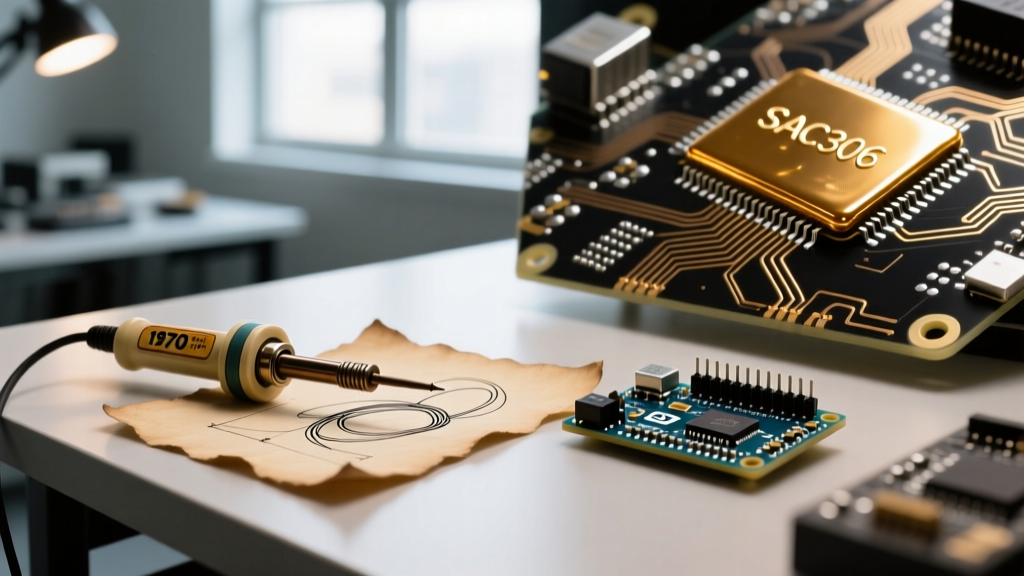
The industry scrambled to find a replacement, eventually settling on SAC305 (96.5% Tin, 3.0% Silver, 0.5% Copper). According to extensive metallurgical data published by the IPC Standards for Soldering Materials, SAC305 offered the best compromise of tensile strength, thermal fatigue resistance, and wetting characteristics. However, SAC305 melts at 217°C–220°C, requiring peak reflow temperatures of 245°C. This forced assemblers to upgrade their reflow ovens and use high-temperature flux chemistries that would not burn off or oxidize prematurely during the extended time-above-liquidus (TAL).
Evolution of Solder Powder Mesh Sizes
As components shrank from 1206 down to 0201 and micro-BGAs, the powder size had to shrink proportionally. The IPC J-STD-005 standard categorizes these by 'Type'. As documented by leading metallurgy labs at the Indium Corporation's Solder Paste Division, using a powder type that is too large for your stencil aperture will cause the 'five-ball rule' failure, where particles jam in the stencil and fail to transfer to the pad.
| Powder Type | Particle Size (µm) | Typical Stencil Thickness | Target Component Pitch / Size |
|---|---|---|---|
| Type 3 | 25 – 45 µm | 5 – 6 mils | Standard SMT (0805, 1206, SOIC) |
| Type 4 | 20 – 38 µm | 4 – 5 mils | Fine Pitch (0402, 0603, QFP 0.5mm) |
| Type 5 | 10 – 25 µm | 3 – 4 mils | Ultra-Fine (0201, 01005, Micro-BGA) |
| Type 6 | 5 – 15 µm | 2 – 3 mils | Advanced Packaging (Flip-chip, WLCSP) |
Modern Formulations (2026 Perspective): Low-Temp and Nano-Pastes
Today, the market for soldering with paste has bifurcated into specialized niches. While SAC305 remains the workhorse for standard commercial boards (priced around $75–$95 per 500g jar), the rise of flexible PCBs, heat-sensitive components, and warpage-prone large BGAs has popularized Bismuth-Tin (BiSn) low-temperature pastes.
Alloys like Sn42Bi57Ag1 melt at just 138°C. Modern formulations dope these alloys with trace amounts of silver or antimony to prevent the brittle joint failures that plagued early bismuth pastes. Furthermore, 'nano-pastes' utilizing Type 6 and Type 7 powders are now commercially viable for DIYers working on advanced Raspberry Pi or custom ESP32 SMT shields, though they command a premium price of $120+ per jar due to the extreme oxygen-scavenging flux chemistries required to prevent the nano-particles from oxidizing into useless dust before reflow.
Practical Buyer's Guide: Matching Paste to Your Project
When purchasing solder paste for your own reflow oven or hotplate setup, do not simply buy the cheapest option. Match the paste to your board's physical realities:
- For standard prototyping (Arduino shields, 0805 passives): Buy a Type 3 or Type 4 Sn63Pb37 (leaded) no-clean paste if your projects are for personal, non-commercial use. It reflows easily at 210°C, saving your components from thermal stress. Cost: ~$35 for 500g.
- For commercial IoT devices (0402 components, QFN ICs): You must use a Type 4 SAC305 no-clean paste. Ensure your reflow profile includes a proper 'soak' zone (150°C–175°C for 60-90 seconds) to activate the flux and prevent solder beading.
- For LED strips or flexible PCBs: Purchase a Type 4 or Type 5 Sn42Bi58 (Bismuth-Tin) paste. The low 138°C reflow temperature prevents the polyimide or PET substrates from melting or warping.
Callout: Avoiding the 'Head-in-Pillow' Defect
Failure Mode: Head-in-Pillow (HiP) occurs when the solder paste on the pad melts, but the solder ball on the BGA component does not fully collapse to merge with it, leaving a hidden, disconnected joint.
The Fix: This is rarely a paste defect; it is a thermal profile defect. If you are seeing HiP, your peak temperature is too low, or your Time Above Liquidus (TAL) is too short. Extend your TAL to 60–90 seconds and ensure the peak reaches at least 240°C for SAC305 pastes to allow the flux to fully strip the oxides from both the pad and the BGA sphere simultaneously.
Conclusion
The evolution of soldering with paste is a testament to the relentless push for smaller, faster, and more environmentally responsible electronics. From the toxic solvents and large-mesh rosin pastes of the 1970s to the precision-engineered, nano-scale, no-clean SAC305 formulations of 2026, solder paste remains the invisible lifeblood of modern circuit assembly. By understanding this history, makers and engineers can make informed, metallurgically sound purchasing decisions that ensure reliable, long-lasting solder joints on every board they print.