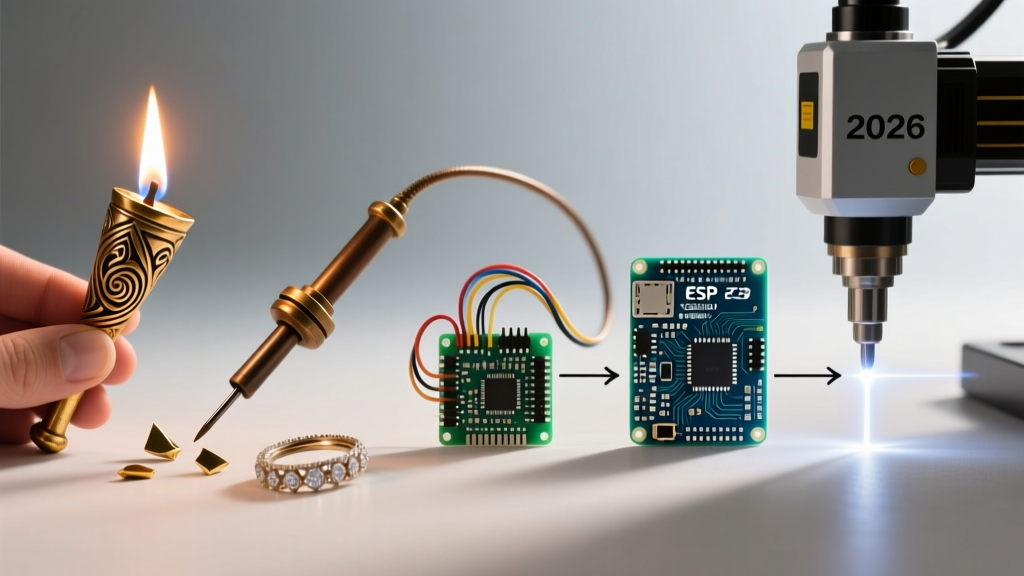

The art of joining precious metals has undergone a radical transformation over the last 5,000 years. What began as a rudimentary process using mouth-blown pipes and crushed minerals has evolved into a highly precise science utilizing pulsed lasers and high-frequency induction fields. For modern bench jewellers, understanding the history of soldering jewellery is not just an academic exercise; it provides critical context for why modern alloys behave the way they do and how to choose the right equipment for a 2026 workshop.
The Ancient Origins: Colloidal Hard Soldering
Long before the invention of gas torches, ancient Egyptian and Etruscan artisans mastered a technique known as colloidal hard soldering or granulation. According to historical analyses by Britannica, early goldsmiths needed a way to attach tiny gold spheres to a base sheet without melting the entire piece.
They achieved this by creating a paste from copper carbonate (malachite), water, and hide glue. When heated over a charcoal fire using a simple mouth blowpipe, the organic glue carbonized, creating a localized reducing atmosphere that prevented oxidation. The copper then diffused into the surface of the gold, creating a eutectic alloy with a melting point of roughly 890°C—significantly lower than pure gold’s 1,064°C. This capillary action allowed for permanent, nearly invisible joints that still baffle modern metallurgists.
Historical Insight: The Etruscans guarded their granulation techniques so closely that the exact chemical process was lost for centuries, only being fully reverse-engineered by modern chemists in the 20th century.
The Renaissance to the Industrial Era: Bellows and Borax
By the Middle Ages and into the Renaissance, the mouth blowpipe was augmented by leather bellows and oil lamps. The introduction of borax (sodium tetraborate) as a flux was a monumental leap. Borax dissolves metal oxides at high temperatures, allowing the molten solder to flow cleanly into the joint via capillary action.
During the Industrial Revolution, the advent of town gas (coal gas) allowed jewellers to move away from oil lamps. Early gas-air torches provided a more consistent, hotter flame, enabling the mass production of complex chains and filigree work that required hundreds of soldered joints per piece.
The 20th Century: Gas Torches and Temperature Grading
The true golden age of bench soldering began in the mid-20th century with the introduction of compressed gas cylinders. The undisputed king of the jeweller’s bench became the Smith Little Torch (Model 11-100 series). Running on oxygen and acetylene (or propane), this torch produces a pinpoint, concentrated flame capable of reaching over 3,100°C. However, the skill lies not in the maximum temperature, but in heat management—using the outer envelope of the flame to bring the entire piece to flow temperature without melting the base metal.
To accommodate complex pieces requiring multiple soldering steps, the industry developed graded silver and gold solders. These alloys are formulated to melt at sequentially lower temperatures, preventing previously soldered joints from remelting during subsequent steps.
Silver Solder Grades & Flow Temperatures
| Solder Grade | Flow Temperature | Primary Use Case | Key Alloying Elements |
|---|---|---|---|
| Hard | 745°C - 780°C | Initial structural joints, ring shanks, heavy bezels | Higher Silver, Copper, Zinc |
| Medium | 680°C - 720°C | Secondary joints, adding settings to pre-soldered bands | Balanced Silver, Copper, Tin/Zinc |
| Easy | 615°C - 650°C | Final repairs, delicate findings, catch mechanisms | Higher Tin/Zinc content to lower melt point |
The Toxicity Awakening: Banning Cadmium
For much of the 20th century, cadmium was a staple ingredient in both gold and silver solders. Cadmium is highly effective at lowering the melting point of an alloy while simultaneously improving its fluidity and color match. However, cadmium boils at just 767°C. When hit with a jeweller’s torch, it instantly vaporizes, releasing highly toxic fumes that cause severe respiratory and kidney damage.
As detailed by the Occupational Safety and Health Administration (OSHA), prolonged exposure to cadmium fumes is a critical health hazard. By the early 2000s, and solidifying into strict global mandates like the EU’s REACH regulations, cadmium was entirely phased out of commercial jewellery solders.
The 2026 Standard: Today’s cadmium-free solders rely on complex metallurgy, utilizing elements like indium, tin, and gallium to depress the melting point safely. While cadmium-free easy solders can sometimes be slightly more brittle or prone to oxidation, modern fluxes (like Prip's Flux or specialized boron-nitride pastes) have largely mitigated these historical drawbacks.
The Modern Era: Laser Welding and Induction Heating
While traditional torch soldering remains a fundamental bench skill, the 21st century introduced two technologies that fundamentally altered the jewellery manufacturing and repair landscape: Pulsed Laser Welding and High-Frequency Induction Heating.
Laser Welders: The Solderless Alternative
Laser welders, such as the industry-standard Sunstone Orion 150s, use pulsed Nd:YAG technology to deliver highly focused bursts of light energy. As highlighted by Sunstone Welders, this allows jewellers to fuse metal directly without any filler solder. A laser can retip a platinum prong millimeters away from a heat-sensitive emerald without damaging the stone, a feat nearly impossible with a gas torch.
Comparison Matrix: Torch vs. Laser vs. Induction (2026 Bench Setups)
| Technology | Best Application | Heat Affected Zone (HAZ) | Estimated 2026 Cost |
|---|---|---|---|
| Oxy-Acetylene Torch | Ring sizing, heavy chain repair, custom fabrication | Large (Requires pickling and cleanup) | $800 - $2,500 |
| Pulsed Laser Welder | Prong retipping, porous metal filling, stone-safe repairs | Microscopic (No cleanup required) | $6,000 - $15,000+ |
| Induction Heater | Production chain soldering, uniform heating of thick bands | Medium (Uniform volumetric heating) | $3,000 - $8,000 |
2026 Buyer’s Guide: Selecting Your Jewellery Soldering Setup
If you are outfitting a bench today, your choice of equipment should be dictated by your specific workflow, safety requirements, and production volume.
- The Hobbyist & Beginner ($200 - $500): Start with a high-quality butane micro-torch (like the Blazer Big Shot) or a basic Propane/Air setup. Pair this with cadmium-free Easy and Medium silver solders and a reliable pickling solution (like warm citric acid). This is sufficient for basic silver ring sizing and jump ring closures.
- The Professional Bench Jeweller ($1,000 - $3,000): The Smith Little Torch with an oxygen concentrator or bottled oxy-acetylene is mandatory. You will need a full suite of graded solders (Hard, Medium, Easy) for both silver and various carats of gold. Invest in a third-hand tool with cross-locking tweezers and a high-quality solder pick (titanium or ceramic-tipped) to prevent the solder from alloying to your tool.
- The High-Volume Repair & Production Shop ($8,000+): A pulsed arc or laser welder (e.g., Orion mPulse or Sunstone) is no longer a luxury; it is a necessity for profitability. The ability to repair a white gold chain without removing the rhodium plating, or fix a tungsten carbide ring, pays for the machine within the first year of use.
Conclusion
The evolution of soldering jewellery is a testament to the intersection of art and metallurgy. From the toxic fumes of cadmium-laced alloys to the sterile, pinpoint accuracy of modern laser welders, the tools of the trade have become safer, more precise, and vastly more capable. Whether you are wielding a mouth-blown pipe or a 150-watt pulsed laser, the core principle remains unchanged: mastering the flow of molten metal through the precise application of heat.