
The Evolution of the Soldering Person in Modern Electronics
In the 2026 landscape of high-mix, low-volume electronics manufacturing and advanced prosumer DIY labs, the role of the soldering person has evolved from a basic assembly worker into a precision thermal engineer. Modern printed circuit boards (PCBs) present severe thermal challenges: 01005 passive components, dense Ball Grid Array (BGA) footprints, and heavy multi-layer ground planes that act as massive heat sinks. To achieve IPC Class 3 reliability, the operator must choose the correct energy delivery method.
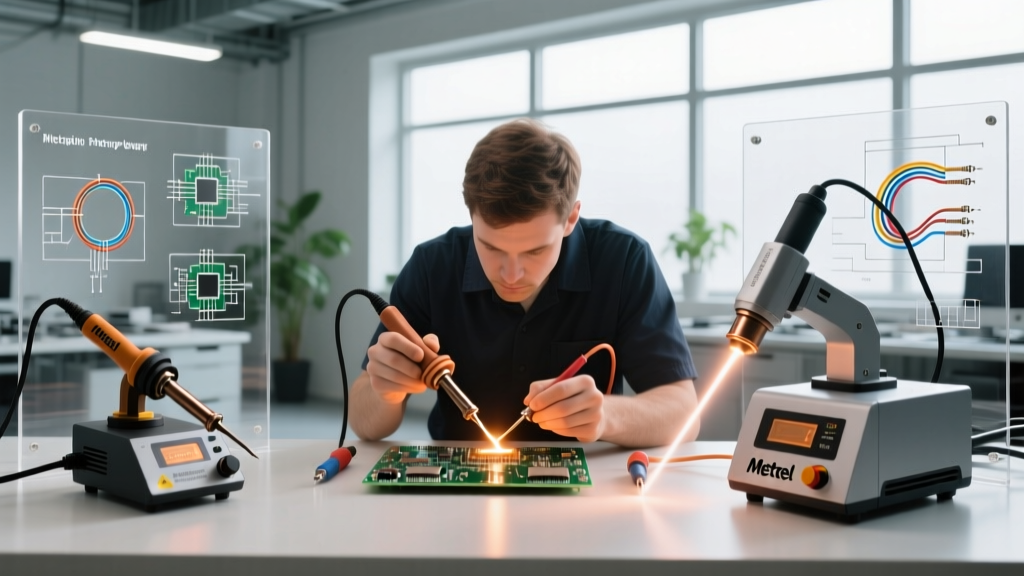
This guide provides a deep-dive method comparison for the modern soldering person, evaluating three dominant technologies: Active Thermal Irons, RF Induction (SmartHeat), and Non-Contact Laser Soldering. We will analyze capital costs, thermal recovery profiles, specific failure modes, and ergonomic impacts to help you decide which method belongs on your workbench.
Method 1: Active Thermal Irons (The Baseline Standard)
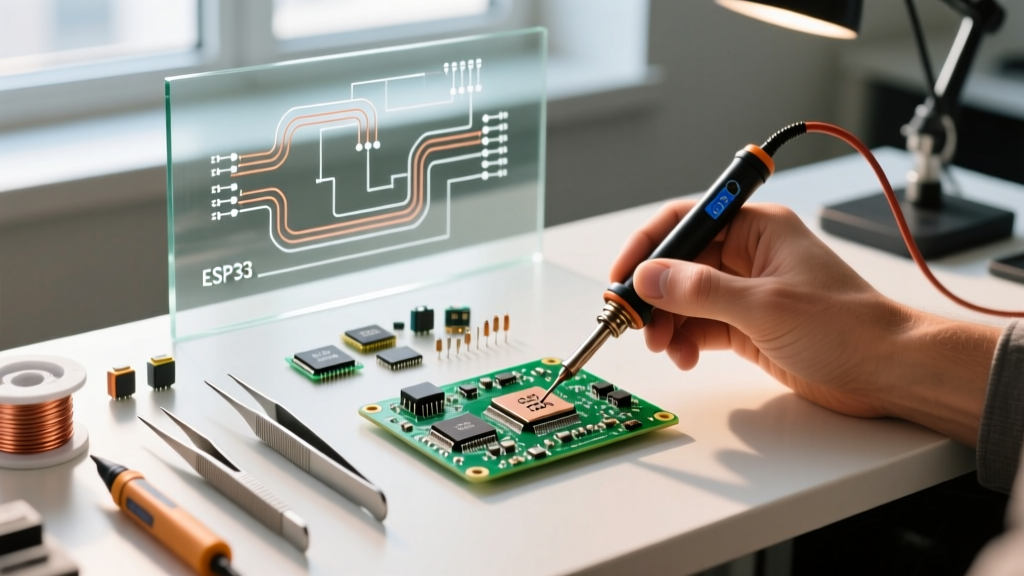
Traditional thermal irons have largely been replaced by active-tip systems where the heating element and temperature sensor are integrated directly into the tip cartridge. The industry benchmarks for the skilled soldering person remain the Hakko FX-951 (approx. $230) and the Weller WX2021 (approx. $720).
Performance and Thermal Recovery
Active thermal irons boast rapid thermal recovery. The Weller WX2021, delivering 200W to the handpiece, can recover from a 50°C temperature drop in roughly 1.5 seconds. This is critical when soldering high-thermal-mass joints, such as large surface-mount power pads or through-hole connectors on 4oz copper planes.
Edge Cases and Failure Modes
- Tip Oxidation: If the soldering person leaves the iron at 400°C without engaging auto-sleep, the iron plating degrades within 48 hours of continuous use, leading to de-wetting.
- Thermal Runaway on Ground Planes: When attempting to solder a 10-layer PCB with internal ground planes, a 70W iron will experience severe thermal drain. The operator may compensate by pressing harder, which mechanically damages the barrel plating and causes inner-layer delamination.
Method 2: RF Induction Soldering (The Curie Point Advantage)
RF induction systems, pioneered by Metcal, utilize a 13.56 MHz magnetic field to heat a ferromagnetic core inside the tip. The Metcal MX-5200 (approx. $1,200) is the gold standard for aerospace and medical device assembly.
The Physics of SmartHeat
Unlike thermal irons that rely on a sensor to turn the heater on and off, induction tips heat themselves until they reach their specific Curie temperature (the point at which the core loses its magnetic properties). At this exact temperature, heating stops instantly. When the solder joint draws heat away, the core becomes magnetic again, and RF energy resumes. This provides infinite, un-calibratable thermal stability.
Failure Modes and Operator Errors
Expert Insight: A common mistake made by an inexperienced soldering person is selecting a tip with a Curie point that is too low (e.g., 310°C) for a high-mass joint. The system will run at a 100% duty cycle, constantly trying to reach a temperature it physically cannot achieve, which degrades the RF generator over time and results in cold, crystalline solder joints.
To avoid this, the operator must match the tip series (e.g., STTC-117 for 350°C) to the thermal mass of the board, not just the melting point of the solder alloy.
Method 3: Laser Soldering (The Non-Contact Revolution)
For heat-sensitive components and flex-PCBs, physical contact with an iron tip introduces mechanical stress and thermal shock. Desktop laser soldering systems, such as the Quick 938 or automated-assist 50W diode laser stations ($3,500 - $6,500), deliver precise photons directly to the joint.
Process Control and Dwell Times
Laser soldering requires the soldering person to think in terms of optical absorption and flux chemistry rather than thermal conductivity. The laser beam (typically 1mm to 3mm in diameter) heats the copper pad and component lead simultaneously. Because there is no physical tip, there is zero risk of cross-contamination or tip wear.
Critical Laser Failure Modes
- Flux Charring: If the laser dwell time exceeds 2.5 seconds, or if the power ramp-up is too aggressive, the rosin or no-clean flux will boil and carbonize, creating a high-resistance insulating layer inside the joint.
- Pad Lift-Off: Misaligning the laser beam so that it strikes the FR4 substrate instead of the copper pad will instantly vaporize the epoxy resin, causing the pad to lift off the board.
- Solder Splatter: Applying the laser directly to the solder wire rather than the pad causes localized superheating, resulting in micro-solder balls bridging adjacent 0.4mm pitch IC pins.
Method Comparison Matrix for the Soldering Person
| Feature | Active Thermal (Weller WX2021) | RF Induction (Metcal MX-5200) | Desktop Laser (50W Diode) |
|---|---|---|---|
| Capital Cost | $700 - $850 | $1,100 - $1,300 | $3,500 - $6,500 |
| Thermal Recovery | 1.5 - 3.0 seconds | Instantaneous (Curie effect) | N/A (Non-contact) |
| Mechanical Stress | Moderate (Operator dependent) | Moderate (Operator dependent) | Zero (Non-contact) |
| Tip/Consumable Cost | $12 - $15 per cartridge | $35 - $45 per cartridge | None (Optics cleaning only) |
| Best Application | General DIY, mixed through-hole/SMD | Aerospace, heavy ground planes, Class 3 | Flex-PCBs, RF modules, heat-sensitive ICs |
Ergonomics and the Human Element
The physical toll on the soldering person is a critical factor in method selection. Repetitive Strain Injury (RSI) and cervical spine degradation are prevalent in manual assembly environments. According to the OSHA Ergonomics Guidelines, minimizing repetitive gripping and awkward wrist postures is essential for long-term operator health.
- Thermal & Induction Irons: Require continuous grip pressure and precise wrist articulation. Heavy handpieces (like the Metcal MX-H100 at 115g) can accelerate carpal tunnel fatigue over an 8-hour shift.
- Laser Systems: Often utilize foot-pedal activation and camera-guided joystick alignment. This completely removes the need for fine-motor hand stabilization, drastically reducing RSI risks for the operator.
Furthermore, fume extraction is non-negotiable. Laser soldering vaporizes flux at a much higher localized temperature, creating finer particulate matter that requires HEPA and activated carbon filtration systems positioned within 2 inches of the joint.
Adhering to IPC and NASA Workmanship Standards
Regardless of the method chosen, the output of the soldering person must meet stringent industry standards. For commercial high-reliability products, operators must follow the IPC-A-610 Class 3 guidelines, which mandate specific wetting angles, fillet shapes, and the absence of voiding in the solder joint.
For spaceflight and extreme-environment electronics, the NASA Electronic Parts and Packaging (NEPP) Program dictates even stricter criteria under NASA-STD-8739.3. This standard explicitly addresses the thermal profiles required to prevent intermetallic compound (IMC) overgrowth, which makes joints brittle. Induction and laser systems excel here, as their precise thermal control prevents the prolonged liquidus-state exposure that causes excessive IMC formation.
Final Verdict: Equipping the Modern Soldering Person
There is no single 'best' method; the optimal choice depends entirely on the PCB architecture and production volume.
- Choose Active Thermal if you are a hobbyist, DIY repair technician, or working in a high-mix prototyping lab where flexibility and low consumable costs are paramount.
- Choose RF Induction if you are a professional soldering person tasked with IPC Class 3 aerospace, automotive, or medical assemblies featuring heavy copper layers and strict thermal stability requirements.
- Choose Laser Soldering if your workflow involves flexible circuits, micro-optics, or components that are highly susceptible to mechanical stress and electrostatic discharge (ESD) from physical iron contact.
By understanding the physics, failure modes, and ergonomic impacts of each technology, the modern soldering person can transition from a simple assembler to a master of thermal dynamics, ensuring flawless, high-yield electronic assemblies every time.