
The Etymology and Ancient Roots of Solderan and Soldering
While modern hobbyists and engineers search for advanced soldering techniques, historical metallurgists and early linguistic texts occasionally referenced early alloy blends with terms akin to solderan—an archaic, regional root denoting the act of fusing metals. Derived from the Latin solidare (to make solid), the evolution of soldering is a journey from crude ancient metallurgy to the precision nanotechnology of 2026.
The transition from ancient plumbing to modern microelectronics hinges entirely on the manipulation of alloy phase diagrams and flux chemistry.
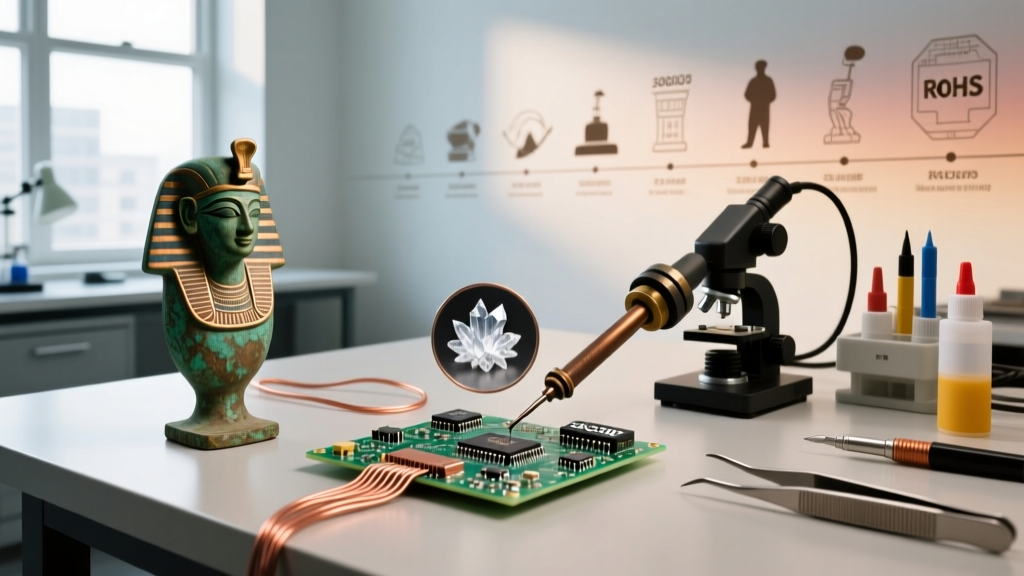
Long before the advent of printed circuit boards (PCBs), the ancient Egyptians utilized gold-copper and rudimentary tin-lead mixtures to craft jewelry and seal vessels. By the Roman Empire, metallurgists were employing lead-tin alloys to seal aqueducts and cast bronze statues. These early solderan practices relied on high-lead content mixtures that melted above 250°C, requiring massive charcoal furnaces rather than the precision temperature-controlled irons we use today.
The Eutectic Era: 60/40 and 63/37 Alloys
The true revolution in electronic assembly occurred in the mid-20th century with the standardization of tin-lead (Sn-Pb) alloys. As through-hole components became the backbone of consumer electronics, the industry demanded an alloy that could form reliable electrical and mechanical bonds without damaging heat-sensitive bakelite boards.
Why Sn63/Pb37 Became the Gold Standard
Enter the eutectic alloy: Sn63/Pb37 (63% Tin, 37% Lead). Unlike the slightly cheaper Sn60/Pb40, the 63/37 ratio is perfectly eutectic. This means it possesses a single melting point of exactly 183°C (361°F) and transitions instantly from solid to liquid without passing through a 'plastic' or pasty state.
- Sn60/Pb40: Melts between 188°C and 190°C. The 2-degree plastic range makes it susceptible to 'disturbed joints' if the component moves while cooling, resulting in a grainy, weak connection.
- Sn63/Pb37: Melts and freezes instantly at 183°C. Eliminates disturbed joints, making it the undisputed king of hand soldering and wave soldering for decades.
According to IPC standards for electronic assemblies, the visual inspection criteria for these leaded joints rely on a smooth, concave fillet with high gloss—a hallmark of rosin-activated (RA) fluxes that dominated the era under IPC J-STD-004 classifications.
The RoHS Directive and the Lead-Free Revolution
The early 2000s brought a massive paradigm shift. Driven by environmental concerns over lead toxicity in landfills, the European Union enacted the RoHS (Restriction of Hazardous Substances) Directive. This forced the global electronics industry to abandon the reliable Sn63/Pb37 eutectic alloy. For professionals navigating OSHA's regulations on lead exposure, the shift was a welcome safety improvement, but it introduced severe metallurgical challenges.
The Shift to SAC305 and Thermal Penalties
The industry largely settled on SAC305 (96.5% Sn, 3.0% Ag, 0.5% Cu). While environmentally friendly, SAC305 introduced a higher melting point of 217°C to 220°C. This 35°C increase fundamentally changed soldering iron requirements:
- Tip Oxidation: Iron-clad copper tips oxidize exponentially faster above 350°C. A tip that lasted 500 joints in the Sn63 era might degrade in 150 joints using SAC305.
- Thermal Mass Demands: High-density 2026 IoT boards with heavy ground planes require irons with rapid thermal recovery, such as active-tip systems (e.g., Weller RT series or JBC cartridge tips), rather than traditional ceramic-heater irons.
- Wetting Issues: Lead-free alloys do not wet copper pads as aggressively. No-clean, water-soluble, or highly activated rosin fluxes became mandatory to prevent cold joints and tombstoning in SMD components.
Alloy Evolution Matrix
| Era / Application | Alloy Composition | Melting Point | Key Characteristics |
|---|---|---|---|
| Antiquity (Plumbing/Crafts) | Pb-Sn (High Lead) | ~250°C+ | Crude, high thermal mass required |
| Industrial (Early Radio) | Sn60/Pb40 | 188-190°C | Pasty range, prone to disturbed joints |
| Eutectic Peak (Through-Hole) | Sn63/Pb37 | 183°C | Instant phase change, high gloss, reliable |
| RoHS Era (Modern SMD) | SAC305 | 217-220°C | Lead-free, requires higher iron temps, silver cost |
| Niche Modern (Heat-Sensitive) | Sn42/Bi58 | 138°C | Bismuth-based, extremely low temp, brittle |
Modern Restoration vs. Prototyping: Buyer’s Alloy Guide
Understanding the history of solderan and soldering alloys is not just academic; it dictates how you should stock your workbench today. Mixing historical and modern alloys can lead to catastrophic joint failures due to galvanic corrosion and phase incompatibility.
Restoring Vintage Electronics (Pre-2000s)
If you are repairing a 1970s Fender amplifier or a vintage Commodore 64, do not use lead-free SAC305. Mixing SAC305 with original Sn60/Pb40 joints creates a bismuth-lead or silver-lead cross-contamination that lowers the melting point and creates brittle intermetallic compounds. Always use Sn63/Pb37 with a mildly activated rosin flux (RMA) to match the original factory metallurgy and ensure long-term mechanical stability.
Modern SMD and High-Density PCBs
For designing modern 2026 microcontrollers or repairing smartphones, SAC305 or the cheaper Sn99.3/Cu0.7 (which melts at 227°C and is better for automated wave soldering) is required. For heat-sensitive components like RF antennas or flexible PCBs, buyers should invest in Sn42/Bi58 (Bismuth-Tin). Melting at just 138°C, it prevents thermal delamination, though it must be handled carefully as bismuth alloys are mechanically brittle and prone to cracking under physical drop-test stress.
Troubleshooting Common Alloy-Specific Defects
Tin Whiskers in Lead-Free Assemblies
The removal of lead inadvertently triggered a massive reliability issue: tin whiskers. These microscopic, crystalline structures of tin grow spontaneously from pure tin finishes and can cause short circuits in high-impedance circuits. Research from NIST's Metallurgy Division and NASA has documented satellite failures caused by these conductive hairs. To mitigate this in mission-critical DIY or aerospace-adjacent projects, apply a conformal coating or intentionally use a Sn-Pb alloy if your project qualifies for RoHS exemptions.
Cold Joints and Tip Degradation
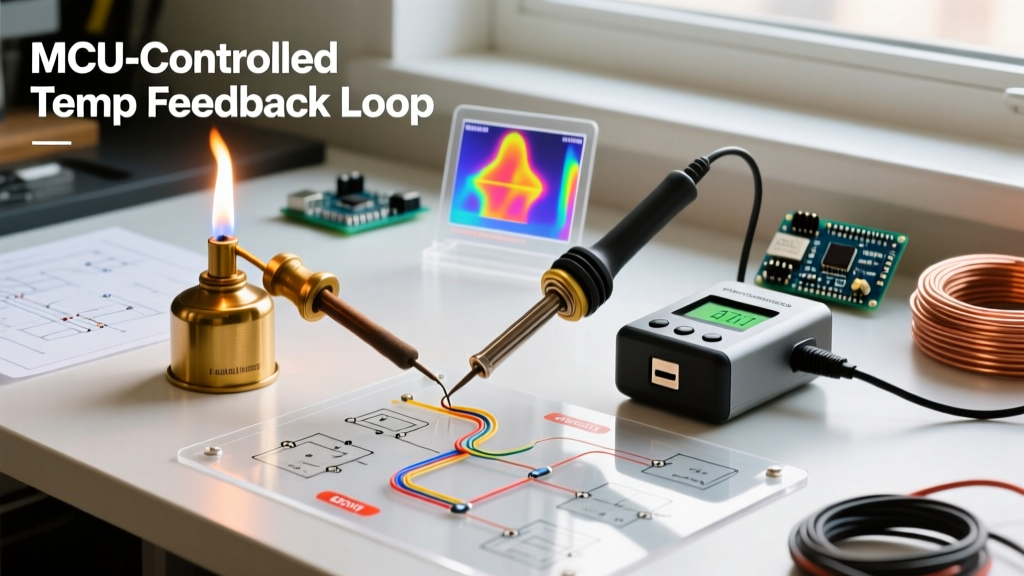
When transitioning from historical leaded solder to modern SAC305, many DIYers encounter dull, grainy cold joints. This is rarely a bad batch of solder; it is almost always a thermal deficit. If your iron is set to 350°C, the pad and via will absorb heat faster than the iron can replenish it, dropping the localized temperature below the 217°C liquidus point. Upgrade to an active-tip soldering station where the heater is embedded directly in the copper tip, ensuring instantaneous thermal transfer and preventing the dreaded grainy fillet.