
The Metallurgy of Soldering Work: Why Material Dictates Method
Executing high-reliability soldering work requires far more than a hot iron and a steady hand. The fundamental challenge in any soldering operation is overcoming the base metal's oxide layer to achieve true metallurgical wetting. According to industry failure analysis data, nearly 68% of cold joint failures and pad lift-offs stem from an alloy-flux mismatch rather than operator error. Whether you are assembling aerospace avionics or repairing vintage audio equipment, treating all metals as if they were standard FR-4 copper is a recipe for catastrophic joint failure.
This guide provides a definitive material compatibility matrix for precision soldering work, detailing the exact alloys, flux chemistries, and thermal profiles required for challenging substrates ranging from oxygen-free copper to stainless steel and aluminum.
Base Material Compatibility Matrix
The following matrix serves as a quick-reference framework for selecting the correct consumables and thermal settings. Always verify these baselines against your specific application's thermal mass.
| Base Material | Recommended Alloy | Flux Chemistry | Optimal Tip Temp (°C) | Wetting Difficulty |
|---|---|---|---|---|
| Oxygen-Free Copper | SAC305 or Sn63Pb37 | RMA or No-Clean | 315°C - 340°C | Easy |
| Brass / Bronze | Sn60Pb40 | RMA (Mildly Activated) | 320°C - 350°C | Moderate (Zinc outgassing risk) |
| Stainless Steel (304/316) | Sn63Pb37 or Indalloy 158 | Water-Soluble (High Acid) | 370°C - 390°C | Hard |
| Aluminum (Alloys 1100-3003) | Indalloy 158 (Zn/Al) or Sn95Ag5 | Specialized Alumin-Solder Flux | 390°C - 420°C | Extreme |
| ENIG / Immersion Silver (PCB) | SAC305 or SAC405 | No-Clean (Synthetic) | 330°C - 350°C | Easy (Gold dissolution risk) |
| Nickel / Kovar | Sn62Pb36Ag2 | RMA or Organic Acid | 340°C - 360°C | Moderate to Hard |
Flux Chemistry: The Unsung Hero of Soldering Work
Flux is not merely a cleaning agent; it is a chemical oxygen barrier that prevents re-oxidation while the solder transitions from liquidus to solidus. Selecting the wrong flux for your base material will result in non-wetting, regardless of how much heat you apply.
Rosin Mildly Activated (RMA) vs. Water-Soluble (WS)
For standard copper and PCB soldering work, RMA flux remains the gold standard. It becomes active at approximately 150°C, dissolving mild cuprous oxides without corroding the substrate. However, when tackling stainless steel or heavily oxidized brass, RMA is chemically insufficient. You must upgrade to a Water-Soluble (WS) flux, which contains aggressive organic acids (like glutamic or lactic acid) capable of etching through chromium oxide layers.
Critical Warning: Water-soluble fluxes are highly corrosive at room temperature. If you use WS flux for stainless steel soldering work, the assembly must be cleaned with heated deionized (DI) water (minimum 1 Megohm-cm resistivity) within 2 hours of cooling to prevent galvanic corrosion and dendritic growth.
No-Clean and Synthetic Resins
For high-density SMD and BGA soldering work, no-clean fluxes utilizing synthetic resins are mandatory. They leave a benign, high-resistivity residue that traps ionic contaminants. However, no-clean fluxes lack the chemical muscle to penetrate heavy oxidation on bare wire or mechanical chassis grounds. Never rely on no-clean flux for structural or non-PCB soldering work.
Thermal Profiling: Station Settings and Tip Selection
A common misconception in soldering work is that higher iron temperatures equal faster joints. In reality, excessive heat degrades flux before it can activate, leaving behind charred, non-wetting oxides. The goal is high thermal transfer rate, not extreme temperature.
Matching Tips to Thermal Mass
When soldering a 12 AWG copper wire to a heavy brass lug, a standard 1.6mm conical tip will experience immediate thermal collapse. You need a tip with high thermal mass and maximum surface contact.
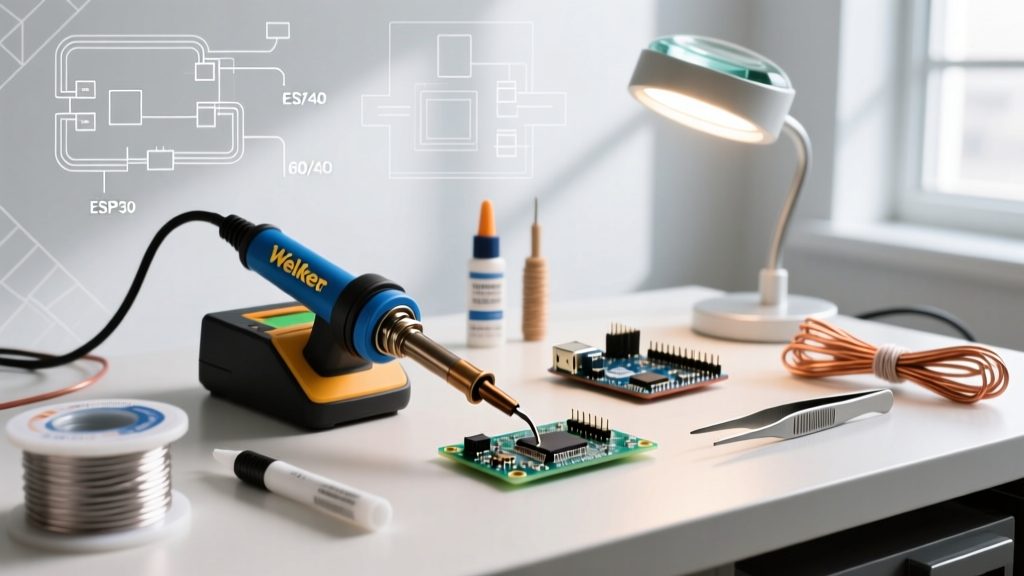
- For heavy ground planes and large lugs: Use a broad chisel or bevel tip (e.g., Hakko T12-D52 or Weller RTW114). These tips store more thermal energy and transfer it efficiently into high-mass joints.
- For 0.5mm pitch QFNs and 0402 passives: Use a micro-pencil or fine bevel tip (e.g., Hakko T12-IL or Weller RT3). The reduced surface area prevents accidental bridging and limits thermal bleed into adjacent pads.
Station Recovery Rates
Your soldering station's wattage dictates its thermal recovery, not its maximum temperature. A 70W station like the Hakko FX-951 (retailing around $235 in 2026) utilizes composite core technology where the heater is embedded directly inside the tip, offering near-instantaneous thermal recovery. Conversely, a standard 65W ceramic heater station like the Weller WE1010NA (approx. $120) relies on thermal conduction through an air gap, making it slower to recover when hitting heavy copper pours. For demanding soldering work involving mixed thermal masses, the FX-951's rapid recovery prevents operators from dwelling on the joint and delaminating PCB pads.
Edge Cases: Soldering Stainless Steel and Aluminum
The most difficult soldering work involves metals that form immediate, hard, and high-melting-point oxide layers the moment they are exposed to air.
The Aluminum Oxide Problem
Aluminum base metal melts at roughly 660°C, but its surface oxide layer (Al2O3) does not melt until 2,072°C. Standard electronic solders simply ball up and roll off. To successfully perform soldering work on aluminum, you must use a specialized zinc-based alloy like Indium Corporation's Indalloy 158 (83% Zinc, 17% Aluminum) alongside a highly corrosive fluoroaluminate flux.
The Technique: You must mechanically abrade the surface underneath a pool of molten flux and solder. The flux prevents new oxygen from reaching the metal, while the mechanical scratching (using a fiberglass pen or stainless steel brush through the liquid solder pool) breaks the existing oxide layer, allowing the zinc alloy to alloy with the bare aluminum.
Stainless Steel and Chromium Oxide
Stainless steel owes its corrosion resistance to a passive chromium oxide layer. Standard rosin fluxes cannot penetrate this layer. For soldering work on 304 or 316 stainless, you must use a high-acid zinc chloride flux (often sold as plumbing or stainless flux). Apply the flux, heat the joint to 380°C using a high-mass chisel tip, and apply a standard Sn63Pb37 or lead-free equivalent. The zinc chloride chemically reduces the chromium oxide, allowing the tin to wet the steel. Post-solder cleaning with isopropyl alcohol and a stiff brush is non-negotiable to halt acid corrosion.
IPC Compliance and Quality Assurance
For commercial and aerospace electronics, soldering work must adhere to the IPC J-STD-001 Standard. This standard categorizes assemblies into three classes, with Class 3 representing high-reliability products (medical, military, aerospace).
Under IPC Class 3, a solder joint is not merely evaluated on electrical continuity, but on metallurgical evidence of wetting. A compliant through-hole joint must exhibit a 360-degree concave fillet with visible wetting on both the component lead and the barrel wall. If your material compatibility matrix is flawed, the solder will exhibit a convex, balled appearance (non-wetting) or a grainy, disturbed texture (cold joint), resulting in an immediate IPC failure. Understanding the exact liquidus and solidus temperatures of your chosen alloy is critical; moving the component during the plastic (pasty) phase between liquidus and solidus will cause a disturbed joint, which is a reject condition in all IPC classes.
Frequently Asked Questions (FAQ)
Can I use lead-free SAC305 for all my general soldering work?
While SAC305 is the RoHS-compliant industry standard for PCB assembly, it is not ideal for all soldering work. SAC305 has a higher melting point (217°C - 220°C) and requires higher tip temperatures (340°C+), which increases the risk of thermal damage to heat-sensitive components and accelerates tip oxidation. For hand-soldering thick wires, vintage gear, or non-PCB mechanical joints, eutectic Sn63Pb37 (melting at a precise 183°C) remains vastly superior due to its lack of a plastic phase and excellent wetting characteristics.
Why does my soldering iron tip turn black and refuse to tin?
Tip blackening is caused by iron oxidation, accelerated by leaving the station at high temperatures (above 380°C) while idle, or using lead-free alloys which require higher operating temperatures. To restore a heavily oxidized tip, never use sandpaper or a file, as this will remove the protective iron plating. Instead, use a specialized tip tinner (a mixture of powdered solder and aggressive flux) or gently roll the hot tip over a damp, high-cellulose sponge or brass wire wool, immediately followed by flooding it with fresh 63/37 rosin-core solder to re-establish a protective metallic barrier.
How do I prevent gold embrittlement when soldering to ENIG pads?
When performing rework soldering work on ENIG (Electroless Nickel Immersion Gold) PCBs, the gold layer dissolves into the tin matrix. If the gold concentration in the solder joint exceeds 3% to 5% by weight, it forms brittle gold-tin intermetallic compounds (AuSn4), leading to catastrophic joint fractures under mechanical stress. To prevent this, use a solder alloy specifically doped with nickel (like SAC305 with trace Ni) or ensure you are using a high-volume solder application that dilutes the gold concentration below the embrittlement threshold.