
The Shift to Flameless: Why Electric Copper Pipe Soldering Tools Are Dominating in 2026
For decades, the acetylene or MAPP gas torch was the undisputed king of plumbing. However, as building codes tighten and insurance liabilities for structural fires skyrocket, the industry is rapidly pivoting. In 2026, electric copper pipe soldering tools—ranging from high-wattage contact irons to advanced electromagnetic induction heaters—are no longer just niche alternatives; they are essential gear for modern tradespeople. Flameless soldering eliminates the need for hot work permits in many jurisdictions, drastically reduces the risk of igniting wall cavities, and provides precise thermal control that prevents annealing the copper or burning the flux.
To separate the marketing hype from job-site reality, we convened a panel of three veteran tradespeople to test and review the top electric soldering solutions on the market. Our panel includes Marcus Thorne (Master Plumber, 22 years commercial experience), Elena Rostova (HVAC-R Specialist focusing on refrigerant lines), and David Chen (Fire Safety Inspector and former pipefitter).
2026 Electric Soldering Tool Comparison Matrix
| Tool / Model | Technology Type | Max Wattage / Power | Ideal Pipe Sizes | Avg. Price (2026) |
|---|---|---|---|---|
| Superior Tool 51800 'Super Iron' | Direct Contact (Resistive) | 800W (120V AC) | 1/8" to 1" | $145 - $160 |
| Master Appliance ProHeat 1100 | Convection (Hot Air) | 1100W (120V AC) | 1/4" to 1-1/4" | $240 - $275 |
| Ajax Induction Pro-Heat 2000 | Electromagnetic Induction | 2000W (120V/240V) | 1/2" to 2"+ | $850 - $950 |
Deep Dive: The Top 3 Electric Copper Pipe Soldering Tools
1. Superior Tool 51800 'Super Iron' (800W)
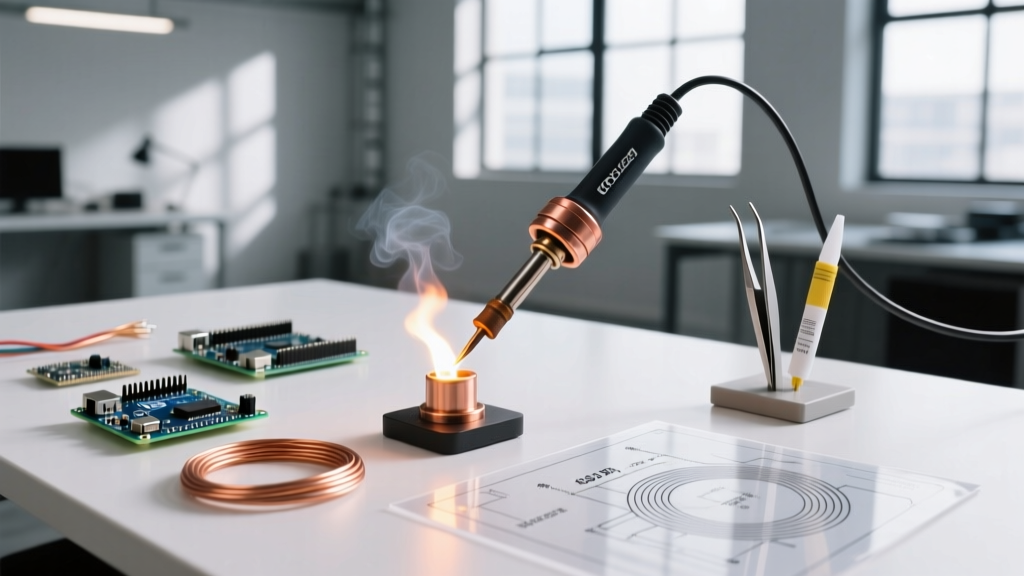
The Superior Tool 51800, universally known as the 'Super Iron,' remains the benchmark for direct-contact electric pipe soldering. Unlike standard electronics irons that max out at 60W, this beast pulls 800 watts, allowing its massive copper tips to store and transfer enough thermal energy to overcome the heat-sink effect of a 3/4-inch copper pipe filled with residual water.
- Heating Time: Reaches 450°F in roughly 90 seconds from a cold start.
- Joint Soldering Time: A properly prepped 1/2-inch joint flows 95/5 solder in about 45 to 60 seconds.
- Edge Case Warning: The included tips are designed for standard Type M and L copper. If you are working on heavy-wall Type K or oversized fittings, the thermal mass may require a secondary pass.
'The Super Iron is my daily driver for indoor remodels where the client is paranoid about fire. The key is using a high-quality tinning flux like Oatey H2O 5. Because the iron doesn't have the aggressive, localized heat spike of a turbo-torch, your flux prep must be flawless to ensure proper capillary action.' — Marcus Thorne, Master Plumber
2. Master Appliance ProHeat 1100 (Flameless Heat Gun)
When physical contact with an iron isn't possible due to tight joist bays or complex manifold clusters, the Master Appliance ProHeat 1100 steps in. This is not a standard hardware store heat gun; it is a highly focused, 1100-watt industrial convection tool engineered specifically for soldering and heat-shrinking. It utilizes a specialized concentrator nozzle to direct a column of 600°F air precisely onto the fitting.
- Pros: Excellent for tight spaces; no physical pressure applied to the pipe (prevents shifting joints before solder solidifies); includes built-in heat shields.
- Cons: Slower than direct contact; requires careful management of ambient heat to avoid scorching nearby drywall or wood framing.
'In HVAC, we often run 1-1/8 inch refrigerant lines through tight chases. The ProHeat 1100 allows me to wrap a fire-retardant mat around the wood studs and blast the copper fitting with hot air. It takes about two minutes for a 1-inch joint, but the even heat distribution prevents the flux from charring.' — Elena Rostova, HVAC-R Specialist
3. Ajax Induction Pro-Heat 2000
Induction heating represents the cutting edge of electric copper pipe soldering tools in 2026. The Ajax Pro-Heat 2000 uses high-frequency alternating current to generate a magnetic field, which induces eddy currents directly within the copper pipe itself. The fitting becomes the heating element. This means zero open flame, zero hot air blowing into wall cavities, and virtually zero risk of igniting surrounding materials.
- Efficiency: Heats a 3/4-inch copper fitting to soldering temperature (approx. 460°F) in under 15 seconds.
- Safety Profile: The induction coil remains relatively cool to the touch. You could technically touch the coil immediately after heating a pipe (though PPE is always recommended).
- The Catch: The entry price is steep (nearly $900), and the coils are somewhat rigid, requiring adequate clearance around the pipe.
'As a fire inspector, I see the aftermath of torch accidents weekly. When I went back to the tools, I bought the Ajax Induction. It pays for itself in time saved on hot work permits and fire-watch protocols. It is, without exaggeration, the safest way to sweat copper inside a finished building.' — David Chen, Fire Safety Inspector
Critical Safety & Compliance: Lead-Free Soldering in 2026
Regardless of the heat source you choose, compliance with potable water regulations is non-negotiable. Under the EPA's Safe Drinking Water Act (SDWA) Lead-Free provisions, the weighted average lead content for wetted surfaces of pipes and fittings must not exceed 0.25%. This means traditional 50/50 tin-lead solder is strictly illegal for any potable water application.
For 2026, experts recommend using either 95/5 Tin-Antimony (e.g., Oatey Safe-Flo) or 97/3 Tin-Copper (e.g., Harris Bridgit). These lead-free alloys have higher melting points (typically 440°F to 480°F) and a narrower plastic range than leaded solder. This is precisely why 800W+ electric tools are required; lower wattage tools simply cannot maintain the thermal mass needed to keep lead-free alloys fluid long enough for capillary draw.
Furthermore, when working in confined spaces, remember that while electric tools eliminate ignition risks, they still generate severe burn hazards. Always adhere to OSHA's fire safety and hot work guidelines, ensuring you have a fire extinguisher rated for electrical and Class A fires nearby, even when using flameless equipment.
Step-by-Step: Soldering a 3/4" Joint with an 800W Electric Iron
- Cut and Ream: Cut the Type L copper pipe square. Use an internal reamer to remove burrs. A burr creates turbulence and restricts the 0.002" to 0.005" optimal clearance required for capillary action.
- Clean to Bright Finish: Use 120-grit sandcloth on the pipe end and a wire brush inside the fitting. Clean until the copper shines uniformly.
- Apply Water-Soluble Flux: Apply a thin, even layer of lead-free, water-soluble flux (like Oatey H2O 5) to the pipe end. Avoid globbing; excess flux will boil and create voids in the joint.
- Assemble and Heat: Push the fitting fully onto the pipe. Press the pre-heated 800W electric iron tip firmly against the fitting, not the pipe. Heat the fitting for 45-60 seconds.
- Test and Apply Solder: Touch your 95/5 lead-free solder wire to the opposite side of the joint (away from the iron). If the flux is active and the copper is at ~450°F, the solder will instantly melt and be drawn into the joint. Feed until a continuous silver ring appears at the seam.
- Cool and Wipe: Remove the heat. Do not quench with water, as thermal shock can crack the lead-free alloy. Let it cool naturally for 60 seconds, then wipe with a damp rag to remove flux residue.
Expert Roundup FAQ
Can I use a standard 60W electronics soldering iron for copper pipes?
No. A 60W iron (like a Hakko FX-888D) lacks the thermal mass and wattage to overcome the heat dissipation of copper plumbing. Copper is an exceptional thermal conductor; a 60W iron will drop below the melting point of lead-free solder the moment it touches a 1/2-inch pipe, resulting in a cold, leaky joint.
Do I need to drain the water lines completely when using electric tools?
Yes. While electric tools don't have the explosive risk of a gas torch igniting trapped steam, even a small amount of residual water inside the pipe will act as a massive heat sink. Water boils at 212°F, and your solder needs 450°F+. The water will absorb the heat from your electric iron, making it impossible to reach soldering temperature. Always use pipe plugs or a water-absorbing bread/polymer gel to create a dry work zone.
Are battery-powered (cordless) electric pipe soldering irons viable in 2026?
Currently, true cordless soldering irons for 3/4"+ plumbing are limited by battery discharge rates. While brands like Milwaukee and DeWalt offer excellent cordless press-tools (ProPress) and cordless heat guns, a dedicated cordless contact-soldering iron that maintains 800W continuous output for plumbing is still largely tethered to AC power or heavy external battery packs. For now, corded 120V electric irons or induction heaters remain the professional standard for soldering.
How do I prevent lead exposure when working on older homes?
When repairing legacy systems built before 1986, you may encounter existing lead-based solder. Sanding or dry-scraping old joints can aerosolize lead dust. Always use wet-sanding techniques, wear a properly fitted N95 or P100 respirator, and follow the NIOSH guidelines for lead exposure prevention to protect your long-term neurological and renal health.