
Why Learn to Connect Wires Without Soldering?
While soldering remains the undisputed king for printed circuit boards (PCBs) and delicate electronics, it is often the wrong choice for chassis wiring, automotive harnesses, and in-wall residential electrical work. In high-vibration environments, solder can lead to work hardening and eventual fatigue fractures. Furthermore, the thermal expansion mismatch between the rigid solder joint and flexible copper wire creates a stress riser right at the edge of the joint.
If you need to connect wires without soldering, modern mechanical and cold-weld alternatives provide superior reliability, faster installation, and strict compliance with electrical codes. This comprehensive guide breaks down the five most reliable solderless connection methods, complete with 2026 tooling costs, specific model numbers, and failure-mode analysis.
Method 1: Precision Crimping (The Aerospace & Automotive Standard)
Crimping creates a cold weld—a gas-tight mechanical bond where the terminal and wire deform together, eliminating oxygen and preventing corrosion. When executed to IPC/WHMA-A-620 standards, a proper crimp is actually stronger than the wire itself.
Required Tooling: Ratchet Crimpers
Never use cheap, non-ratchet pliers for critical connections. Non-ratchet tools allow you to release the grip prematurely, resulting in a high-resistance "cold crimp." In 2026, a professional-grade ratchet crimper like the IWISS IWS-10 (approx. $45) or the Knipex PreciForce (approx. $380) ensures the tool only releases once the exact compression force is achieved.
Expert Insight: For MIL-DTL-22520 aerospace applications, indent crimpers are mandatory. For standard automotive or marine use, a standard ratcheting jaw crimper with heat-shrink adhesive terminals (like the Glarks 300-piece kit, ~$32) provides a waterproof seal that solder simply cannot match in wet environments.
Method 2: WAGO Lever Nuts (The In-Wall & Junction Box Champion)
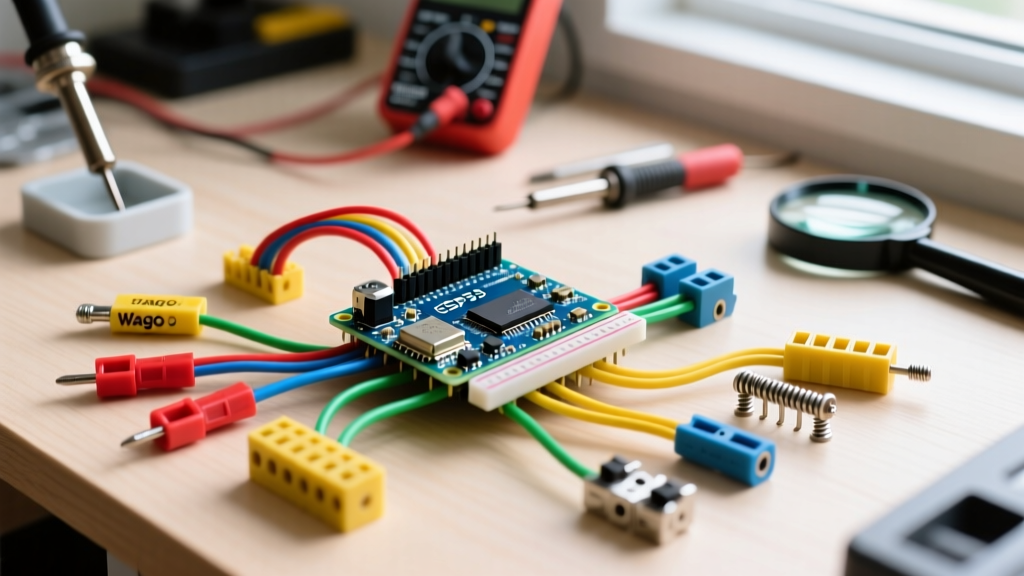
For residential wiring and DIY junction boxes, the WAGO 221 Series Lever Nuts have entirely replaced traditional twist-on wire nuts (Marrettes) in professional settings. They utilize a cage-clamp mechanism that maintains constant, temperature-independent pressure on the wire.
Step-by-Step WAGO 221 Installation
- Strip the Wire: Use a precision wire stripper to remove exactly 11mm (7/16 inch) of insulation. The WAGO 221 housing features a built-in strip gauge on the side.
- Lift the Lever: Flip the orange lever up to 60 degrees until it clicks and locks in the open position.
- Insert and Close: Push the stripped wire fully into the transparent housing until it hits the backstop. Snap the lever down.
- Test: Use the built-in test port on the side of the connector to verify continuity with a multimeter.
Cost Analysis: As of 2026, genuine WAGO 221-412 (2-port) connectors cost roughly $0.38 each in bulk. Beware of counterfeit versions on third-party marketplaces that lack the UL 486C rating and use inferior spring steel.
Method 3: Insulation Displacement Connectors (IDCs)
IDCs, commonly known by the 3M Scotchlok brand name, pierce through the wire insulation to make contact with the copper conductor. The 3M Scotchlok 560 is a staple for telecommunications and low-voltage sprinkler wiring.
- Best For: Solid-core copper wire (22 to 26 AWG).
- Failure Mode: Using IDCs on stranded wire. The piercing blade will sever individual strands, drastically reducing ampacity and creating a high-resistance hotspot.
Method 4: DIN Rail Terminal Blocks (For Control Panels)
When building control panels or prototyping high-current systems, soldering is entirely impractical. Screw-clamp or spring-cage DIN rail terminal blocks (such as those from Phoenix Contact or Weidmüller) allow for modular, vibration-resistant connections.
A standard 10mm spring-cage terminal block rated for 8 AWG wire will cost around $4.50 per block. They require specific ferrule crimps on stranded wire to prevent strand splaying when the cage clamps down.
Method 5: Solderless Heat-Shrink Sealers
Products like Solder Seal (or generic equivalents) contain a low-temperature melting alloy ring inside a flux-lined heat shrink tube. While they technically use a "solder ring," the installation requires only a heat gun, not a soldering iron, making them a popular field-expedient alternative for automotive repairs.
Warning: These are highly dependent on user technique. Overheating will melt the insulation; underheating will result in a cold, high-resistance joint. They are not recommended for NEC-compliant in-wall residential wiring.
Comparative Analysis: Which Method Should You Choose?
| Connection Method | Vibration Resistance | Avg Cost (2026) | Best Application | NEC In-Wall Approved? |
|---|---|---|---|---|
| Precision Crimp (Adhesive) | Excellent | $0.15 - $0.40 /ea | Automotive, Marine, Aviation | No (Chassis only) |
| WAGO 221 Lever Nut | Very Good | $0.35 - $0.50 /ea | Residential, Junction Boxes | Yes (UL 486C) |
| IDC (Scotchlok) | Poor | $0.20 /ea | Telecom, Sprinklers (Solid) | No (Low voltage only) |
| DIN Terminal Block | Excellent | $3.00 - $6.00 /ea | Industrial Control Panels | N/A (Panel mount) |
| Heat-Shrink Solder Ring | Moderate | $0.25 /ea | Quick Automotive Field Fixes | No |
Critical Failure Modes & NEC Compliance
When deciding to connect wires without soldering, you must adhere to the National Electrical Code (NEC). Specifically, NEC Article 110.14 mandates that electrical connections must be made using listed connectors approved for the specific wire types and sizes being joined.
The "Tinned Wire" Trap
Never clamp a soldered (tinned) wire into a WAGO lever nut or a screw-terminal block. Solder undergoes cold flow (creep) under continuous mechanical pressure. Over time, the solder deforms, the joint loosens, and resistance spikes, leading to thermal runaway and potential fires. Always use bare, stripped copper in mechanical clamp connectors.
Strand Splaying in Screw Terminals
If you are using screw-clamp terminal blocks with stranded wire, failing to use a wire ferrule will cause the screw to sever the outer strands. A 10 AWG wire reduced to 14 AWG effective cross-section by a crushed screw terminal will overheat at standard loads.
Frequently Asked Questions
Is crimping really stronger than soldering?
Yes, in terms of tensile strength and vibration resistance. According to the NASA Workmanship Standards for crimped interconnections, a properly executed crimp deforms the metal matrix so thoroughly that the wire will snap before the crimp joint pulls apart. Solder, by contrast, is brittle and prone to fatigue cracking under mechanical stress.
Can I use WAGO connectors for high-current appliances?
The standard WAGO 221 series is rated for up to 32 Amps and 12 AWG wire, which covers most 20A residential circuits. However, for heavy appliances like electric ranges or EV chargers requiring 6 AWG or 4 AWG wire, you must use heavy-duty WAGO 222 series or properly crimped lug connectors bolted to a busbar.
Are twist-on wire nuts obsolete?
While not strictly obsolete, twist-on wire nuts require high installer skill to ensure the internal coil bites into both conductors evenly. Push-in and lever connectors like WAGO Lever Nuts offer verifiable, consistent connections regardless of the installer's wrist torque, which is why they are dominating the 2026 commercial electrical market.