
The Short Answer: Yes, But With Caveats
When makers, HVAC technicians, and electronics repair specialists ask, 'can aluminium be soldered?', the short answer is yes. However, it is fundamentally different from soldering copper or brass. The primary obstacle is not the melting point of the base metal, but rather the invisible, ceramic-like shield that forms on its surface the millisecond it is exposed to air: aluminum oxide (Al2O3).
While pure aluminum melts at a relatively low 660°C (1,220°F), its oxide layer melts at a staggering 2,072°C (3,762°F). Standard rosin-based fluxes (R, RMA, RA) and typical SAC305 or Sn63/Pb37 solders are entirely incapable of penetrating this oxide barrier. If you attempt to use standard electronics solder on aluminum, the solder will simply ball up and roll off the surface, resulting in a catastrophic cold joint.
The Aluminum Oxide Paradox: To solder aluminum, you must mechanically or chemically breach the oxide layer without allowing the underlying base metal to melt, all while preventing the oxide from instantly reforming before the filler metal can wet the surface.
Material Compatibility Matrix: What Can You Solder to Aluminum?
Soldering aluminum to itself is challenging enough, but joining it to dissimilar metals introduces complex galvanic and metallurgical variables. Below is a compatibility matrix for common aluminum soldering scenarios in 2026.
| Base Metal 1 | Base Metal 2 | Recommended Filler Alloy | Required Flux Type | Galvanic Corrosion Risk (Outdoor) |
|---|---|---|---|---|
| Aluminum | Aluminum | Zinc-Aluminum (Zn-Al) | Zinc Chloride / Fluoroaluminate | Low |
| Aluminum | Copper | Zinc-Tin (Zn-Sn) | Highly Active Acid (ZnCl2) | Severe (Requires Dielectric Isolation) |
| Aluminum | Brass | Zinc-Tin (Zn-Sn) | Highly Active Acid (ZnCl2) | High |
| Aluminum | Stainless Steel | Zinc-Aluminum (Zn-Al) | Specialized Stainless/Al Flux | Moderate |
Note on Galvanic Corrosion: When joining aluminum to copper (such as in HVAC line sets or automotive wiring), the solder joint acts as a transitional bridge. However, if moisture is present, the aluminum will act as a sacrificial anode and corrode rapidly. Joints exposed to the elements must be sealed with adhesive-lined heat shrink tubing or coated with dielectric grease to prevent electrolytic degradation.
Essential Consumables: Fluxes and Filler Alloys
Success in aluminum soldering relies entirely on specialized chemistry. Standard hardware store consumables will yield poor results.
1. The Flux Requirement
You must use a highly active, corrosive flux designed specifically for aluminum. These are typically zinc chloride-based or complex fluoroaluminate formulations. The flux chemically dissolves the oxide layer and displaces oxygen to prevent re-oxidation during heating.
- Superior Flux #N5: A staple for aluminum-to-copper transitions. Highly active, but requires thorough post-solder cleaning. (Approx. $18 - $25 per 2oz jar).
- LA-CO 11190 Al-Cop Flux: Excellent for HVAC and refrigeration tubing joints. (Approx. $22 - $30 per 2oz jar).
- Warning: Because these fluxes are highly corrosive, they must be neutralized and cleaned with warm water and a stiff brush immediately after the joint cools. Leaving residue will guarantee long-term joint failure.
2. Filler Alloys (The Solder)
Tin-lead and standard lead-free electronics solders do not wet aluminum effectively. You must use alloys with high zinc content, which metallurgically bonds with the aluminum substrate.
- Zinc-Aluminum (Zn-Al): Alloys like Indalloy 265 (91% Zn, 9% Al) are ideal for aluminum-to-aluminum joints. Indalloy 265 melts at approximately 382°C (720°F), providing excellent shear strength and corrosion resistance. (Approx. $35 - $50 per 1lb spool, sourced from specialized suppliers like Indium Corporation).
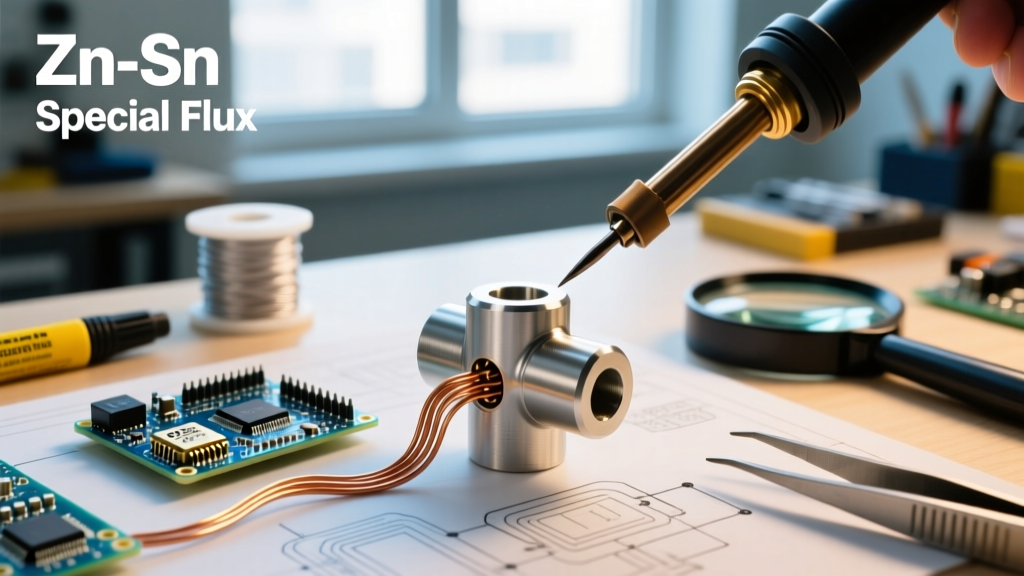
- Zinc-Tin (Zn-Sn): Alloys like Harris AlumiFlow contain zinc, tin, and trace copper. They melt at a slightly lower range of 360°C - 430°C (680°F - 806°F) and are the industry standard for joining aluminum to copper or brass. (Approx. $25 - $40 per tube/spool, available via Harris Products Group).
Step-by-Step Soldering Procedure
Follow this precise methodology to ensure a metallurgical bond rather than a superficial mechanical wrap.
- Mechanical Preparation: Clean the joint area with a solvent (like isopropyl alcohol) to remove oils. Use a stainless steel wire brush to score the surface. Do not use sandpaper, as it can embed silica particles that inhibit wetting.
- Flux Application (The Critical Step): Apply a generous layer of your aluminum-specific flux before you finish your final wire brushing. Brushing through the flux layer breaks the oxide while the flux immediately caps the exposed raw aluminum, preventing the oxide from reforming.
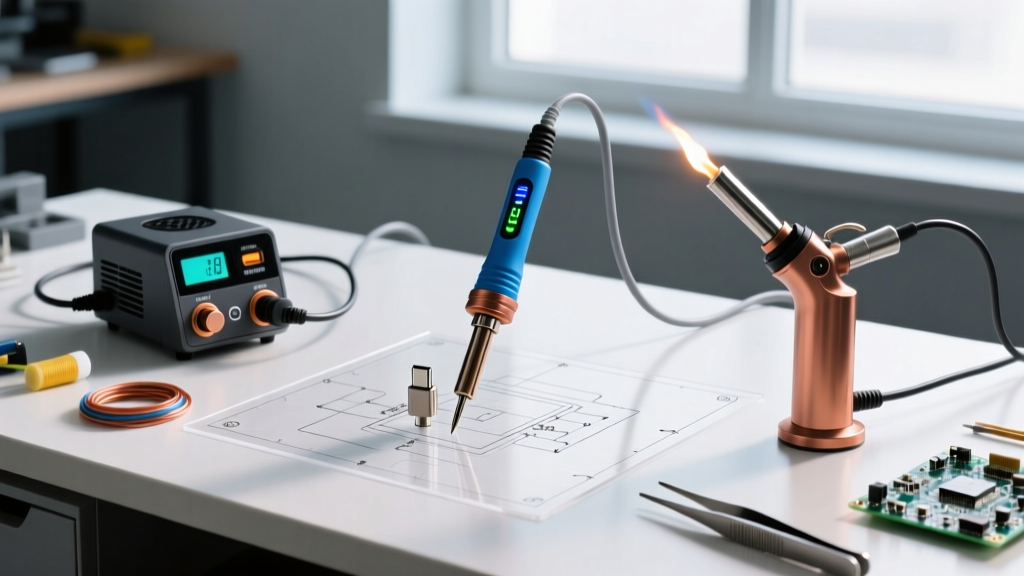
- Heat Application: Aluminum is an exceptional heat sink. A standard 40W electronics iron will fail. Use a high-wattage station like the Hakko FX-888D set to 380°C (716°F) with a heavy chisel tip (e.g., T18-D32), or use a propane/MAPP gas torch for tubing thicker than 1/4 inch. Apply heat to the base metal, not directly to the solder wire.
- Tinning the Surface: Once the base metal reaches the alloy's melting point, introduce the Zn-Al or Zn-Sn filler. You should see the solder 'flash' and wet the surface beneath the flux. If it balls up, the metal is either too cold, or the oxide layer was not fully breached.
- Joining and Cooling: Bring the pre-tinned mating parts together, apply a final touch of heat to flow the joint, and remove the heat source. Allow the joint to cool naturally. Do not quench it in water, as thermal shock can crack the brittle zinc-rich intermetallic layer.
- Cleaning: Scrub the joint with warm water and a brush to remove all corrosive flux residues.
Advanced Alternative: Ultrasonic Soldering
For high-reliability electronics, solar cell interconnects, or aerospace applications where chemical flux residues are unacceptable, the industry relies on ultrasonic soldering. As documented by the American Welding Society in their advanced joining guidelines, ultrasonic soldering irons utilize high-frequency acoustic waves (typically 20 kHz to 60 kHz) transmitted through the molten solder tip.
This acoustic energy creates cavitation in the liquid solder. The collapsing microscopic bubbles generate high-velocity micro-jets that physically shatter the aluminum oxide layer, allowing the molten solder to wet the pure metal underneath. While ultrasonic soldering systems (from manufacturers like Telsonic or Sonosolder) eliminate the need for corrosive fluxes, the capital expenditure is significant, ranging from $3,500 to over $12,000 in 2026, restricting this method to industrial and laboratory environments.
Common Failure Modes and Troubleshooting
Even experienced technicians encounter issues when transitioning to aluminum. Here is how to diagnose the most common edge cases:
- The 'Ball-Up' Effect: The solder melts but forms perfect spheres that roll off the workpiece. Diagnosis: The oxide layer is intact. Your flux is either depleted, the wrong type (e.g., standard rosin), or the base metal temperature is too low to activate the chemical reaction.
- Brittle Joints (Intermetallic Fracture): The joint holds initially but snaps under minor vibration. Diagnosis: Excessive heat input caused the zinc in the filler alloy to diffuse too deeply into the aluminum substrate, creating a thick, brittle intermetallic compound layer. Use lower heat and faster cycle times.
- White Powder Residue (Post-Solder Corrosion): A white, crusty powder appears on the joint days after soldering. Diagnosis: Incomplete flux removal. Zinc chloride flux is highly hygroscopic (absorbs moisture from the air) and will continuously eat the joint if not thoroughly washed and neutralized.
Summary
Aluminium can absolutely be soldered, provided you respect its unique metallurgical properties. By abandoning standard electronics consumables in favor of zinc-based filler alloys (like Indalloy 265 or Harris AlumiFlow), utilizing highly active zinc-chloride fluxes, and employing rigorous mechanical and thermal preparation techniques, you can achieve joints that rival brazing in strength and reliability.