
The Hidden Hazards of Circuit Board Soldering
When enthusiasts and professionals discuss circuit board soldering, the conversation usually revolves around thermal recovery, tip geometry, and solder alloy composition. However, the most critical aspect of any electronics workbench is often relegated to an afterthought: respiratory and thermal safety. As of 2026, the widespread adoption of lead-free alloys and aggressive no-clean fluxes has fundamentally altered the chemical environment of the modern soldering station.
Solder fumes are not merely 'smoke'; they are a complex aerosol of vaporized flux chemicals, rosin degradation byproducts, and microscopic metallic particulates. Prolonged exposure without adequate engineering controls can lead to occupational asthma, contact dermatitis, and neurological risks. This guide breaks down the exact equipment, chemical realities, and personal protective equipment (PPE) required to build a safe, IPC-compliant soldering environment.
The Chemistry of Solder Fumes: What Are You Actually Breathing?
A common misconception is that the smoke generated during circuit board soldering is vaporized metal. In reality, the visible plume is almost entirely vaporized flux. The base metals (tin, silver, copper, lead) do not vaporize at standard iron tip temperatures (300°C–400°C). However, the flux activators and solvents decompose rapidly when subjected to thermal shock.
Flux Decomposition and Hazard Matrix
Understanding your flux chemistry is the first step in selecting the right safety gear. Below is a breakdown of common flux types and their thermal byproducts.
| Flux Type | Primary Base | Decomposition Temp | Hazardous Byproducts | Risk Level |
|---|---|---|---|---|
| Rosin (R, RMA, RA) | Colophony (Abietic Acid) | 200°C - 300°C | Aliphatic aldehydes (formaldehyde), hydrochloric acid (if RA) | High (Sensitizer/Asthma) |
| No-Clean | Synthetic Resins / Alcohols | 180°C - 250°C | Volatile Organic Compounds (VOCs), isopropanol vapor | Moderate (Irritant) |
| Water-Soluble (OA) | Organic Acids | 220°C - 320°C | Carboxylic acids, intense acrid aerosols | High (Corrosive/Irritant) |
The Lead-Free Paradox: Higher Temps, More Fumes
The transition to RoHS-compliant lead-free solders (like SAC305) introduced a secondary safety hazard. SAC305 melts at 217°C, requiring soldering iron tip temperatures of 350°C to 380°C to maintain adequate thermal transfer. By contrast, traditional Sn63/Pb37 (leaded) solder melts at 183°C and flows beautifully with a tip set to 315°C.
This 50°C to 70°C increase in tip temperature causes flux to vaporize much more violently. You will notice increased 'spitting' and a denser plume of smoke with lead-free alloys. Consequently, if you are doing lead-free circuit board soldering, your fume extraction requirements are actually more stringent than when working with leaded solder, despite the absence of lead vapor.
Fume Extraction Systems: Benchtop vs. Ambient (2026 Buyer's Breakdown)
Ambient air purifiers (the type that sit in the corner of a room) are virtually useless for capturing solder fumes. The smoke plume cools and disperses into your breathing zone long before an ambient unit can cycle the room's air. You need source capture extraction. Here is how the top-tier systems compare for serious hobbyists and professional labs.
1. Hakko FA-400 (Entry-Level / Light Hobbyist)
- Price: ~$65 USD
- Filtration: Single-stage activated carbon mat (HAP-100)
- Airflow: ~24 CFM
- Verdict: Adequate for occasional through-hole soldering with mild RMA flux. The carbon mat saturates quickly (replace every 30-50 hours) and does not capture sub-micron particulates. Not recommended for daily SMD rework or water-soluble fluxes.
2. Weller WFE 2X (Professional / Prosumer)
- Price: ~$1,150 USD
- Filtration: HEPA 13 (99.95% efficiency) + Deep-bed Activated Carbon (gas phase)
- Airflow: Up to 230 CFM (dual channel)
- Verdict: The gold standard for independent repair shops. The HEPA filter traps solid flux particulates, while the carbon bed neutralizes VOCs and aldehydes. Features automatic airflow adjustment based on filter saturation.
3. BOFA AD Oracle 250i (Industrial / High-Volume)
- Price: ~$2,400+ USD
- Filtration: Reverse-flow HEPA + Massive molecular carbon bed
- Airflow: 280 CFM
- Verdict: Overkill for home labs, but mandatory for production lines running continuous selective soldering or heavy rework with aggressive organic acid fluxes.
Capture Velocity Rule: For a fume extractor to be effective, the capture hood or nozzle must be positioned within 2 to 4 inches of the solder joint. The capture velocity drops off by the square of the distance. Moving the nozzle from 2 inches to 6 inches reduces capture efficiency by nearly 90%, allowing toxic aldehydes to enter your breathing zone.
Personal Protective Equipment (PPE) That Actually Works
If source capture is unavailable or insufficient, PPE is your last line of defense. However, the wrong PPE provides a dangerous false sense of security.
The N95 Myth
Many makers wear standard N95 masks while soldering. This is fundamentally ineffective against flux fumes. An N95 respirator is designed to filter out solid and liquid particulates (like dust or viruses). It does absolutely nothing to stop gaseous Volatile Organic Compounds (VOCs), formaldehyde, or hydrochloric acid vapor generated by rosin decomposition. To filter gases, you need chemical adsorption.
The Correct Respirator Setup
For heavy circuit board soldering without a high-end HEPA extractor, you must use a half-face elastomeric respirator equipped with both particulate and organic vapor filters.
- Base Mask: 3M 6200 Half Facepiece Reusable Respirator (~$18)
- Vapor Cartridge: 3M 6001 Organic Vapor Cartridges (~$16/pair) - Adsorbs VOCs and rosin aldehydes.
- Particulate Pre-filter: 3M 5P71 P95 Particulate Filters (~$9/pair) - Snaps over the vapor cartridge to catch solid flux dust and extend the life of the carbon bed.
- Retainer: 3M 501 Filter Retainer (~$3)
Thermal and Splash Protection
Flux spitting can eject micro-droplets of boiling, acidic resin onto your skin and eyes.
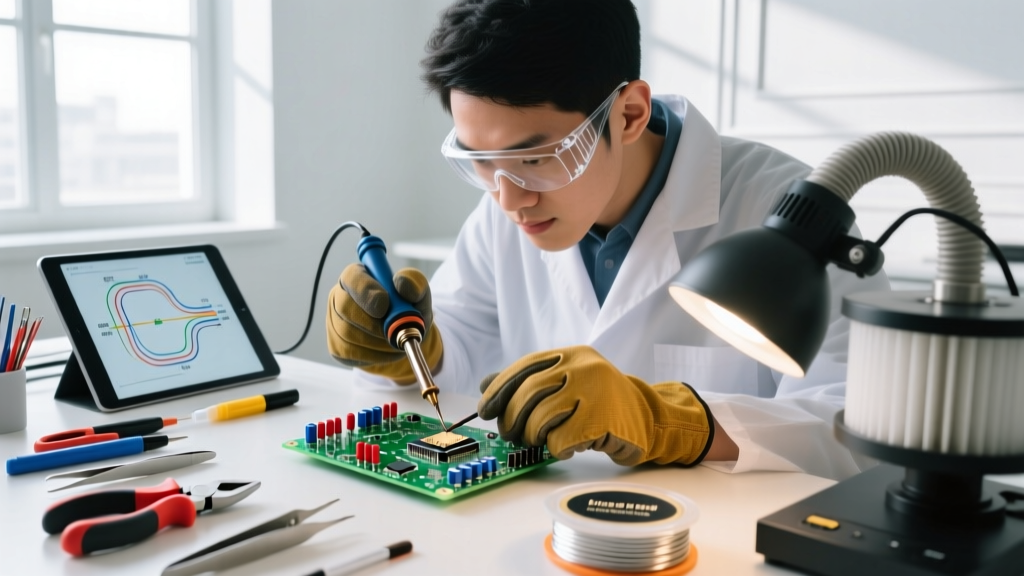
- Eye Protection: ANSI Z87.1 rated polycarbonate safety glasses. Wraparound styles (like the 3M Virtua CCS) prevent lateral splash ingress.
- Hand Protection: Avoid standard latex or nitrile gloves for active soldering; they melt instantly upon contact with a 350°C tip, causing severe thermal burns. Use ESD-safe, heat-resistant Kevlar finger cots or specialized silicone soldering finger guards (e.g., Mechanic iFixit silicone finger cots, ~$8 for a multi-pack).
Ergonomics and Thermal Management on the Bench
Safety also encompasses preventing accidental fires and repetitive strain injuries. A disorganized bench is a hazardous bench.
- Iron Rests: Never use the cheap, lightweight wire stands included with budget irons. Upgrade to a heavy, weighted safety rest like the Weller WDH10T (~$45), which features a brass wool sponge and a high-mass base that prevents tipping if the cord is snagged.
- Silicone Mats: Protect your workbench from scorch marks and chemical spills using a high-temperature silicone mat. The Hakko 602 (~$15) or generic 500°C-rated silicone repair mats provide a non-slip, heat-proof surface that also features compartments for organizing tiny SMD components.
- ESD Matting: If working on static-sensitive ICs, ensure your silicone mat is placed over a properly grounded ESD mat connected to a 1MΩ resistor grounding plug.
Step-by-Step Safe Soldering Workflow
Implement this checklist every time you power on your soldering station to ensure consistent safety and compliance with best practices outlined by organizations like OSHA regarding heavy metal and chemical handling in micro-environments.
- Inspect Ventilation: Turn on the fume extractor 30 seconds before heating the iron to establish baseline airflow. Verify the capture nozzle is within 3 inches of your primary work area.
- Don PPE: Put on safety glasses and, if necessary, your dual-cartridge respirator.
- Pre-Heat and Clean: Allow the iron to reach thermal equilibrium. Tin the tip immediately with a small amount of rosin-core solder to prevent oxidation, then wipe on damp cellulose sponge or brass wool.
- Execute Soldering: Apply heat to the pad and lead simultaneously for 1-2 seconds, then feed solder. Remove solder, then iron. Keep your face out of the direct vertical plume path.
- Post-Solder Hygiene: Wash hands thoroughly with cold water and soap immediately after finishing. As noted by the EPA and CDC NIOSH, cold water prevents pores from opening, reducing dermal absorption of any residual metallic dust or acidic flux residue on the PCB surface.
Summary: Investing in Your Long-Term Health
Circuit board soldering is a highly rewarding skill, but the cumulative effects of inhaling colophony and VOCs are irreversible. By investing in a true HEPA/Carbon source-capture extractor, utilizing the correct organic vapor respirators, and respecting the thermal realities of modern lead-free alloys, you can ensure your workshop remains a safe environment for decades to come. Do not compromise on air quality; your lungs are far more expensive to replace than a Weller WFE 2X.