
What Does Reflow Mean in Soldering? The Core Definition
When transitioning from traditional through-hole hand soldering to Surface-Mount Technology (SMT), builders and engineers inevitably ask: what does reflow mean in soldering? At its core, reflow soldering is a process where a pre-applied solder paste (a mixture of microscopic solder spheres and chemical flux) is subjected to a precisely controlled thermal profile. The heat melts—or 'reflows'—the solder particles, creating a permanent metallurgical bond between surface-mount components and the copper pads on a printed circuit board (PCB).
Unlike wave soldering (which uses a literal wave of molten solder) or hand soldering (which applies localized heat via an iron), reflow heats the entire assembly simultaneously or uses directed hot air. While this enables the assembly of dense, modern electronics like QFN and BGA chips, it introduces severe safety hazards. Managing high-temperature convection environments, toxic flux vaporization, and thermal shock risks requires strict adherence to laboratory safety protocols.
Expert Insight: Reflow is not just about melting metal; it is a chemical activation process. The flux must reach its activation temperature to strip oxidation from the copper pads before the solder alloy liquefies. Mishandling this thermal window creates both weak solder joints and hazardous chemical off-gassing.
The Thermal Profile: Where the Hazards Lurk
To understand the safety risks, you must understand the four stages of a standard lead-free (SAC305) reflow profile. Each stage presents unique hazards to the operator and the equipment.
- Preheat (Ramp): The board temperature rises from ambient to ~150°C. Safety Risk: Rapid ramping (>4°C per second) causes thermal shock, which can crack Multi-Layer Ceramic Capacitors (MLCCs), leading to latent short-circuits and fire hazards in the final product.
- Soak (Thermal Equilibrium): Temperature holds between 150°C and 200°C. The flux activates and VOCs (Volatile Organic Compounds) begin to vaporize heavily. Safety Risk: Peak toxic fume emission occurs here. Inadequate extraction leads to immediate respiratory irritation.
- Reflow (Peak): The assembly crosses the solder's melting point (217°C for SAC305) and peaks around 245°C. Safety Risk: Severe burn hazards from equipment surfaces and potential fire risks if flammable materials are near the reflow chamber.
- Cooling: The board drops back below the solidus temperature. Safety Risk: Operators often attempt to handle PCBs before they drop below 50°C, resulting in contact burns.
Critical Safety Hazards in Reflow Assembly
1. Flux Fumes and Respiratory Sensitization
The most insidious danger in reflow soldering is invisible to the naked eye. Most solder pastes use rosin-based or synthetic no-clean fluxes. When heated past 180°C, these fluxes vaporize into complex chemical plumes. According to the UK Health and Safety Executive (HSE), rosin (colophony) fume is a known respiratory sensitizer that can cause occupational asthma. Even 'no-clean' synthetic fluxes emit isocyanates and aldehydes when subjected to reflow temperatures. A standard desk fan merely blows these sensitizers across the room; true safety requires source-capture extraction.
2. Heavy Metal Exposure (Legacy Pastes)
While the industry has largely adopted RoHS-compliant lead-free pastes (like ChipQuik SMD291AX), many DIY and aerospace labs still use Sn63/Pb37 (Tin/Lead) pastes for superior joint reliability. Lead is a cumulative neurotoxin. Handling leaded solder paste with bare hands, or touching your face after handling stencils, is a direct ingestion pathway. Strict compliance with OSHA's Hazard Communication Standard requires maintaining accessible Safety Data Sheets (SDS) and enforcing mandatory nitrile glove usage when handling leaded pastes.
3. Equipment Grounding and Fire Risks
Prosumer reflow ovens, particularly the ubiquitous and heavily modified T-962A desktop convection oven, are notorious for severe safety flaws out of the box. Stock T-962A units often lack a proper earth ground connection to the metal chassis, creating a lethal shock hazard if a heating element fails. Furthermore, the stock internal masking tape melts and outgasses toxic smoke at reflow temperatures. Modifying these ovens with high-temperature Kapton tape and verifying chassis continuity with a multimeter is a non-negotiable safety prerequisite.
Equipment Safety Matrix: Choosing Your Reflow Method
Different reflow methods carry vastly different safety profiles. Use this matrix to evaluate your lab setup.
| Reflow Method | Peak Temp | Fume Risk | Primary Safety Hazard | Required Mitigation |
|---|---|---|---|---|
| DIY Hotplate (e.g., IR6500) | ~280°C | High (Upward draft) | Severe contact burns; glass shattering | Thick ceramic insulator; overhead fume hood |
| Prosumer Oven (e.g., NeoDen 4) | ~260°C | Contained (Vented) | Internal fire; exhaust routing | External ducting to outside; inline HEPA filter |
| Hot Air Rework Station | ~350°C | Localized | Airborne component blow-off; burns | Nozzle shrouds; localized desk extractor arm |
| Vapor Phase Soldering | ~230°C | Very Low | Toxic fluid inhalation (Galden) | Closed-loop cooling; strict fluid level monitoring |
Building a Safe Reflow Station: 2026 Lab Requirements
To safely execute reflow soldering, your workstation must be engineered to handle both particulate and gaseous hazards. The IPC standards body emphasizes that environmental controls are just as critical as the soldering equipment itself.
- Fume Extraction: You need a dual-stage filtration system. Stage 1 must be a true HEPA filter to trap microscopic rosin particulates. Stage 2 must be a deep-bed activated carbon filter (minimum 2kg of carbon) to adsorb VOCs and aldehydes. Units like the BOFA AD Oracle iQ or the Hakko FA-400 (with upgraded carbon mats) are industry standards.
- Thermal Monitoring: Never guess the temperature of a reflow profile. Use a K-type thermocouple attached to a dummy test board with high-temp Kapton tape, connected to a dual-channel thermometer like the Fluke 52 II. This ensures your oven isn't overshooting into the 260°C+ danger zone, which delaminates FR4 fiberglass and releases toxic brominated flame retardants.
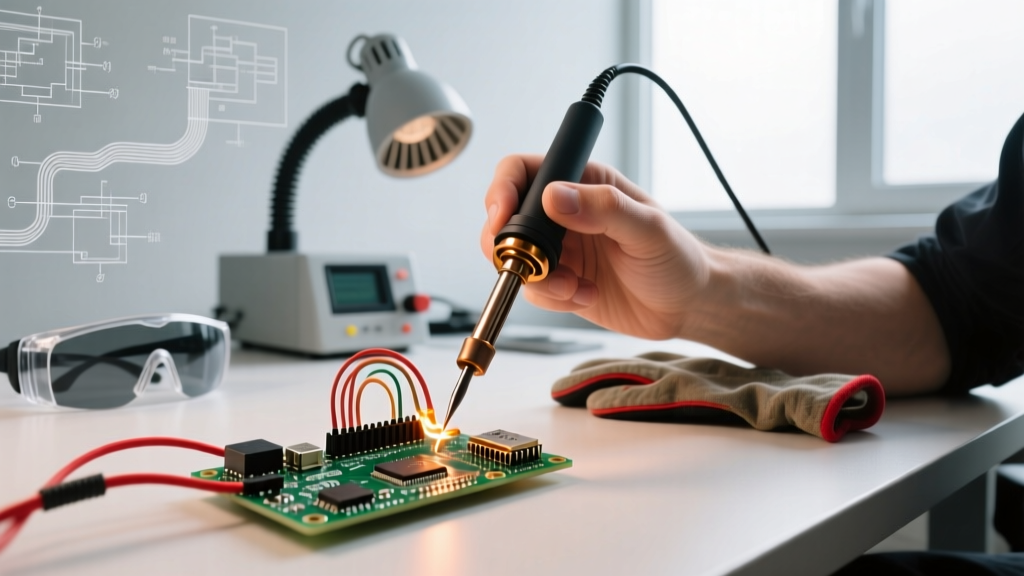
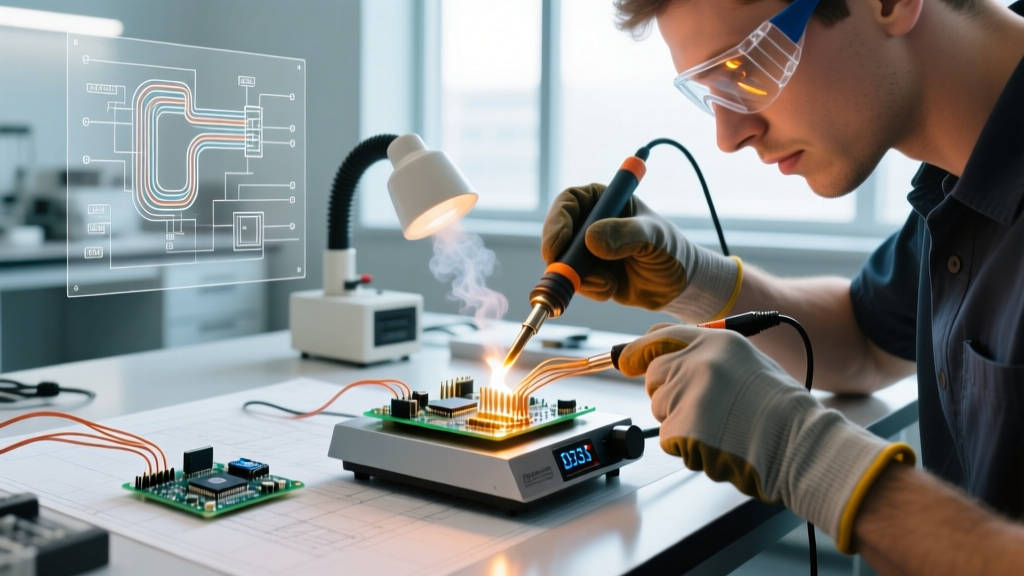
- Personal Protective Equipment (PPE): Always wear ANSI Z87.1-rated safety glasses. Reflowing components with trapped moisture (like un-baked QFP chips) can cause the 'popcorn effect,' where steam expansion violently fractures the plastic IC casing, launching microscopic shrapnel.
Step-by-Step Safe Reflow Execution
Follow this standardized workflow to minimize risk during SMD assembly:
- Preparation: Don nitrile gloves. Apply solder paste using a stainless steel stencil. Store unused paste in a dedicated lab refrigerator (do not use food refrigerators) to prevent solvent separation.
- Placement: Use ESD-safe tweezers to place components. Ensure no components are bridged, which could cause localized short-circuiting and overheating during the reflow phase.
- Profiling: Run the thermal profile on a scrap board equipped with thermocouples. Verify the ramp rate does not exceed 3°C/s to protect sensitive MLCCs and BGA packages.
- Execution: Start the reflow cycle. Keep the oven or hotplate hood closed to maintain thermal equilibrium and trap the initial burst of flux fumes.
- Cooling & Handling: Allow the board to cool naturally to below 45°C. Never use compressed air to force-cool a PCB, as this induces micro-fractures in the solder joints and blows residual flux dust into the air.
Frequently Asked Questions (FAQ)
Is reflow soldering safe to do in a bedroom or home office?
No. Reflow soldering generates VOCs, fine particulates, and potentially toxic heavy metal dust (if sanding stencils). Without dedicated external exhaust routing or a high-end multi-stage HEPA/Carbon scrubber, these chemicals will settle into carpets and HVAC systems, posing long-term health risks.
What does 'reflow' mean regarding component damage?
In the context of damage, 'reflow' refers to accidentally exposing a component to its melting temperature limit for too long. If the 'time above liquidus' (TAL) exceeds 60-90 seconds, the internal die-attach materials inside silicon chips can degrade, and plastic IC packages can scorch or delaminate.
Do I need a fume extractor for lead-free solder paste?
Absolutely. Lead-free pastes actually require higher reflow temperatures (up to 250°C) compared to leaded pastes. These higher temperatures cause more aggressive vaporization of the flux chemicals, making high-quality fume extraction even more critical than it is for traditional Sn63/Pb37 soldering.