
Beyond the Blink: Engineering Cool Arduino Projects for 2026
When most makers search for cool Arduino projects, they are met with endless variations of blinking LEDs, basic weather stations, and line-following robots. While these are excellent for learning syntax, they do not prepare you for real-world embedded systems engineering. In 2026, the landscape of microcontroller development has shifted heavily toward edge computing, deterministic real-time operating systems (RTOS), and ultra-low-power mesh networking.
This guide abandons beginner tutorials and dives deep into five advanced, portfolio-grade Arduino builds. We will explore exact component selections, PCB layout considerations, firmware architecture, and the edge cases that separate a hobbyist prototype from a deployable industrial product.
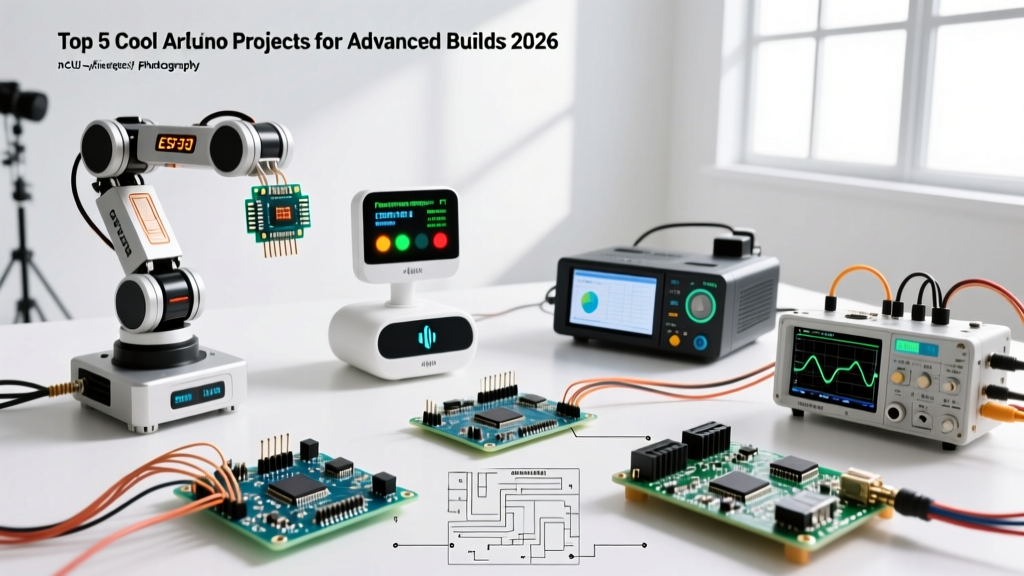
1. FreeRTOS-Based Multi-Axis Robotic Arm Controller
Driving multiple stepper or servo motors simultaneously using standard delay() or basic interrupts leads to jitter and missed steps. Advanced robotic arms require deterministic task scheduling. By utilizing the Arduino Portenta H7 (priced around $115 in 2026) and FreeRTOS, you can assign dedicated tasks to the dual-core Cortex-M7/M4 architecture.
Architecture & Hardware Selection
- MCU: Arduino Portenta H7. The M7 core (480 MHz) handles inverse kinematics calculations, while the M4 core (240 MHz) manages CAN bus communication and motor PWM generation.
- Motor Drivers: TMC5160-TA. These feature integrated motion controllers and StealthChop2 technology for silent operation.
- Communication: Isolated CAN bus (using ISO1050 transceivers) to prevent ground loops between the high-current motor stage and the low-voltage logic stage.
Edge Case Warning: When implementing CAN bus at 1 Mbps over runs longer than 40 meters, signal reflection becomes a critical failure mode. You must place 120-ohm termination resistors at both physical ends of the bus, and ensure your CANH and CANL traces are routed as a 120-ohm differential pair on your custom PCB.
2. High-Speed DAQ for Industrial Vibration Analysis
Standard Arduino analog-to-digital conversion via analogRead() maxes out at roughly 9-10 kHz, which is woefully inadequate for capturing high-frequency mechanical vibrations. To perform Fast Fourier Transforms (FFT) on industrial motors, you need sampling rates above 100 kHz.
Implementing DMA on the Teensy 4.1
The Teensy 4.1 (~$32) features a Cortex-M7 running at 600 MHz and robust Direct Memory Access (DMA) capabilities. Instead of the CPU polling the ADC, DMA transfers sampled data directly into a circular RAM buffer.
- External ADC: Use the ADS8688 (16-bit, 500kSPS) connected via SPI. The Teensy's SPI clock can be pushed to 30 MHz, easily bottlenecked by the ADC's max throughput.
- Buffer Management: Allocate a 64KB block in the Teensy's external PSRAM (if populated) or internal RAM2 using
__attribute__((section('.bss.ram2'))). - Signal Processing: Utilize the CMSIS-DSP library to perform a 4096-point Complex FFT directly on the buffered data, identifying resonant frequencies in real-time.
Microcontroller Selection Matrix for Advanced Builds
Choosing the right silicon is the first critical step in any advanced build. Below is a 2026 comparison of top-tier boards for complex projects.
| Microcontroller | Core / Clock | Key Feature | Approx. Price (2026) | Best Use Case |
|---|---|---|---|---|
| Arduino Portenta H7 | Dual M7/M4 @ 480/240MHz | High-Density Connectors, Vision Shield | $115 | Machine Vision, Industrial IoT |
| Teensy 4.1 | Cortex-M7 @ 600MHz | Massive RAM, Native Ethernet | $32 | High-Speed DSP, Audio, DAQ |
| ESP32-S3-WROOM | Dual Xtensa LX7 @ 240MHz | Vector Instructions, Wi-Fi/BLE | $8 | Edge AI, Wireless Sensor Nodes |
| Arduino Nicla Vision | STM32H747 (Dual Core) | Ultra-compact, Integrated Camera | $110 | TinyML, Wearable Vision |
3. Custom LoRaWAN Environmental Mesh Network
Building a remote sensor network that survives for years on a single battery requires obsessive power management. While Wi-Fi is ubiquitous, its power draw makes it unsuitable for remote agricultural or environmental monitoring. LoRaWAN is the definitive protocol for these scenarios.
Designing for Micro-Amp Sleep Currents
Using the Semtech SX1262 LoRa transceiver paired with an ultra-low-power MCU like the STM32L4 or an ESP32-C3, your target sleep current should be under 5 µA. However, advanced builders know that the silicon is rarely the source of battery drain.
- PCB Leakage: Flux residue and moisture on the PCB can create parasitic parallel resistances, adding 10-50 µA of leakage. Always specify a rigorous cleaning process or use a conformal coating.
- Voltage Regulators: Standard LDOs like the AMS1117 draw 5mA of quiescent current. Replace them with switching regulators optimized for light loads, such as the TPS62840 (quiescent current of 60 nA).
- Network Integration: Follow The Things Network LoRaWAN guide to implement AES-128 payload encryption and manage Over-The-Air Activation (OTAA) join requests efficiently to minimize radio-on time.
4. Edge Computing Node with TinyML and Machine Vision
Running neural networks in the cloud introduces latency and privacy concerns. In 2026, deploying quantized models directly onto microcontrollers (TinyML) is a standard practice for predictive maintenance and quality control.
Deploying INT8 Quantized Models
Using the Arduino Nicla Vision or the Portenta H7 with a Vision Shield, you can deploy convolutional neural networks (CNNs) to detect anomalies on a manufacturing line. According to the Arduino Portenta H7 documentation, the board's hardware accelerator and optimized TensorFlow Lite for Microcontrollers library allow for impressive inference speeds.
The Quantization Imperative: A standard FP32 (32-bit floating point) model might require 2MB of Flash and 500KB of RAM, exceeding the tightly coupled memory (TCM) limits of the MCU. By using Post-Training Quantization (PTQ) to convert weights to INT8 (8-bit integers), you reduce the model size by 75% and leverage the Cortex-M7's DSP instructions, increasing inference speed by up to 3x without significant accuracy loss.
5. High-Precision GPS Disciplined Oscillator (GPSDO)
For projects requiring extreme timekeeping accuracy—such as synchronized RF mesh networks or software-defined radio (SDR) basestations—a standard crystal oscillator drifts by 20-50 PPM. A GPSDO uses the 1PPS (One Pulse Per Second) signal from a GPS module to discipline a local Oven-Controlled Crystal Oscillator (OCXO).
Phase-Locked Loop (PLL) Implementation
This project uses an Arduino to measure the phase difference between the GPS 1PPS signal and a divided-down OCXO signal. The MCU runs a digital PI (Proportional-Integral) controller to adjust a 16-bit DAC, which tunes the OCXO's voltage control pin.
- Hardware: Arduino Due (for native 12-bit DAC and 32-bit processing), a U-blox ZED-F9T timing module, and a 10 MHz OCXO.
- Edge Case - Holdover Mode: If the GPS signal is lost (e.g., in a tunnel or due to jamming), the firmware must seamlessly switch to 'holdover' mode, relying on a moving average of the last 12 hours of DAC correction values to maintain accuracy within 1 PPM for up to 24 hours.
Advanced Troubleshooting: Power Integrity and Ground Bounce
When transitioning these cool Arduino projects from a breadboard to a custom PCB, signal integrity becomes paramount. Mixed-signal designs (combining high-speed digital logic with sensitive analog sensors) often suffer from ground bounce.
PCB Stackup Rules for Advanced Builds
Never route high-speed digital traces (like SPI or Ethernet) over splits in the ground plane. The return current must follow the path of least inductance directly beneath the signal trace. If the ground plane is split, the return current is forced to detour, creating a massive loop antenna that causes Electromagnetic Interference (EMI) and corrupts nearby ADC readings. Always use a 4-layer stackup (Signal -> Ground -> Power -> Signal) for advanced RF and high-speed DAQ projects.
Frequently Asked Questions (FAQ)
Can I use standard Arduino libraries for FreeRTOS projects?
Most standard Arduino libraries rely on blocking delays or assume they have exclusive access to hardware timers. In an RTOS environment, you must use non-blocking, thread-safe versions of libraries, or wrap hardware accesses in Mutexes to prevent race conditions and kernel panics.
How do I prevent memory fragmentation in long-running C++ IoT projects?
Dynamic memory allocation (new, malloc, or String objects) inside the main loop causes heap fragmentation, eventually leading to allocation failures and device reboots. Advanced builders pre-allocate static buffers at compile time or use memory pools provided by the RTOS to manage dynamic memory safely.
Is the ESP32-S3 powerful enough for TinyML vision tasks?
Yes, but with caveats. The ESP32-S3 features vector instructions that accelerate neural network operations. However, it lacks the massive internal SRAM of the Portenta H7. You will need to rely heavily on external PSRAM and optimize your camera resolution (e.g., using QVGA instead of VGA) to fit the model and tensor arenas within the available memory constraints.