
The 2026 Landscape of Ultrasonic Sensing
Whether you are translating international maker logs searching for sensor ultrasonik arduino or engineering a robust industrial IoT fluid-level monitor, ultrasonic time-of-flight (ToF) sensing remains a cornerstone of embedded systems. However, the days of blindly copying naive delay()-based tutorial code are over. Modern microcontrollers like the ESP32-S3 and Raspberry Pi Pico W demand non-blocking, interrupt-driven sensor polling.
This guide bypasses the basic tutorials and dives deep into the library ecosystems, hardware variants, and signal-conditioning techniques required to build reliable ultrasonic sensor Arduino projects in 2026.
Hardware Comparison Matrix: Beyond the HC-SR04
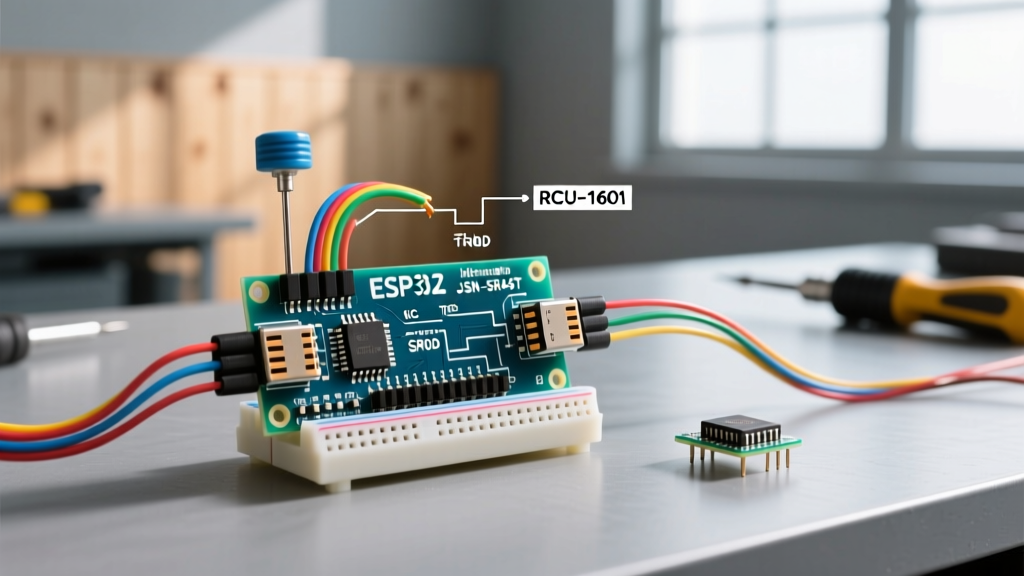
The classic HC-SR04 is ubiquitous, but its open-mesh transducers are highly susceptible to acoustic noise and humidity. For modern deployments, consider the waterproof JSN-SR04T or the multi-protocol RCWL-1601.
| Parameter | HC-SR04 (Standard) | JSN-SR04T (V2.0) | RCWL-1601 |
|---|---|---|---|
| Typical Price (2026) | $1.50 - $2.20 | $4.50 - $6.00 | $2.80 - $3.50 |
| Operating Voltage | 5.0V DC | 3.3V - 5.0V DC | 3.3V - 5.0V DC |
| Blind Zone (Min Range) | ~2 cm | ~20 cm (Ring-down time) | ~2 cm |
| Max Range | 400 cm | 600 cm | 450 cm |
| Beam Angle | ~15° | ~60° (Wide) | ~15° |
| IP Rating | None (IP00) | IP67 (Sealed Transducer) | IP00 |
Why Native pulseIn() is a Liability
Many beginners rely on the native Arduino pulseIn() reference to measure the echo width. While functional for simple blocking scripts, pulseIn() halts the MCU entirely while waiting for the pin state to change. If an ultrasonic pulse scatters and no echo returns, the function blocks execution for its default timeout (usually 1 second, or up to 35ms if manually constrained). In a 2026 multitasking environment running FreeRTOS or handling WiFi stacks, a 35ms blocking delay causes buffer overflows, dropped MQTT packets, and watchdog resets.
Expert Insight: Never use pulseIn() in production firmware. Always utilize timer-interrupt-based libraries that measure pulse width in the background, allowing your main loop to execute state machines without interruption.
The Best Libraries for Ultrasonic Sensor Arduino Projects
1. NewPing (The Non-Blocking Standard)
Originally authored by Tim Eckel, the NewPing library remains the undisputed champion for HC-SR04 and JSN-SR04T integration. Its primary advantage is the ping_timer() method, which utilizes hardware timer interrupts to trigger the 40kHz burst and measure the echo without blocking the CPU.
- Multi-Sensor Support: Easily poll up to 15 sensors by staggering their trigger times, preventing acoustic cross-talk.
- Automatic Median Filtering: The
ping_median()method fires multiple pings and discards outliers, drastically reducing phantom reads caused by acoustic reflections. - Memory Footprint: Highly optimized C++ with minimal SRAM overhead, crucial for ATmega328P-based boards.
2. HCSR04 Ultrasonic (Modern C++ Alternative)
For developers using the ESP32 Arduino Core or RP2040 who prefer modern C++ paradigms over legacy AVR C, the HCSR04 library by gamegine offers a cleaner object-oriented API. It handles the microsecond timing via hardware-specific timer abstractions, ensuring compatibility across diverse 32-bit architectures without the manual timer register tweaking required by NewPing on non-AVR boards.
Critical Wiring: 5V vs 3.3V Logic Translation
A catastrophic failure mode in modern ultrasonic sensor Arduino projects is frying the GPIO pins of 3.3V microcontrollers (like the ESP32 or Arduino Nano 33 IoT). The HC-SR04 outputs a 5V logic HIGH on the Echo pin. Feeding 5V directly into a 3.3V tolerant pin will degrade the silicon over time or cause immediate latch-up.
The Voltage Divider Solution
To safely interface a 5V HC-SR04 Echo pin to a 3.3V MCU, use a simple resistor voltage divider. Using a 1kΩ resistor (R1) in series with the Echo pin and a 2kΩ resistor (R2) to ground yields:
Vout = 5V × (2000 / (1000 + 2000)) = 3.33V
This safely steps down the signal while maintaining the fast rise-times required for accurate microsecond timing.
The JSN-SR04T V2.0 3.3V Hardware Hack
If you are using the waterproof JSN-SR04T V2.0, you can bypass the voltage divider entirely. The board features an unpopulated resistor pad labeled R27. By soldering a 4.7kΩ pull-up resistor across the R27 pads, you reconfigure the internal logic circuitry to natively output 3.3V on the Echo pin, making it perfectly safe for direct connection to ESP32 and Raspberry Pi Pico GPIOs.
Advanced Calibration: Temperature Compensation
Ultrasonic sensors calculate distance by measuring the time it takes for a 40kHz acoustic wave to bounce back. The default speed of sound used in most libraries is 343 meters per second. However, this is only accurate at 20°C (68°F). In outdoor or industrial environments, temperature fluctuations introduce massive errors.
According to acoustic physics principles documented by the Engineering Toolbox, the speed of sound in dry air scales with temperature. To achieve millimeter-level accuracy, you must integrate a digital temperature sensor (like the BME280) and apply the following compensation formula in your firmware:
// Speed of sound in m/s based on Celsius
float speedOfSound = 331.3 * sqrt(1.0 + (temperatureC / 273.15));

// Convert to cm per microsecond (round trip)
float cmPerMicrosecond = speedOfSound / 10000.0;

// Calculate compensated distance
float distanceCm = (echoTimeUs / 2.0) * cmPerMicrosecond;
Implementing this dynamic calculation reduces measurement drift from over 5% in extreme conditions down to less than 0.5%.
Troubleshooting Edge Cases and Phantom Reads
1. The 20cm Blind Zone (JSN-SR04T)
Makers frequently report that the JSN-SR04T returns erratic or zero values when objects are placed closer than 20cm. This is not a defect; it is a physical limitation. The JSN-SR04T uses a single transducer for both transmitting and receiving. After emitting the 8-cycle 40kHz burst, the transducer continues to vibrate (ring-down) for several milliseconds. The internal MCU blanks the receiver during this time to prevent the transmit burst from being misread as an echo. Solution: Mount the JSN-SR04T at least 25cm away from the minimum target boundary.
2. Acoustic Cross-Talk in Multi-Sensor Arrays
If you are building a rover with four ultrasonic sensors, firing them simultaneously will cause Sensor A to receive the echo from Sensor B's transmission. Solution: Implement a round-robin polling sequence with a minimum 35ms delay between pings. The speed of sound dictates that a 6-meter maximum range takes roughly 35ms for a full round trip. Waiting 40ms between sensor triggers guarantees the acoustic environment is clear before the next burst.
3. Soft Target Absorption
Ultrasonic waves at 40kHz are heavily absorbed by porous materials like acoustic foam, heavy curtains, or winter clothing. If your sensor is failing to detect a person but easily detects a wall, the target's acoustic impedance is too low. In these scenarios, consider fusing your ultrasonic data with a 24GHz mmWave radar sensor (like the RCWL-0516 or HLK-LD2410), which penetrates soft materials and operates independently of acoustic reflections.