
The Evolution of Proximity Sensing in DIY Electronics
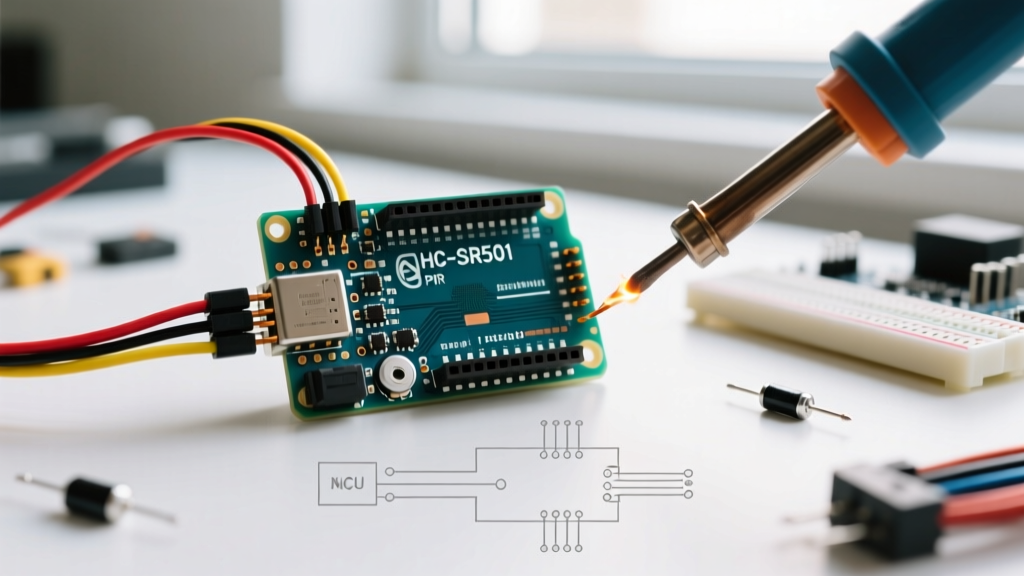
For over a decade, the HC-SR04 has been the undisputed king of beginner distance measurement. If you have ever built a robot or a parking assistant, you have likely wired this 40kHz ultrasonic transceiver to a microcontroller. However, as we navigate the electronics landscape in 2026, the limitations of raw acoustic time-of-flight (ToF) sensing have become glaringly obvious in demanding environments. Acoustic crosstalk, temperature drift, and a notorious 2cm blind spot frequently derail precision projects.
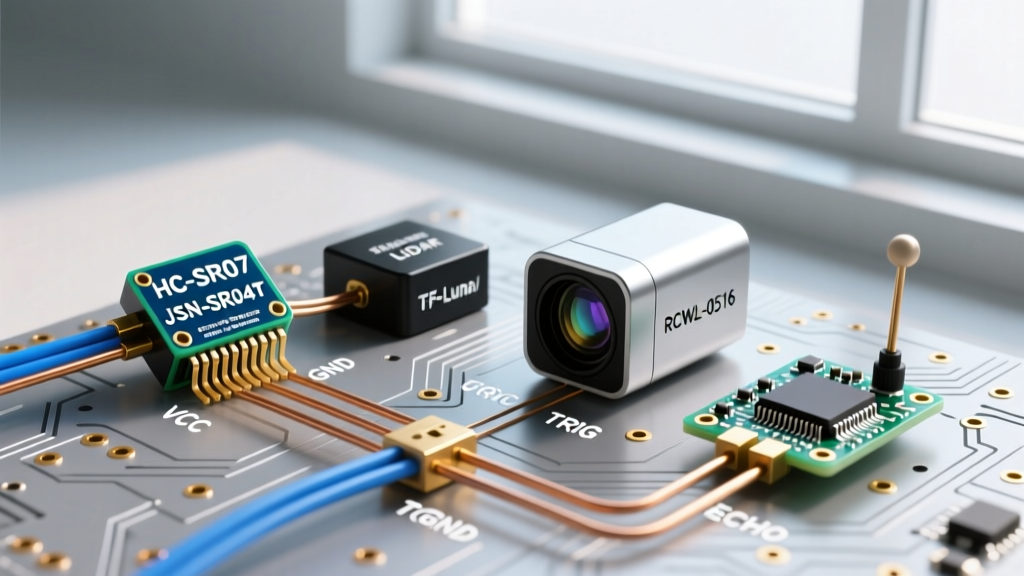
In this comprehensive component comparison, we dissect the classic HC-SR04 Arduino sensor setup against three modern, specialized alternatives: the waterproof JSN-SR04T, the Benewake TF-Luna LiDAR, and the RCWL-0516 microwave radar module. We will evaluate real-world pricing, exact wiring nuances for 3.3V and 5V logic, and the specific failure modes that datasheets conveniently omit.
1. The Baseline: HC-SR04 Ultrasonic Sensor
The HC-SR04 operates by emitting an eight-cycle burst of 40kHz ultrasound when the trigger pin is held HIGH for 10µs. The echo pin then outputs a pulse whose width corresponds to the distance.
- Current Market Price: $1.20 - $2.50
- Voltage: 5V DC (15mA working current)
- Range: 2cm to 400cm
- Blind Spot: < 2cm (transducer ring-down time)
Real-World Failure Modes
The most critical flaw of the HC-SR04 is temperature drift. The speed of sound in dry air at 20°C is roughly 343 m/s, but it changes by approximately 0.606 m/s for every 1°C shift. If your outdoor Arduino project experiences a 15°C temperature drop from noon to midnight, your distance calculations will drift by nearly 2.5%—an error of 5cm at a 2-meter range. Furthermore, the HC-SR04 is highly susceptible to acoustic specular reflection; if the target surface is angled just 15 degrees away from the sensor's normal axis, the sound waves deflect away, resulting in a false 'timeout' reading.
2. Contender A: JSN-SR04T (Waterproof Ultrasonic)
The JSN-SR04T takes the HC-SR04's core acoustic原理 but separates the transducer from the PCB via a 2.5-meter shielded cable, encasing the transducer in an IP67-rated aluminum and plastic housing.
- Current Market Price: $4.50 - $6.50
- Range: 20cm to 600cm
- Best Application: Automotive reversing, liquid level sensing in tanks, outdoor robotics.
While it solves the moisture and dust ingress issues that instantly kill a standard HC-SR04, the JSN-SR04T suffers from a much larger blind spot (20cm) due to the physical damping required to prevent the sealed housing from ringing. It also retains the same temperature and angular deflection vulnerabilities as its cheaper sibling.
3. Contender B: Benewake TF-Luna (Time-of-Flight LiDAR)
Entering the optical domain, the TF-Luna utilizes an 850nm VCSEL (Vertical-Cavity Surface-Emitting Laser) to measure phase-shift ToF. In 2026, the price of solid-state LiDAR has plummeted, making this a viable upgrade path for advanced Arduino and ESP32 projects.
- Current Market Price: $16.00 - $22.00
- Voltage: 5V (compatible with 3.3V I2C logic natively)
- Range: 0.2m to 8m
- Interface: UART / I2C (Address 0x10)
Unlike acoustic sensors, the TF-Luna is immune to ambient acoustic noise, wind, and temperature fluctuations. According to SparkFun's Qwiic TF-Luna documentation, the sensor outputs data at up to 250Hz, making it ideal for high-speed drone altitude hold or fast-moving conveyor belt sorting. The primary drawback is its struggle with highly reflective surfaces (like mirrors) or pure light-absorbing materials (like black velvet), which can skew the phase-shift calculations.
4. Contender C: RCWL-0516 (Microwave Doppler Radar)
If your goal is presence detection rather than precise millimeter distance measurement, the RCWL-0516 operates on an entirely different physics principle: the Doppler shift of 5.8GHz microwaves.
- Current Market Price: $1.00 - $1.80
- Detection Range: 5m to 9m (adjustable via C2 capacitor)
- Unique Trait: Penetrates non-metallic walls (plastic, drywall, wood).
You can hide the RCWL-0516 entirely inside a 3D-printed PLA enclosure without affecting its range. However, it cannot tell you how far an object is, only that motion has occurred within its broad teardrop-shaped detection field.
Component Comparison Matrix
| Feature | HC-SR04 | JSN-SR04T | TF-Luna LiDAR | RCWL-0516 |
|---|---|---|---|---|
| Technology | 40kHz Acoustic | 40kHz Acoustic | 850nm Optical ToF | 5.8GHz Microwave |
| Avg. Price (2026) | $1.50 | $5.50 | $18.00 | $1.40 |
| Blind Spot | ~2 cm | ~20 cm | ~20 cm | N/A (Motion only) |
| IP Rating | None (IP00) | IP67 (Transducer) | IP00 (Module) | None (IP00) |
| Logic Level | 5V Tolerant | 5V Tolerant | 3.3V / 5V | 3.3V / 5V |
| Output Type | Pulse Width | Pulse Width | I2C / UART Data | Binary HIGH/LOW |
Crucial Wiring Nuances: The 3.3V Logic Trap
A massive point of failure for modern makers is connecting 5V peripherals to 3.3V microcontrollers like the ESP32-S3, Arduino Nano 33 IoT, or Raspberry Pi Pico. The Echo pin on a genuine HC-SR04 outputs a 5V HIGH signal when an object is detected. Feeding 5V directly into a 3.3V GPIO pin will eventually degrade or destroy the silicon.
Expert Troubleshooting Tip: Do not rely on the internal clamping diodes of your ESP32 to absorb the 5V over-voltage from an HC-SR04 Echo pin. Over time, the leakage current will cause erratic Wi-Fi resets. Always use a voltage divider (e.g., 1kΩ and 2kΩ resistors) or a dedicated logic level shifter like the 74LVC245 when bridging 5V ultrasonic sensors to 3.3V MCUs.
Conversely, the TF-Luna natively supports 3.3V I2C communication. When wiring it to an Arduino Uno R4 Minima, you can connect the SDA and SCL lines directly without level shifting, provided you pull the I2C lines HIGH to 3.3V, not 5V. For detailed I2C implementation strategies, refer to the Adafruit Sonar Breakout guidelines, which outline universal best practices for mixing I2C sensors on a single bus.
Software Implementation: Moving Beyond pulseIn()
The standard method for reading the HC-SR04 involves the Arduino pulseIn() function. While adequate for blinking an LED when a wall is near, pulseIn() is a blocking function. If the sensor faces an open void and times out, your entire Arduino sketch halts for up to 1 second (the default timeout).
The Interrupt-Driven Approach
For motor control or balancing robots, blocking code is fatal. Instead of pulseIn(), professional firmware utilizes Pin Change Interrupts (PCINT) or hardware timers to capture the Echo pulse width in the background.
- Set the Trigger pin HIGH for exactly 10µs using
delayMicroseconds(10). - Attach an interrupt to the Echo pin on the
RISINGedge to recordmicros()asstartTime. - Re-attach the interrupt on the
FALLINGedge to recordendTime. - Calculate distance:
distance = ((endTime - startTime) * 0.0343) / 2.
This non-blocking architecture ensures your PID control loops for stepper motors continue executing at 1kHz, regardless of whether the ultrasonic sensor successfully receives an echo.
Final Verdict: Which Sensor Should You Choose?
The HC-SR04 remains the undisputed champion for indoor, low-budget educational projects where a 5% error margin is acceptable and 5V logic is abundant. However, if your project is moving outdoors, the JSN-SR04T is a mandatory upgrade to survive humidity and dust. For high-precision robotics, drone altitude tracking, or integration with modern 3.3V I2C ecosystems, the TF-Luna LiDAR justifies its $18 price tag by eliminating acoustic blind spots and temperature drift entirely. Finally, reserve the RCWL-0516 strictly for hidden, through-wall human presence detection where exact distance metrics are irrelevant.