
Hardware Selection in 2026: HC-SR04 vs. Modern Alternatives
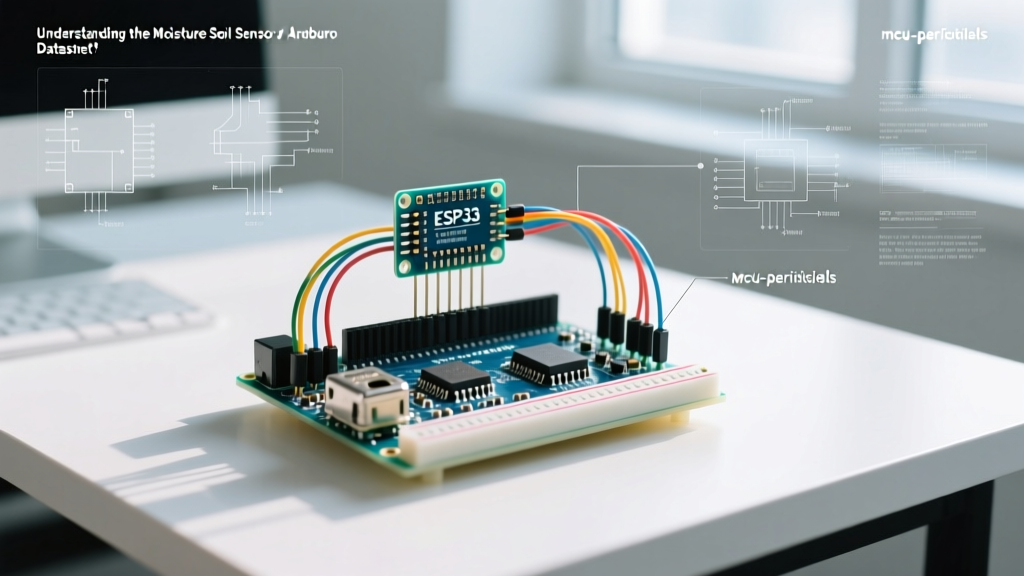
When engineers search for code for ultrasonic sensor Arduino projects, they typically default to the ubiquitous HC-SR04. While this $1.50 module remains a staple for basic hobbyist breadboarding, professional integration in 2026 demands a deeper understanding of the available hardware ecosystem. The standard HC-SR04 operates strictly on 5V logic, which poses a severe risk to 3.3V microcontrollers like the ESP32 or Raspberry Pi Pico (RP2040) without a logic level shifter.
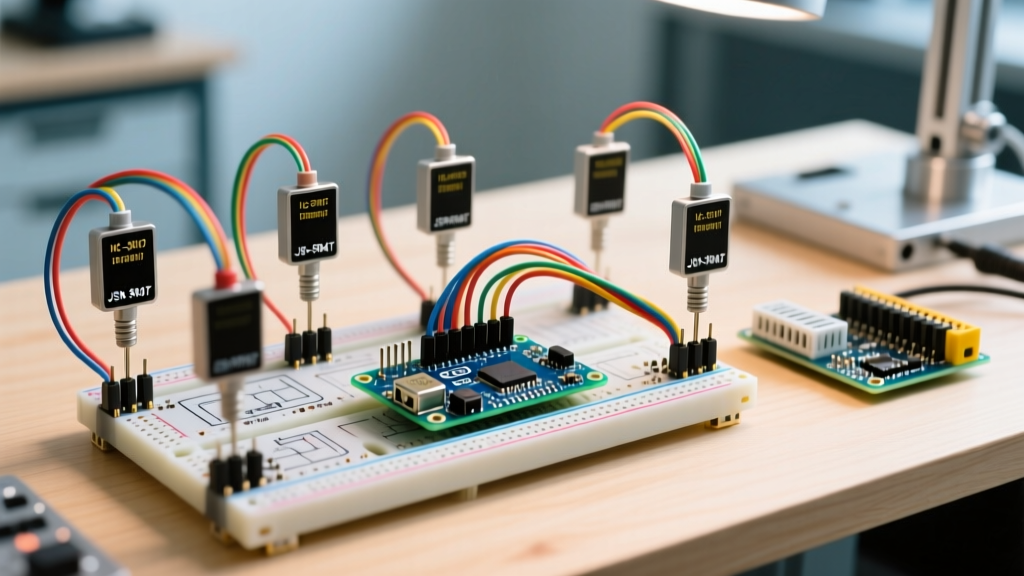
To build robust systems, you must select the correct transceiver for your environment. Below is a comparison of the three most prevalent ultrasonic modules used in modern embedded systems.
| Model | Logic Level | Blind Zone | Max Range | 2026 Avg. Cost | Best Use Case |
|---|---|---|---|---|---|
| HC-SR04 | 5V Only | 2 cm | 400 cm | $1.50 - $2.50 | 5V Arduino Uno/Mega prototyping |
| HC-SR04P | 3.3V / 5V | 2 cm | 400 cm | $3.50 - $4.50 | ESP32, RP2040, STM32 integration |
| JSN-SR04T | 3.3V / 5V | 20 cm | 450 cm | $12.00 - $15.00 | Outdoor, wet, or dusty environments |
The Physics of 40kHz Acoustic Ranging
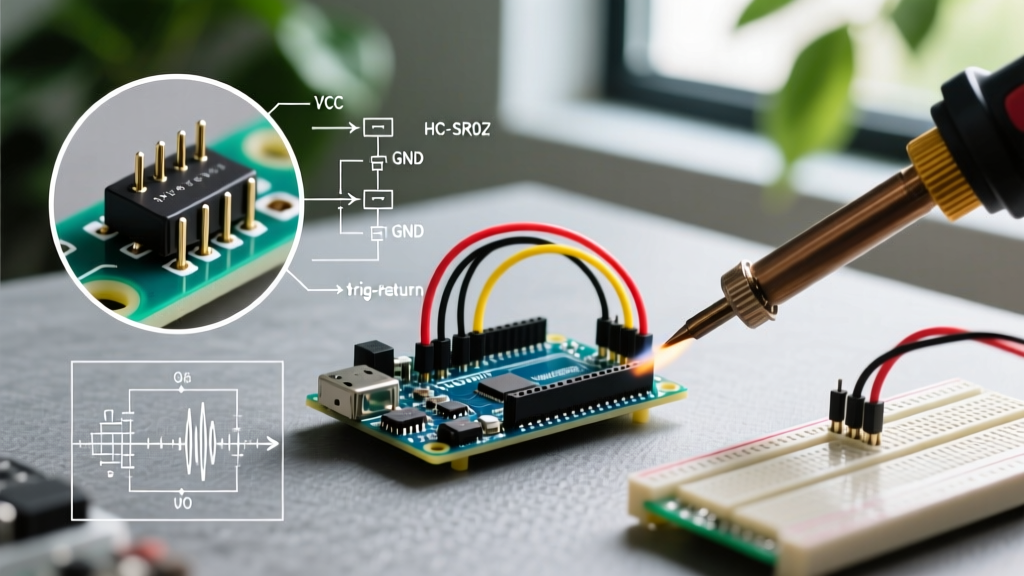
Before writing a single line of C++, you must understand the physics governing the sensor. Ultrasonic modules emit a burst of eight 40kHz square waves. The microcontroller then measures the time it takes for the acoustic echo to return. The fundamental equation is:
Distance = (Echo Time × Speed of Sound) / 2
The critical variable here is the speed of sound, which is not a constant. According to Georgia State University's HyperPhysics, the speed of sound in dry air is highly dependent on temperature. At 0°C, sound travels at 331.3 m/s, but at 20°C, it travels at 343.2 m/s. If your code hardcodes the speed of sound for a 20°C room, but your robot operates in a 5°C warehouse, your distance calculations will carry a ~2.5% error. Over a 4-meter range, that is a 10 cm discrepancy—enough to cause a collision in autonomous navigation.
While humidity and air pressure have minor effects on acoustic velocity, temperature is the dominant variable. For high-precision applications, integrate a BME280 or SHT40 temperature/humidity sensor and dynamically calculate the speed of sound in your Arduino loop using the formula: c = 331.3 * sqrt(1 + (T / 273.15)).
The Problem with Naive pulseIn() Code
The most common code for ultrasonic sensor Arduino tutorials relies on the built-in pulseIn() function. While adequate for blinking LEDs, pulseIn() is a blocking function. If the sensor fails to receive an echo (e.g., the sound is absorbed by acoustic foam or angled away), the function will halt the entire microcontroller until the timeout period expires.
The default timeout for pulseIn() is one full second. In a multitasking RTOS environment or a fast PID control loop, a 1000ms blocking delay is catastrophic. Furthermore, pulseIn() disables interrupts while waiting, which can disrupt PWM motor control, encoder counting, or serial communication buffers.
Writing Production-Grade Non-Blocking Code
To achieve true real-time performance, we must abandon pulseIn() and implement a non-blocking state machine using micros(). This approach triggers the sensor and immediately returns control to the main loop, checking the echo pin status asynchronously.
Below is a robust, non-blocking implementation designed for high-frequency polling without freezing your microcontroller:
const int TRIG_PIN = 9;
const int ECHO_PIN = 10;

unsigned long lastTriggerTime = 0;
unsigned long echoStartTime = 0;
unsigned long echoEndTime = 0;

enum SensorState { IDLE, WAITING_ECHO, ECHO_RECEIVED, TIMEOUT };
SensorState currentState = IDLE;

float getDistanceNonBlocking() {
  unsigned long currentMicros = micros();

  switch (currentState) {
    case IDLE:
      // 60ms between readings to prevent acoustic cross-talk
      if (currentMicros - lastTriggerTime >= 60000) {
        pinMode(TRIG_PIN, OUTPUT);
        digitalWrite(TRIG_PIN, LOW);
        delayMicroseconds(2);
        digitalWrite(TRIG_PIN, HIGH);
        delayMicroseconds(10);
        digitalWrite(TRIG_PIN, LOW);

        lastTriggerTime = currentMicros;
        currentState = WAITING_ECHO;
      }
      break;

    case WAITING_ECHO:
      if (digitalRead(ECHO_PIN) == HIGH) {
        echoStartTime = currentMicros;
        currentState = ECHO_RECEIVED;
      }
      // 30ms max timeout (approx 5 meters)
      if (currentMicros - lastTriggerTime > 30000) currentState = TIMEOUT;
      break;

    case ECHO_RECEIVED:
      if (digitalRead(ECHO_PIN) == LOW) {
        echoEndTime = currentMicros;
        currentState = IDLE;
        // 0.0343 cm/us at 20C
        return (echoEndTime - echoStartTime) * 0.0343 / 2.0;
      }
      if (currentMicros - echoStartTime > 30000) currentState = TIMEOUT;
      break;

    case TIMEOUT:
      currentState = IDLE;
      return -1.0; // Error code for timeout/out of range
  }
  return -2.0; // Code for 'measurement in progress'
}
This architecture ensures your Arduino can process motor encoders, update OLED displays, and handle Wi-Fi stacks while waiting for acoustic echoes to return.
Advanced Signal Conditioning: The Median Filter
Ultrasonic sensors are notorious for "multipath interference." This occurs when the 15-degree acoustic cone strikes a smooth surface at an oblique angle, bouncing off a secondary wall before returning to the receiver. This results in sporadic, massive spikes in distance readings that do not reflect the true target distance.
A standard moving average filter will smear these spikes, corrupting your data and causing phantom obstacles. Instead, professional embedded engineers use a Median Filter. By taking 5 rapid samples, sorting them, and selecting the middle value, you completely reject outlier multipath bounces.
float medianFilter(float* samples, int size) {
  // Simple insertion sort for small arrays (size=5)
  for (int i = 1; i < size; ++i) {
    float key = samples[i];
    int j = i - 1;
    while (j >= 0 && samples[j] > key) {
      samples[j + 1] = samples[j];
      j--;
    }
    samples[j + 1] = key;
  }
  return samples[size / 2]; // Return the median value
}
Combine this filter with the non-blocking state machine above to create an enterprise-grade distance sensing subsystem that operates flawlessly in cluttered warehouse environments.
Troubleshooting Matrix: Field Failures and Solutions
When deploying ultrasonic sensors outside the laboratory, you will encounter physical edge cases that software alone cannot fix. Use this diagnostic matrix to resolve common integration failures.
| Failure Symptom | Physical Root Cause | Engineering Solution |
|---|---|---|
| Readings randomly jump to maximum range (Timeout) | Target surface is highly absorptive (e.g., acoustic foam, heavy curtains, clothing). | Switch to a Time-of-Flight (ToF) LiDAR sensor like the VL53L1X for soft-target detection. |
| Readings are consistently 10-15% too high | Operating environment is significantly colder than the hardcoded speed of sound constant. | Implement dynamic temperature compensation using an onboard thermistor or digital temp sensor. |
| Sensor reads 0 cm or erratic low values | Target is inside the 2 cm acoustic blind zone, or transceiver ringing is overlapping the echo. | Offset the sensor physically or implement a software deadband ignoring returns under 25,000 µs. |
| Multiple sensors interfere with each other | Acoustic cross-talk; Sensor A is receiving the echo from Sensor B's ping. | Implement a sequential firing chain with a minimum 60ms delay between sensor triggers. |
Conclusion and 2026 Alternatives
Writing reliable code for ultrasonic sensor Arduino projects requires moving beyond copy-pasted blocking scripts. By selecting the correct 3.3V-tolerant hardware, implementing non-blocking state machines, and applying median filtering to reject multipath noise, you elevate a $2 hobby component into a robust industrial ranging tool. Always respect the physics of sound, and your autonomous systems will navigate the real world with precision.
However, recognize the physical limits of 40kHz acoustics. If your 2026 project requires detecting static human presence or penetrating thin plastic enclosures, ultrasonic sensors will fail. In those scenarios, pivot to 60GHz mmWave radar modules like the HLK-LD2410 or Time-of-Flight (ToF) LiDAR arrays. But for pure, cost-effective distance ranging in dynamic environments, a well-coded ultrasonic setup remains unbeatable.