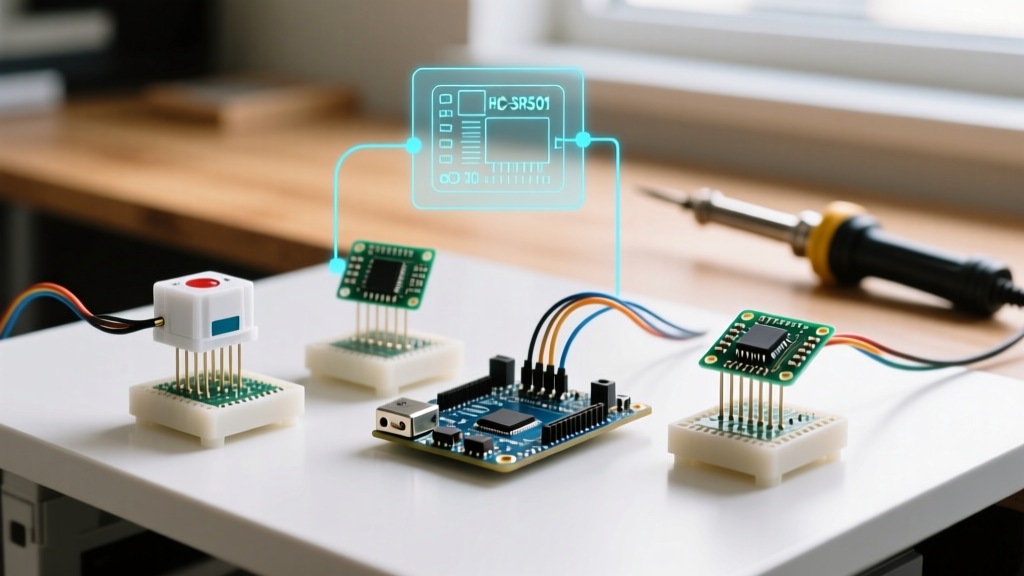

The Evolution of the Arduino Motion Sensor
When building automated lighting, security systems, or smart home peripherals, selecting the correct Arduino motion sensor is the difference between a reliable installation and a frustrating parade of false triggers. For years, the hobbyist and prototyping community relied almost exclusively on basic pyroelectric sensors. However, as of 2026, the landscape has shifted dramatically. Makers and engineers now have access to advanced Doppler radar and 24GHz millimeter-wave (mmWave) technologies that were previously reserved for expensive industrial applications.
But which technology actually fits your project? A sensor that works perfectly for a hallway burglar alarm might fail completely in a smart bathroom lighting setup. In this comprehensive component comparison, we will dissect the four most prominent motion and presence detection modules available for Arduino ecosystems: the HC-SR501 (Standard PIR), the RCWL-0516 (Microwave Radar), the AM312 (Micro PIR), and the HLK-LD2410 (24GHz mmWave). We will analyze their underlying physics, real-world pricing, wiring edge cases, and specific failure modes.
The Contenders: Breaking Down the Technologies
1. HC-SR501: The Classic Pyroelectric PIR
The HC-SR501 is the undisputed legacy champion of Arduino motion detection. Priced between $1.50 and $2.50, it utilizes a pyroelectric sensor paired with a BISS0001 signal processing IC to detect changes in infrared radiation. The distinctive white dome is a multi-faceted Fresnel lens that focuses IR energy from a 120-degree cone onto the sensor element.
- Pros: Extremely low power consumption in standby, simple digital HIGH/LOW output, and adjustable delay/sensitivity via onboard potentiometers.
- Cons: Cannot detect static presence. If a person sits perfectly still, the sensor will time out and turn off the lights. Highly susceptible to thermal false triggers.
- Expert Insight: The module features a 3-pin jumper for trigger modes. The 'H' position enables retriggerable mode (the timer resets with continuous motion), while 'L' enables non-retriggerable mode (the output goes LOW after the set delay, ignoring motion). Most smart home applications require the 'H' mode. For deeper integration, refer to Adafruit's comprehensive guide on PIR sensors.
2. RCWL-0516: 5.8GHz Doppler Microwave Radar
Selling for roughly $1.20 to $1.80, the RCWL-0516 emits a 5.8GHz microwave signal and measures the Doppler shift of the reflected waves. Unlike PIR, it does not rely on heat differentials, meaning it works flawlessly in extreme temperatures and can detect motion through thin non-metallic barriers like drywall, plastic, or wood.
- Pros: Wall-penetration capabilities allow for completely hidden installations (e.g., mounting behind a plastic 3D-printed enclosure). Unaffected by ambient light or temperature.
- Cons: The 5-7 meter detection radius is highly sensitive. It will easily detect motion through interior walls, leading to 'ghost triggers' from adjacent rooms. It also struggles with micro-motions like breathing.
- Expert Insight: The board includes pads for a CDS (Cadmium Sulfide) photoresistor. By soldering a photoresistor here, you can gate the sensor to only trigger in low-light conditions, saving processing cycles on your Arduino. See Random Nerd Tutorials' RCWL-0516 integration guide for the exact voltage divider math required for the CDS pad.
3. AM312: The Micro PIR for Wearables
The AM312 is a miniaturized PIR sensor, typically costing around $0.80 to $1.20. It strips away the bulky Fresnel lens and the BISS0001 adjustment pots, offering a fixed 3-meter range and a 2-second auto-delay. It operates on a wide voltage range (2.7V to 12V) but outputs a clean 3.3V logic signal.
- Pros: Tiny footprint (roughly 10x8mm), ultra-low standby current (under 10µA), and instant boot time (no 30-second initialization delay like the HC-SR501).
- Cons: Very short range, narrow detection angle without a secondary lens, and zero hardware adjustability.
- Best Use Case: Battery-powered Arduino wearables, portable camping lanterns, or inside tight 3D-printed enclosures where the HC-SR501 simply won't fit.
4. HLK-LD2410: 24GHz mmWave (The 2026 Standard)
The HLK-LD2410 has revolutionized DIY presence detection. Priced between $3.50 and $6.00, it uses Frequency Modulated Continuous Wave (FMCW) radar at 24GHz. Crucially, it does not just detect motion; it detects presence. It can sense the micro-movements of a human chest expanding during breathing, even if the subject is asleep and completely still.
- Pros: True static presence detection. Highly configurable 'gates' (spatial zones) via UART. Immune to temperature, light, and most environmental interference.
- Cons: Complex integration. Requires UART serial communication rather than a simple digital pin read. Higher power draw (~70mA active).
- Expert Insight: The default UART baud rate is an unusual 256,000 bps. Standard Arduino SoftwareSerial struggles at this speed. You must use hardware serial ports (like Serial1 on an Arduino Mega or Leonardo) or a high-performance ESP32. Furthermore, the TX/RX pins are 3.3V logic. Connecting a 5V Arduino Uno's TX pin directly to the LD2410's RX pin will eventually fry the sensor's UART receiver. Use a bidirectional logic level shifter or a simple MOSFET-based voltage divider. For advanced gate configuration, consult the Seeed Studio mmWave sensor documentation.
Head-to-Head Specification Matrix
| Feature | HC-SR501 (PIR) | RCWL-0516 (Radar) | AM312 (Micro PIR) | HLK-LD2410 (mmWave) |
|---|---|---|---|---|
| Detection Type | Infrared Heat Shift | Doppler Shift | Infrared Heat Shift | FMCW Phase Shift |
| Static Presence | No | No | No | Yes (Breathing) |
| Max Range | 7 Meters | 7 Meters | 3 Meters | 6 Meters (Target) |
| Wall Penetration | None | High (Non-metal) | None | Low (Plastics only) |
| Interface | Digital GPIO | Digital GPIO | Digital GPIO | UART / Bluetooth |
| Logic Level | 3.3V or 5V | 3.3V | 3.3V | 3.3V (Strict) |
| Avg Price (2026) | $1.50 - $2.50 | $1.20 - $1.80 | $0.80 - $1.20 | $3.50 - $6.00 |
Real-World Failure Modes and Troubleshooting
Theory is clean; real-world wiring is messy. Here are the specific edge cases and failure modes you will encounter when integrating these sensors into Arduino projects, along with actionable fixes.
PIR 'False High' Thermal Ghosting
The HC-SR501 and AM312 rely on a temperature differential between the human body (approx. 37°C) and the background. If your Arduino project is deployed in a sunroom, near an HVAC vent, or in a garage during a hot summer day where ambient temperatures exceed 32°C, the sensor's sensitivity plummets. Conversely, a sudden blast of hot air from a heater will cause a false trigger. Fix: Physically mask the edges of the Fresnel lens with electrical tape to narrow the field of view away from heat sources, or switch to mmWave.
Microwave Radar 'Vibration' Triggers
The RCWL-0516 is incredibly sensitive to physical vibration. If you mount it on a wooden stud shared with a closing door, or near a ceiling fan, the Doppler shift caused by the vibrating surface will mimic human motion. Fix: Isolate the sensor using a silicone dampening pad between the PCB and the mounting surface, and lower the sensitivity by adding a 1MΩ resistor across the sensitivity pads on the rear of the board.
mmWave 'Clutter' and Curtain Noise
The HLK-LD2410 is so sensitive that it will detect the micro-movements of a curtain blowing from an air conditioner, registering it as a human. Fix: You must use the manufacturer's Bluetooth app or send UART configuration commands from your Arduino to set 'Gate Sensitivities'. Divide the 6-meter range into 8 gates (0.75m each). Lower the sensitivity of the gates that correspond to the physical location of the curtains or ceiling fans, while keeping the gates over the bed or desk at maximum sensitivity.
Pro-Tip for UART Sensors: When debugging the HLK-LD2410 on an Arduino Mega, always double-check your TX/RX crossover. The sensor's TX pin must connect to the Arduino's RX pin (e.g., Pin 19), and the sensor's RX to the Arduino's TX (Pin 18). A common beginner mistake is wiring TX-to-TX, resulting in silent failures and zero serial output.
Decision Framework: Which Sensor for Which Project?
To finalize your Bill of Materials (BOM), use this quick decision matrix based on your project's environmental constraints:
- Choose the HC-SR501 if: You are building a basic intruder alarm, a shed light, or an outdoor wildlife camera trigger where the subject will be actively walking, and budget is the primary constraint.
- Choose the RCWL-0516 if: You need to hide the sensor completely inside a sealed, weatherproof PVC pipe or behind a thick 3D-printed PLA enclosure for an outdoor driveway alarm.
- Choose the AM312 if: You are designing a wearable device, a portable USB-powered desk gadget, or a battery-operated node where every microamp of standby current matters.
- Choose the HLK-LD2410 if: You are building smart home automation (like turning off a TV or lights based on room occupancy), a smart bed presence tracker, or an automated bathroom fan where the user will be sitting or lying perfectly still for extended periods.
Conclusion
The era of relying solely on basic PIR sensors for Arduino projects is over. While the HC-SR501 and AM312 remain excellent, budget-friendly choices for simple kinetic motion detection, the introduction of affordable microwave and mmWave modules has fundamentally changed what DIYers can achieve. By understanding the physics of Doppler shifts versus FMCW radar, and by respecting the strict 3.3V logic and UART requirements of modern sensors, you can build commercial-grade presence detection systems right from your workbench.