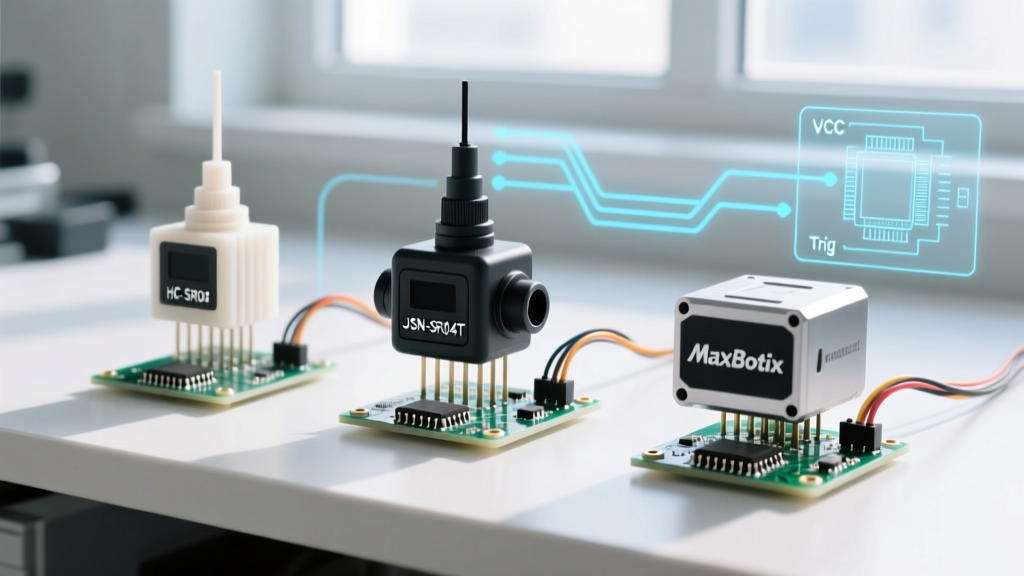

The Core Contenders: HC-SR04, JSN-SR04T, and MaxBotix MB1010
When integrating a sonar distance sensor Arduino projects, engineers and hobbyists typically default to the first module they find on a marketplace. However, ultrasonic time-of-flight (ToF) sensors vary wildly in acoustic design, signal processing, and environmental resilience. In 2026, the market is dominated by three distinct tiers of ultrasonic peripherals: the hobbyist-standard HC-SR04, the ruggedized JSN-SR04T, and the industrial-grade MaxBotix MB1010 LV-MaxSonar-EZ1.
Selecting the wrong module leads to ghost readings, acoustic multipath errors, and hardware failure in humid environments. This component comparison dissects the exact specifications, failure modes, and circuit-level quirks of each sensor to help you architect reliable embedded systems.
Specification Comparison Matrix
| Feature | HC-SR04 | JSN-SR04T (V3.0) | MaxBotix MB1010 |
|---|---|---|---|
| Average Price (2026) | $1.20 - $1.50 | $4.50 - $6.00 | $32.00 - $35.00 |
| Operating Frequency | 40 kHz | 40 kHz | 42 kHz |
| Maximum Range | 400 cm | 450 cm | 645 cm (254 inches) |
| Blind Zone | ~2 cm | ~20 cm | ~6 cm (unfiltered) |
| Beam Angle | 15° (effective) | 12° (narrow mesh) | 30° (wide conical) |
| Environmental Rating | IP20 (Indoor only) | IP67 (Probe only) | IP67 (With optional coating) |
| Interface Options | Trigger/Echo (Digital) | Trigger/Echo (Digital) | Analog, PWM, Serial (RS232) |
Tier 1: HC-SR04 — The Hobbyist Standard
The HC-SR04 is the ubiquitous blue 4-pin module found in almost every starter kit. It operates by sending an 8-cycle burst of 40 kHz ultrasound when the Trigger pin is held HIGH for 10 microseconds. The Echo pin then goes HIGH for a duration proportional to the distance.
Circuit-Level Quirks and Failure Modes
- The Voltage Multiplier: The HC-SR04 transducer requires roughly 10V to 16V to generate a loud enough acoustic ping. The module achieves this using an onboard MAX232-style charge pump circuit. If your Arduino's 5V rail is noisy or drooping under load, the charge pump fails to generate sufficient acoustic pressure, resulting in premature signal attenuation and falsely short distance readings.
- Acoustic Shadowing: With a 15-degree effective beam angle, the HC-SR04 struggles with edge detection. If an object is placed at a 25-degree offset, the sound wave deflects away from the receiver transducer, creating an acoustic shadow and reporting 'no obstacle'.
- Soft Target Absorption: 40 kHz ultrasound is heavily absorbed by porous materials. Testing against acoustic foam or heavy winter clothing will reduce the maximum effective range from 400 cm down to less than 50 cm.
Expert Tip: Never wire the HC-SR04 Echo pin directly to a 3.3V microcontroller (like the ESP32 or Raspberry Pi Pico) without a voltage divider. The 5V Echo output will degrade the GPIO over time. Use a 2kΩ and 3.3kΩ resistor network.
Tier 2: JSN-SR04T — The Waterproof Workhorse
The JSN-SR04T separates the transducer from the control board via a 2.5-meter shielded cable, allowing the IP67-rated probe to be mounted in wet environments like sump pumps, car washes, or outdoor rain barrels. As of 2026, the V3.0 revision is the standard, fixing many of the pull-up resistor issues that plagued the older V2.0 boards.
The 20cm Blind Zone Explained
The most common complaint regarding the JSN-SR04T is its massive 20 cm blind zone (compared to the HC-SR04's 2 cm). This is not a software bug; it is a physical acoustic limitation. The waterproof probe utilizes a metal mesh grill to protect the piezoelectric element. When the 40 kHz burst is fired, the acoustic energy rings against the inside of this metal mesh. The control board must intentionally blank the receiver for roughly 1.2 milliseconds to prevent this 'ringing' from being interpreted as a close-range object. At 343 m/s, 1.2 ms equates to a ~20 cm physical blind spot.
Best Use Cases
- Liquid level sensing in water tanks (mounting the probe facing straight down from the lid).
- Automotive reverse-parking assistants (where objects closer than 20cm are already in the bumper's crush zone).
- Agricultural soil-depth profiling where dust and moisture destroy exposed PCBs.
Tier 3: MaxBotix MB1010 — The Industrial Benchmark
Priced around $34.00, the MaxBotix MB1010 LV-MaxSonar-EZ1 is in a completely different performance class. It features continuous wave-variable bandwidth filtering, internal temperature compensation, and three simultaneous output interfaces: Analog Voltage, PWM, and RS232 Serial.
Why the Premium Price Tag?
Cheap modules like the HC-SR04 use fixed-gain amplifiers. If a loud acoustic reflection returns early, the amplifier saturates, and subsequent weaker echoes (multipath signals) are entirely missed. The MB1010 utilizes a dynamically controlled variable-gain amplifier. It suppresses the receiver gain immediately after the ping and ramps it up as time passes, perfectly matching the inverse-square law of acoustic decay. This results in incredibly stable readings even in cluttered, highly reflective environments like indoor warehouses.
Analog Output Noise and Filtering
While the MB1010 offers an analog output (scaling roughly 9.8mV per inch on a 5V reference), it is highly susceptible to 50Hz/60Hz mains hum. According to MaxBotix Official Tutorials, you must implement a hardware low-pass filter if using the ADC. A simple RC filter using a 10kΩ resistor and a 0.1µF ceramic capacitor placed directly at the Arduino's analog input pin will eliminate the AC ripple, providing a rock-solid DC voltage proportional to distance.
Environmental Drift: The Physics of Temperature Compensation
A frequently overlooked factor in sonar distance sensor Arduino implementations is the speed of sound. Ultrasonic sensors calculate distance by multiplying the time-of-flight by the speed of sound. Most basic libraries hardcode this value at 343 meters per second, which is only accurate at 20°C (68°F).
In reality, the speed of sound in dry air fluctuates by roughly 0.6 m/s for every 1°C change. If your outdoor JSN-SR04T operates at 0°C in the winter, the speed of sound drops to 331 m/s. Over a 4-meter distance, this temperature delta introduces a measurement error of nearly 15 centimeters.
As documented by The Engineering Toolbox, you can compensate for this in your firmware using the formula: v = 331.4 + (0.6 * T_c). By adding a $2.00 DS18B20 digital thermometer to your I2C or OneWire bus, you can dynamically update the speed of sound variable in your distance calculation, reducing environmental error to less than 1%.
Advanced Troubleshooting: Multipath and Cross-Talk
When deploying multiple sonar sensors on a single robot chassis, cross-talk is inevitable. Sensor A fires a ping, which glances off a curved wall and hits Sensor B's receiver. Sensor B interprets this as a nearby obstacle, triggering a phantom stop command.
Solving Cross-Talk with Time-Division Multiplexing
Do not attempt to fire multiple HC-SR04 sensors simultaneously. Instead, implement a round-robin polling sequence in your Arduino code. Fire Sensor 1, wait for the Echo to drop LOW, add a 30-millisecond acoustic settling delay to allow residual room echoes to dissipate, and then fire Sensor 2. For a 4-sensor array, this full sweep takes roughly 200 milliseconds, yielding a 5Hz update rate—more than sufficient for indoor roving robots traveling under 1 meter per second.
For high-speed applications requiring simultaneous firing, you must physically isolate the sensors using acoustic dampening foam and angle them away from each other, or upgrade to the MaxBotix series which supports a 'chaining' mode via its serial TX/RX pins, allowing the master sensor to sequentially command the slave sensors to fire without microcontroller intervention.
Final Verdict: Which Sensor Should You Choose?
Your choice of a sonar distance sensor Arduino module must be dictated by the physical environment and the cost of failure.
- Choose the HC-SR04 if you are building an indoor, climate-controlled project on a strict budget, and your targets are solid, flat surfaces within a 3-meter range.
- Choose the JSN-SR04T if your application involves liquids, high humidity, or outdoor deployment, provided you can design your mechanical enclosure to accommodate the 20 cm blind zone.
- Choose the MaxBotix MB1010 for commercial robotics, medical device proximity sensing, or any application where a false reading could result in mechanical collision or financial loss. The hardware-level signal processing justifies the 20x price premium.
For further reading on embedded sensor integration, consult the Arduino Official Sensor Documentation to ensure your GPIO interrupt routines are optimized for microsecond-accurate pulse width measurement.