
The Legacy of the Blue Board: L298N and Arduino
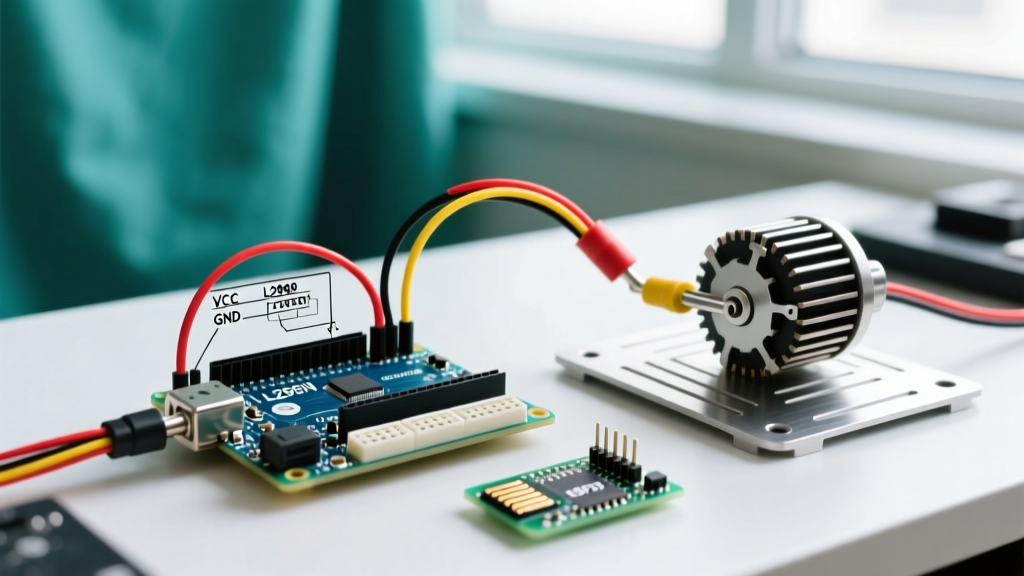
If you have ever built a DIY robot, automated a camera slider, or wired up a smart car, you have likely encountered the iconic red-and-blue dual H-bridge module. For over a decade, the pairing of the L298N and Arduino has been the undisputed starting point for hobbyist motor control. Based on the STMicroelectronics L298P bipolar junction transistor (BJT) IC, this module is cheap, widely available, and heavily documented.
However, as we navigate the electronics landscape in 2026, silicon technology has moved on. Modern MOSFET-based drivers like the Toshiba TB6612FNG and Texas Instruments DRV8833 offer vastly superior efficiency, lower heat generation, and better logic-level compatibility. In this deep-dive component comparison, we will dissect the electrical realities of the L298N against modern alternatives, examining voltage drops, thermal failure modes, and PWM limitations to help you choose the right peripheral for your next microcontroller project.
Bipolar vs. MOSFET: The Physics of Voltage Drop
The most critical flaw in the L298N design is its internal topology. According to the STMicroelectronics L298 Datasheet, the IC utilizes Darlington BJT pairs to switch the motor current. While robust against voltage spikes, BJTs require a significant base-emitter voltage to saturate.
The 2.5V Tax
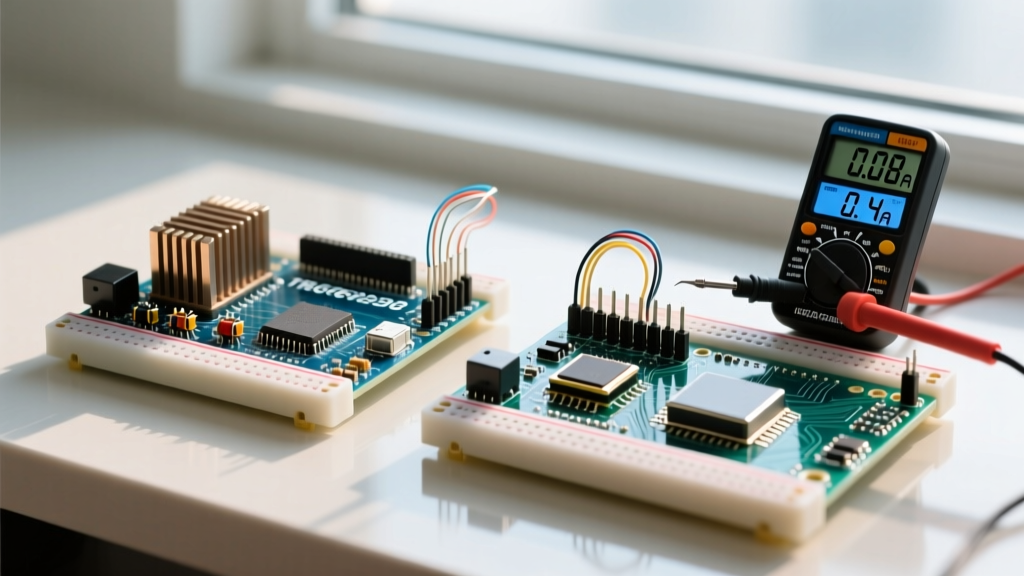
When driving a motor through an L298N, you lose a minimum of 1.8V to 3.2V across the H-bridge, depending on the current draw. If you power your Arduino robot with a 2S LiPo battery (7.4V nominal), your motors will only ever see roughly 5.4V at peak performance. This massive voltage drop manifests as waste heat, necessitating the bulky aluminum heatsink bolted to the top of the blue module.
In contrast, modern drivers use N-channel and P-channel MOSFETs. The TB6612FNG Hookup Guide by SparkFun highlights that MOSFETs behave like resistors when fully enhanced, characterized by their $R_{DS(on)}$ (drain-source on-resistance). At 1A, the TB6612FNG drops a mere 0.5V (0.25V per MOSFET in the H-bridge path), returning nearly 90% of your battery voltage directly to the motor.
Expert Insight: Never use an L298N for low-voltage applications (e.g., 3.7V single-cell LiPo or 4.5V AA battery packs). The internal voltage drop will starve the motor and cause the logic circuitry to brown out.
Head-to-Head Comparison Matrix
Below is a technical comparison of the most common motor drivers used with Arduino, ESP32, and STM32 boards in 2026.
| Feature | L298N (Classic) | TB6612FNG (Toshiba) | DRV8833 (TI) | BTS7960 (Infineon) |
|---|---|---|---|---|
| Internal Topology | BJT (Darlington) | MOSFET | MOSFET | MOSFET (Half-Bridge) |
| Continuous Current | 2.0A per channel | 1.2A per channel | 1.5A per channel | 27.0A per channel |
| Peak Current | 3.0A (brief) | 3.2A (1 sec) | 2.0A | 43.0A |
| Voltage Drop @ 1A | ~2.5V | ~0.5V | ~0.4V | ~0.1V |
| Logic Level (V_IL/V_IH) | 1.5V / 2.3V | 1.0V / 2.0V | 0.8V / 2.0V | 1.5V / 3.3V |
| Quiescent Current | ~36mA | ~2µA (Standby) | ~0.8µA (Sleep) | ~100µA |
| Avg. Module Price | $2.50 - $4.00 | $3.50 - $5.50 | $2.00 - $3.50 | $8.00 - $14.00 |
Real-World Failure Modes and Edge Cases
When integrating the L298N and Arduino in continuous-duty applications, several hardware-level failure modes frequently trap beginners.
1. Flyback Diode Thermal Runaway
The L298N module relies on 1N4007 diodes arranged in a freewheeling configuration to protect against inductive kickback. However, the 1N4007 is a standard rectifier diode, not a fast-recovery or Schottky diode. When you apply a high-frequency PWM signal (e.g., 20kHz from an Arduino analogWrite()), the diodes cannot switch fast enough. This leads to cross-conduction, massive heat generation on the diodes, and eventual PCB trace melting.
- Fix: If you must use an L298N with high-frequency PWM, physically desolder the 1N4007 diodes and replace them with 1N5819 Schottky diodes.
2. Ground Loop Logic Corruption
Many cheap L298N clones feature poorly isolated ground planes. When a heavy DC motor starts, it pulls a massive inrush current. If the Arduino's ground is tied to the motor ground at the L298N's screw terminal, the voltage potential on the ground line can bounce by 1-2 volts. This "ground bounce" pushes the logic pins out of spec, causing the Arduino to reset or behave erratically.
- Fix: Always use a star-ground topology. Connect the battery negative, the L298N GND, and the Arduino GND to a single, thick bus bar or heavy-gauge wire nut, keeping the high-current motor paths physically separated from the logic paths.
The 3.3V Logic Problem: ESP32 and Raspberry Pi Pico
While the L298N and Arduino (specifically 5V boards like the Uno R3 or Mega 2560) communicate flawlessly, modern 3.3V microcontrollers struggle with the L298N. The L298N requires a minimum High-level Input Voltage ($V_{IH}$) of 2.3V, which a 3.3V ESP32 can technically provide. However, due to voltage sag on breadboards and long jumper wires, the signal often drops below the threshold, resulting in stuttering motors.
Furthermore, the L298N board includes an onboard 5V linear regulator (78M05) to power its internal logic. If you attempt to feed this regulator from a high-voltage source (e.g., 24V for a stepper motor), the regulator will overheat and shut down, killing the logic side while the motor side remains dangerously live.
The Modern Alternative: DRV8833
For low-to-medium current applications (under 1.5A), the Texas Instruments DRV8833 is the superior 2026 choice. It operates natively on 3.3V logic, includes internal fast-recovery clamp diodes, features a dedicated sleep pin to drop quiescent current to sub-microamp levels, and costs less than $3 on breakout boards. It fits perfectly on a standard solderless breadboard, unlike the bulky L298N shield or module.
When to Stick with the L298N
Despite its inefficiencies, the L298N still holds specific advantages:
- High Voltage Tolerance: The L298N supports up to 46V absolute maximum. The TB6612FNG and DRV8833 cap out around 15V. If you are driving 24V or 36V industrial stepper motors, the L298N (or a dedicated TB6560 chopper) remains relevant.
- Physical Robustness: The heavy screw terminals and thick PCB traces of the L298N can handle accidental shorts and physical abuse better than fragile SMD breakout boards.
- Educational Value: The 5V onboard regulator provides a convenient, albeit limited, 5V rail to power an Arduino Uno directly from a 7V-12V battery pack, eliminating the need for a secondary voltage converter in basic prototypes.
Final Verdict: Choose Your Silicon Wisely
The era of defaulting to the L298N for every microcontroller project is over. If you are building a battery-powered mobile robot using a 3.3V ESP32 or a 5V Arduino Nano, the TB6612FNG will double your battery life, eliminate the need for a heatsink, and fit neatly onto a breadboard. If you need to drive massive 12V windshield wiper motors drawing 10A+, bypass both and opt for a BTS7960 high-power driver module.
Reserve the classic L298N and Arduino combination for high-voltage (24V+) stepper applications, heavy-duty educational kits where physical robustness is prioritized over efficiency, or when you simply need a cheap 5V power rail for a quick weekend prototype.