
Most hobbyist tutorials teach you to wire up an HC-SR04 and call the pulseIn() function. While this works for a simple weekend project, it completely ignores the hardware realities outlined in the sensor's datasheet. When you move from a blinking LED to a multi-sensor autonomous rover or a precision fluid-level monitor, blocking code and unhandled edge cases will cause your microcontroller to stutter, miss interrupts, and fail.
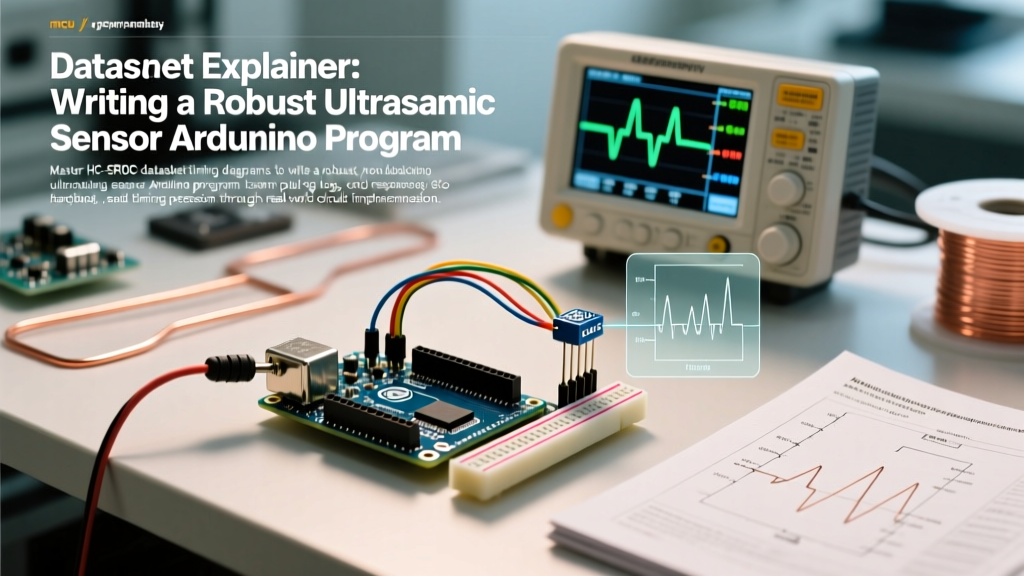
In this datasheet explainer, we are going to dissect the actual timing diagrams of the ubiquitous HC-SR04 and its waterproof sibling, the JSN-SR04T. By understanding the 40kHz burst mechanics and the 38ms timeout trap, you will learn how to write a production-grade, non-blocking ultrasonic sensor Arduino program that respects your MCU's clock cycles.
Decoding the HC-SR04 Timing Diagram
The HC-SR04 datasheet specifies a very precise sequence of events to initiate a distance reading. It is not simply 'turn on a pin and wait'. The sequence operates as follows:
- The Trigger Pulse: The MCU must pull the Trigger pin HIGH for a minimum of 10µs (microseconds). This acts as a hardware reset and start signal for the sensor's internal control logic.
- The 40kHz Burst: Upon detecting the 10µs trigger, the sensor automatically emits eight cycles of a 40kHz ultrasonic burst. This takes exactly 200µs (8 cycles / 40,000 Hz = 0.0002 seconds).
- The Echo Pin: Immediately after the burst, the sensor pulls the Echo pin HIGH. It remains HIGH until the acoustic echo returns to the receiver transducer, or until a hard internal timeout of 38ms is reached.
The Math Behind the Echo Pulse
At 20°C (68°F), the speed of sound in dry air is approximately 343.2 meters per second. Because the ultrasonic wave must travel to the target and back (round-trip), we must divide the distance by two. According to standard acoustic physics and Texas Instruments' application notes on ultrasonic sensing, calculating the distance in centimeters based on the Echo HIGH time (in microseconds) simplifies to:
Distance (cm) = Echo Pulse Width (µs) / 58.3
If the sensor times out after 38ms (38,000µs) without receiving an echo, it registers a distance of roughly 651 cm. In your code, any value at or above this threshold must be treated as an 'Out of Range' error, not a valid physical measurement.
Why pulseIn() Fails in Production
The official Arduino pulseIn() reference documents that this function waits for the pin to go HIGH, starts counting, and waits for it to go LOW. This is a blocking operation.
If your sensor is pointed down an empty hallway and hits the 38ms timeout, your ATmega328P or ESP32 is completely paralyzed for 38 milliseconds. If you have an array of three ultrasonic sensors to avoid crosstalk, you must fire them sequentially. Three timeouts equal 114ms of dead time. During this window, your motor PID controllers will wind up, your OLED display will freeze, and your IMU sensor fusion filter will drift.
Writing a Non-Blocking Ultrasonic Sensor Arduino Program
To write a robust ultrasonic sensor Arduino program, we must abandon pulseIn() and use a state machine driven by the micros() timer. This allows the MCU to handle the sensor's timing requirements in the background while the main loop continues to execute thousands of times per second.
The State Machine Architecture
We divide the sensor reading into four distinct states:
- STATE_IDLE: Waiting for the next polling interval.
- STATE_TRIGGER: Sending the 10µs pulse and immediately moving to the next state.
- STATE_WAIT_ECHO: Polling the Echo pin for a HIGH signal (handling the ~200µs burst delay).
- STATE_MEASURE: Recording the
micros()timestamp when Echo goes HIGH, and capturing the final duration when it drops LOW.
// Non-Blocking Ultrasonic Sensor Arduino Program (State Machine)
enum SensorState { IDLE, TRIGGER, WAIT_ECHO, MEASURE };

class NonBlockingHC_SR04 {
private:
  uint8_t trigPin, echoPin;
  SensorState state;
  unsigned long stateTimer;
  unsigned long echoStart;
  float lastDistance;

public:
  NonBlockingHC_SR04(uint8_t t, uint8_t e) : trigPin(t), echoPin(e) {
    pinMode(trigPin, OUTPUT);
    pinMode(echoPin, INPUT);
    state = IDLE;
    lastDistance = -1.0;
  }

  void update() {
    unsigned long now = micros();
    switch (state) {
      case IDLE:
        if (now - stateTimer >= 60000) { // 60ms polling to prevent crosstalk
          state = TRIGGER;
        }
        break;

      case TRIGGER:
        digitalWrite(trigPin, HIGH);
        delayMicroseconds(10); // Datasheet requires minimum 10us
        digitalWrite(trigPin, LOW);
        stateTimer = now;
        state = WAIT_ECHO;
        break;

      case WAIT_ECHO:
        if (digitalRead(echoPin) == HIGH) {
          echoStart = micros();
          state = MEASURE;
        } else if (now - stateTimer > 1000) {
          state = IDLE; // Timeout waiting for burst to finish
          stateTimer = now;
        }
        break;

      case MEASURE:
        if (digitalRead(echoPin) == LOW) {
          unsigned long duration = micros() - echoStart;
          if (duration < 38000) { // Datasheet 38ms max timeout
            lastDistance = (float)duration / 58.3;
          } else {
            lastDistance = -1.0; // Out of range
          }
          state = IDLE;
          stateTimer = micros();
        } else if (now - echoStart > 40000) {
          state = IDLE; // Hard fail-safe timeout
          stateTimer = now;
        }
        break;
    }
  }

  float getDistance() { return lastDistance; }
};

NonBlockingHC_SR04 frontSensor(9, 10);

void setup() {
  Serial.begin(115200);
}

void loop() {
  frontSensor.update(); // Runs in microseconds, never blocks

  // Main loop remains free for motor control, displays, etc.
  float dist = frontSensor.getDistance();
  if (dist > 0) {
    Serial.print('Distance: '); Serial.println(dist);
  }
}
Datasheet Edge Cases & Hardware Failure Modes
As of 2026, while the core 40kHz transducer technology remains unchanged, manufacturing variations in cheap clone boards introduce specific hardware failure modes that your software must anticipate.
| Parameter | HC-SR04 (Standard) | JSN-SR04T (V3.0 Waterproof) | Real-World Software Implication |
|---|---|---|---|
| Operating Voltage | 5V DC (Strict) | 3.3V - 5V DC | HC-SR04 on 3.3V logic often fails to trigger; requires a logic level shifter. |
| Quiescent Current | 2mA | 5mA | Minimal impact on battery life. |
| Peak Burst Current | 15mA | 20mA | Can cause brownouts on weak 3.3V LDOs; add a 100µF decoupling capacitor. |
| Blind Zone | ~2cm | ~20cm | JSN-SR04T cannot detect objects closer than 20cm; code must filter < 20cm as noise. |
| Max Range | 400cm | 600cm | Readings > 400cm on HC-SR04 are usually acoustic ghosting; discard them. |
Failure Mode 1: The 38ms Ghost Echo
If the sensor is placed in an environment with high acoustic reflectivity (e.g., a plastic enclosure or parallel walls), the 40kHz burst can bounce multiple times before returning. The internal timer stops at the first threshold crossing, but if the signal is weak, the comparator might not trip until a secondary reflection arrives. If your code does not explicitly cap the math at the 38ms datasheet limit, a delayed echo can result in a calculated distance of 800+ cm, causing a robot to drive into a wall.
Failure Mode 2: Acoustic Crosstalk in Arrays
If you are building a 4-sensor array for 360-degree collision avoidance, firing them simultaneously will result in Sensor A receiving the 40kHz burst from Sensor B. The datasheet implicitly requires a recovery and clearing time between pings. The 60ms polling interval implemented in the state machine code above is specifically chosen to allow the acoustic energy in a standard room to dissipate below the receiver's noise floor before the next sensor fires.
Expert Troubleshooting Matrix
When your ultrasonic sensor Arduino program returns erratic data, use this diagnostic matrix before rewriting your code:
- Symptom: Sensor always returns 0 cm.
Datasheet Root Cause: Trigger pulse is < 10µs, or the 5V rail is sagging below 4.5V during the 15mA burst, resetting the internal logic gate.
Fix: Verify trigger timing with an oscilloscope; add a 100µF electrolytic capacitor across VCC and GND. - Symptom: Sensor returns random values between 300cm and 600cm indoors.
Datasheet Root Cause: Acoustic multipath interference or soft surfaces (like curtains) absorbing the 40kHz wave, pushing the return signal below the comparator threshold until the 38ms timeout.
Fix: Implement a software median filter (take 5 readings, discard the highest and lowest, average the rest). - Symptom: JSN-SR04T reads '20cm' when completely uncovered.
Datasheet Root Cause: The waterproof transducer has a physical acoustic ring-down time. The receiver is deaf while the transmitter is vibrating.
Fix: Hardcode a software blind-spot. Any reading < 22cm on a JSN-SR04T must be flagged as an invalid 'Too Close' state.
Conclusion
Writing a reliable ultrasonic sensor Arduino program requires looking past the basic hobbyist tutorials and respecting the physics and timing constraints detailed in the component datasheets. By replacing blocking functions with a microsecond-accurate state machine, handling the 38ms timeout gracefully, and accounting for hardware-specific blind zones, you elevate your project from a fragile prototype to a robust, production-ready embedded system.