
Understanding the Arduino Soft Reset Anomaly
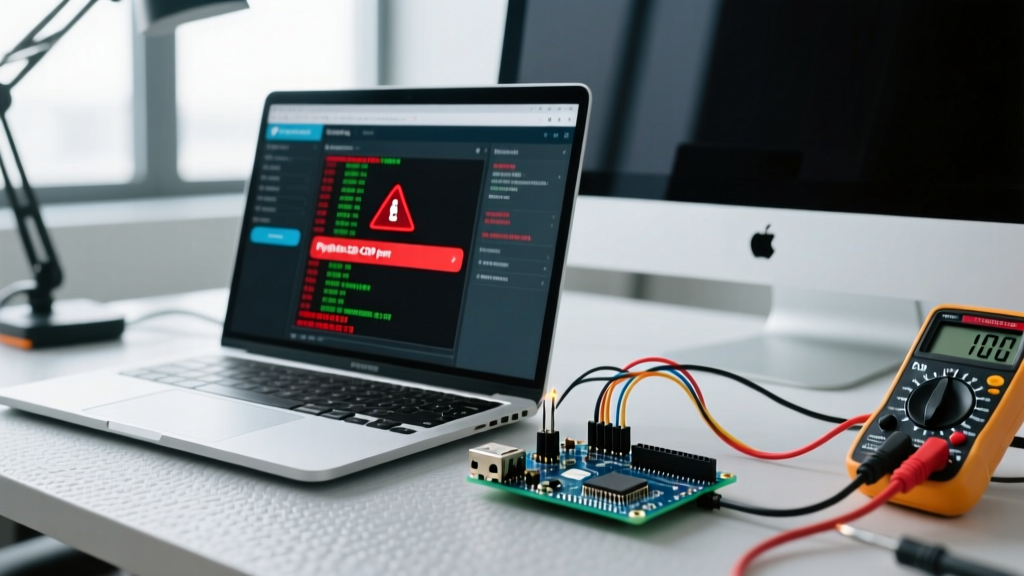
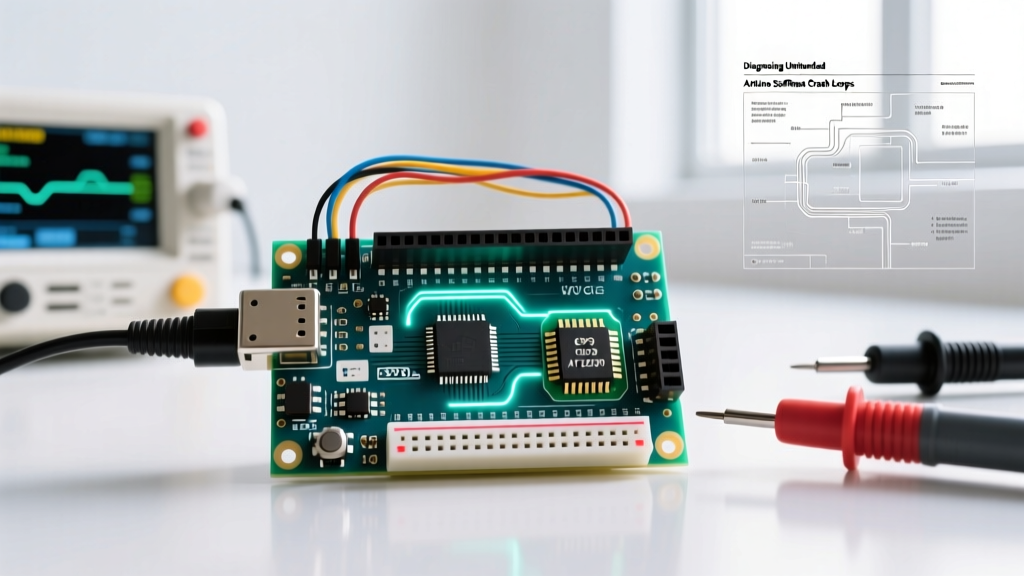
When an embedded project randomly restarts without a physical trigger, you are witnessing an unintended Arduino soft reset. Unlike a hardware reset—where the RESET pin is pulled LOW or the DTR line is toggled via the USB UART bridge—a soft reset originates from within the silicon's execution state or the sketch itself. In the maker community, this is often colloquially called the 'bootloop of death,' and it is one of the most frustrating failure modes to diagnose because the serial monitor simply prints the setup sequence over and over without an obvious error code.
As of 2026, with the proliferation of cheap ATmega328P clones and high-power ESP32-S3 dev boards, soft resets have evolved beyond simple code bugs. They are frequently triggered by peripheral bus lockups, heap fragmentation, and aggressive brownout detection (BOD) circuits. To fix a crash loop, you must first determine if the microcontroller is deliberately resetting itself via a software vector, or if a hardware protection mechanism is forcing a restart due to an unstable environment.
Top 4 Culprits of Soft Reset Crash Loops
Before attaching a logic analyzer or rewriting your firmware, compare your symptoms against the most common failure modes that trigger a soft reset.
| Failure Mode | Trigger Mechanism | AVR (Uno/Nano) Symptom | ESP32 Symptom | Diagnostic Tool |
|---|---|---|---|---|
| Stack Overflow | Deep recursion or massive local arrays overwrite the heap. | Random restarts, corrupted serial output. | Guru Meditation Error (Stack canary failed), then reboot. | Memory profiling, static analysis. |
| I2C Bus Lockup | SDA line held LOW by a slave during a power glitch. | Sketch hangs indefinitely (or WDT triggers reset). | Wire library timeout, task watchdog triggers reset. | 24MHz Logic Analyzer, oscilloscope. |
| Heap Fragmentation | Dynamic memory allocation (String class) exhausts RAM. | malloc() fails, null pointer dereference causes reset. | Reboot with 'Heap corrupted' panic message. | FreeMemory() tracking functions. |
| Watchdog Starvation | WDT enabled but wdt_reset() missed in a long loop. | Immediate restart, bootloader may get stuck. | Task Watchdog Timer (TWDT) panic and reboot. | Serial debug, MCUSR register read. |
AVR ATmega328P: Reading the MCUSR Register
On 8-bit AVR boards like the Arduino Uno or Nano, the microcontroller stores the reason for its last reset in the MCUSR (Microcontroller Unit Status Register). By reading this register at the very beginning of your setup() function, you can definitively prove whether a restart was a software fault or a hardware event.
The MCUSR contains four critical bits:
- PORF: Power-on Reset Flag (Voltage dropped below the BOD threshold).
- EXTRF: External Reset Flag (The physical RESET pin was pulled LOW).
- BORF: Brown-out Reset Flag (Supply voltage dipped below BOD setting, e.g., 2.7V).
- WDRF: Watchdog Reset Flag (The WDT timer expired, causing a soft reset).
Implementing the Diagnostic Snippet
Insert this code at the absolute top of your setup() function. It is critical to clear the MCUSR and disable the watchdog immediately. If you do not, and your sketch crashes again, the bootloader (specifically older Optiboot versions found on Nano clones) will inherit the active WDT and get trapped in an infinite reset loop before your sketch even loads.
#include <avr/wdt.h>

void setup() {
  // Read MCUSR before clearing it
  byte mcusr_mirror = MCUSR;
  MCUSR = 0; // Clear reset flags
  wdt_disable(); // Prevent bootloader lockup

  Serial.begin(115200);

  if (mcusr_mirror & (1 << WDRF)) Serial.println("RESET: Watchdog (Soft)");
  if (mcusr_mirror & (1 << BORF)) Serial.println("RESET: Brownout (Power Dip)");
  if (mcusr_mirror & (1 << EXTRF)) Serial.println("RESET: External Pin");
  if (mcusr_mirror & (1 << PORF)) Serial.println("RESET: Power-On");
}
Expert Insight: If your serial monitor repeatedly prints 'RESET: Watchdog (Soft)', but you never explicitly enabled the Watchdog Timer in your code, you are likely suffering from a stack overflow that is corrupting the WDT control registers, or a peripheral I2C lockup that is causing the default Arduino hidden WDT to trip.
ESP32 Soft Reset Diagnostics and Brownouts
The ESP32 architecture handles resets differently than the AVR. When an ESP32 undergoes an unintended soft reset, it usually outputs a 'Guru Meditation Error' or a Brownout Detector (BOD) trigger over the UART0 serial console at 115200 baud. According to the Microchip ATmega328P and Espressif technical documentation, modern 32-bit MCUs have built-in reset reason APIs.
To diagnose ESP32 soft resets, use the esp_reset_reason() function provided by the ESP-IDF framework. A very common issue in 2026 with budget ESP32-WROOM-32 clones is the 'Brownout detector was triggered' error. This happens when the WiFi radio initiates a transmission, causing a current spike of up to 500mA. The onboard AMS1117-3.3 LDO voltage regulator cannot respond fast enough, the voltage drops below 2.4V, and the silicon forces a soft reset to protect the flash memory from corruption.
Fixing the ESP32 Brownout Soft Reset
- Hardware Fix: Desolder the cheap AMS1117 LDO and replace it with a high-transient-response buck converter or a modern LDO like the ME6211C33, which handles 500mA spikes effortlessly.
- Software Workaround: If you are in the field and cannot modify the hardware, you can disable the BOD in software. Add
WRITE_PERI_REG(RTC_CNTL_BROWN_OUT_REG, 0);at the top of your setup. Warning: This risks flash corruption if a genuine power failure occurs during a write operation.
The Danger of 'jmp 0' vs. Watchdog Timers
Many makers attempt to force a deliberate Arduino soft reset by using inline assembly to jump the program counter back to address zero: asm volatile (" jmp 0");. This is a dangerous anti-pattern.
Jumping to 0x0000 does not clear the hardware registers, disable active timers, or reset the state of peripheral interrupts. When the setup() function runs again, it attempts to re-initialize hardware that is already in an unknown state, often leading to immediate I2C lockups or UART baud rate mismatches. For a deep dive into safe reset vectors, Nick Gammon's Watchdog Guide remains the definitive resource on AVR architecture.
The industry-standard method for executing a safe, deliberate soft reset is to enable the Watchdog Timer with a 15ms timeout and then enter an infinite while(1) loop. This allows the WDT to expire, triggering a hardware-level reset that properly clears all silicon registers and peripheral states, mimicking a physical button press perfectly.
Memory Leaks and Heap Fragmentation
A hidden cause of delayed soft resets is heap fragmentation, heavily documented in the official Arduino Memory Guide. If your sketch uses the String class to parse JSON or MQTT payloads, it continuously allocates and deallocates small blocks of SRAM. Over hours or days, the heap becomes fragmented. Eventually, a request for a contiguous block of memory fails, returning a null pointer. When your sketch attempts to write to that null pointer, the MCU encounters a fatal exception and triggers a soft reset.
The Fix: Abandon the String object entirely in production firmware. Use fixed-size char arrays and standard C functions like strncpy() and strtok(). This guarantees deterministic memory usage and eliminates heap fragmentation as a vector for unintended soft resets.
Summary Checklist for Diagnosis
- Read the MCUSR (AVR) or esp_reset_reason() (ESP32) to identify the exact reset vector.
- Monitor SRAM usage to rule out heap fragmentation caused by dynamic Strings.
- Use a logic analyzer to check for I2C SDA lines stuck LOW, which cause task watchdog timeouts.
- Verify your power supply can handle RF transmission spikes (500mA+) without tripping the Brownout Detector.
- Never use
jmp 0; always rely on the Watchdog Timer for deliberate software resets.