
The Niche Intersection: Wilderness Camping & Regional Photo Hosting
Combining backcountry camping with automated digital documentation is a premier use case for low-power IoT devices. For makers in Central Europe, the camping rajce idnes cz arduino workflow represents a highly specific but incredibly rewarding project: building an off-grid trail camera that automatically uploads captured wildlife or campsite photos to the popular Czech image-hosting service, Rajce (idnes.cz). While most tutorials focus on AWS S3 or generic FTP servers, integrating the Arduino IDE with regional platforms like Rajce requires a deep understanding of HTTP multipart boundaries, session authentication, and extreme low-power hardware design.
As of 2026, the AI-Thinker ESP32-CAM remains the undisputed king of budget DIY trail cameras. However, pushing a 100KB+ JPEG from a forest canopy to a specific web API endpoint while running on a single 18650 lithium cell demands rigorous power budgeting and precise code architecture. This quick-reference FAQ and technical guide breaks down the exact hardware, software, and edge-case troubleshooting required to make this integration seamless.
Hardware BOM & Power Budget Matrix
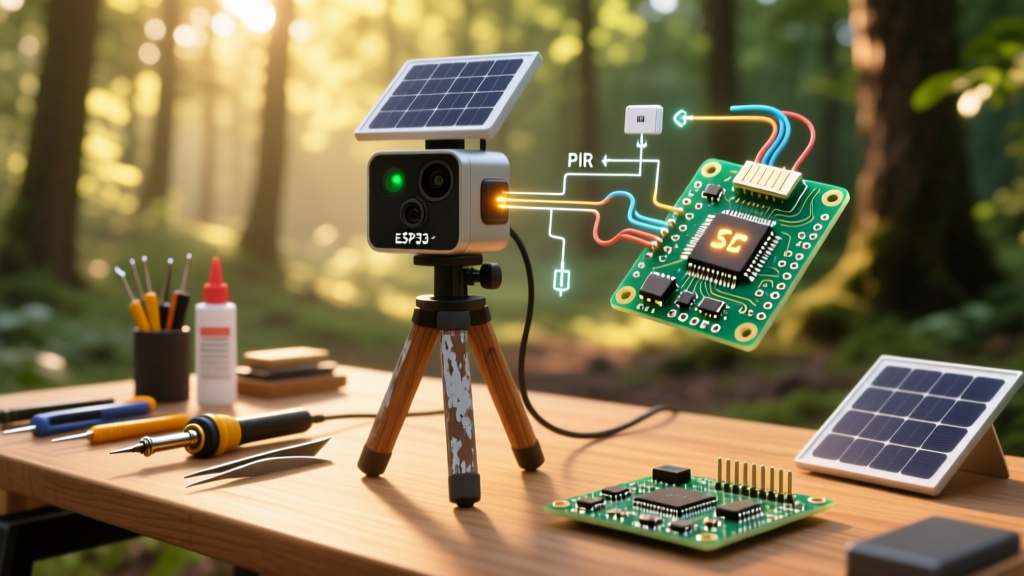
Before writing a single line of Arduino C++, you must validate your power budget. A camping trail cam spends 99% of its life in deep sleep. Using a standard HC-SR501 PIR sensor (which draws ~150µA continuously) will drain your battery in weeks. We use the AM312 Mini PIR instead.
| Component | Specific Model / Variant | Approx. Cost (2026) | Active Current | Standby Current |
|---|---|---|---|---|
| MCU & Camera | AI-Thinker ESP32-CAM + OV2640 (w/ IR-Cut) | $9.50 | 160mA (Capture) | 150µA (Deep Sleep) |
| Motion Sensor | AM312 Mini PIR (Non-latching) | $1.20 | 15mA | 12µA |
| Power Management | 18650 Shield w/ TP4056 & 5V Boost | $3.50 | N/A | ~80µA (Quiescent) |
| Energy Harvesting | 5V 300mA Epoxy Solar Panel (110x60mm) | $8.00 | N/A | N/A |
| Local Storage | SanDisk Ultra 16GB microSD (Class 10) | $6.00 | 30mA (Write) | ~10µA |
Total BOM Cost: ~$28.20
According to Texas Instruments' battery life estimation guidelines, calculating the daily mAh consumption is critical. With a combined standby current of roughly 242µA, the system consumes ~5.8mAh per day in deep sleep. A 3000mAh 18650 cell provides over 500 days of baseline autonomy, easily bridging multi-week camping trips during low-light winter months.
FAQ: Rajce idnes.cz Arduino API Mechanics
Q: Does Rajce (idnes.cz) offer an official Arduino or IoT API?
A: No. Rajce is designed for consumer web and desktop uploads. However, their backend accepts standard multipart/form-data HTTP POST requests. By reverse-engineering the headers sent by the official Rajce Windows desktop uploader, we can trick the server into accepting uploads directly from the ESP32's HTTPClient library. You must spoof the User-Agent to match their desktop client to avoid immediate 403 Forbidden rejections from their WAF (Web Application Firewall).
Q: How do I handle authentication tokens in the Arduino IDE?
A: Rajce requires an active session cookie or an API token generated via a preliminary login POST request. In a camping scenario where the device might reboot or lose power, hardcoding a session cookie is a failure point.
The Fix: Program the ESP32 to perform a lightweight application/x-www-form-urlencoded POST to the Rajce login endpoint upon waking, extract the Set-Cookie header from the response, store it in RTC memory, and append it to the subsequent image upload request.
Q: Why does my upload fail on 4G but work on my home WiFi?
A: Camping environments often rely on a paired 4G LTE router (like a GL.iNet GL-X3000) broadcasting a local WiFi SSID. Cellular networks frequently employ CGNAT (Carrier-Grade NAT) and aggressive MTU (Maximum Transmission Unit) limits. If your JPEG is 150KB, sending it in a single TCP packet will result in silent drops. You must configure the Espressif Arduino Core HTTPClient to use chunked transfer encoding.
Deep Sleep & PIR Wakeup Architecture
The cornerstone of any camping trail cam is the wakeup mechanism. The ESP32-CAM must be entirely powered down, with only the RTC (Real-Time Clock) memory and ULP (Ultra-Low-Power) coprocessor active.
Critical Wiring Note: Do NOT connect the AM312 PIR OUT pin to GPIO 15 or GPIO 2. These are strapping pins that dictate the ESP32's boot mode. If the PIR triggers during a brownout or reboot, it will pull the strapping pin high, causing the ESP32 to enter the serial bootloader instead of running your sketch. Always use GPIO 13 as your esp_sleep_enable_ext0_wakeup source.
For comprehensive details on RTC memory retention and wakeup sources, refer to the official Espressif Deep Sleep Documentation.
Step-by-Step Wake Sequence
- Trigger: AM312 detects IR heat signature, pulls GPIO 13 HIGH.
- Boot: ESP32 wakes from
ESP_SLEEP_WAKEUP_EXT0in ~400ms. - Capture: OV2640 initializes. We bypass the standard 2-second initialization delay by keeping the camera in a low-power standby mode rather than cutting its power entirely (requires custom I2C register writes via the Arduino camera library).
- Local Fallback: Image is immediately written to the SD card as
camp_log_[timestamp].jpg. This guarantees data retention even if the Rajce upload fails due to forest canopy signal attenuation. - Upload: WiFi connects, HTTP POST executes, device returns to deep sleep.
Constructing the Multipart HTTP POST Request
Uploading to Rajce idnes.cz via Arduino requires manually constructing the multipart boundary. The HTTPClient library does not natively build multipart forms for raw byte arrays without loading the entire file into RAM, which will cause an immediate Guru Meditation Error (Out of Memory) on the ESP32.
Instead, you must stream the payload using a custom WiFiClient stream wrapper.
- Boundary Generation: Use a pseudo-random string like
----ESP32CamBoundary7d1b4. - Header Block: Send the
Content-Disposition: form-data; name="file"; filename="camp.jpg"string first. - Chunking: Read the SD card file in 4KB chunks (
file.read(buffer, 4096)) and write directly to theWiFiClientstream. - Termination: Send the closing boundary
\r\n------ESP32CamBoundary7d1b4--\r\n.
This streaming method ensures your RAM footprint never exceeds 8KB, regardless of whether the captured JPEG is 50KB or 300KB.
Troubleshooting Field Edge Cases
When deploying your camping rajce idnes cz arduino setup in the wild, theoretical code meets harsh physical reality. Here are the most common failure modes and their exact fixes:
1. The "Brownout Detector Was Triggered" Loop
Symptom: The ESP32 serial monitor spams Brownout detector was triggered and reboots instantly when the WiFi radio powers on.
Root Cause: The WiFi transmission spike draws up to 450mA for a few milliseconds. The TP4056 boost converter on cheap 18650 shields cannot react fast enough, causing the 3.3V LDO to drop below the 2.4V brownout threshold.
Fix: Solder a 100µF low-ESR electrolytic capacitor and a 100nF ceramic capacitor in parallel directly across the 5V and GND pins on the ESP32-CAM header. This provides the instantaneous current buffer required for RF transmission.
2. SD Card Corruption in Humid Tents
Symptom: The Arduino IDE serial output shows SD.begin() failed after the first night of camping.
Root Cause: Condensation inside the enclosure causes micro-shorts on the SD card SPI bus, or the card itself is a counterfeit drive that fails under temperature fluctuations.
Fix: Use only genuine SanDisk Ultra or Samsung EVO cards formatted to FAT32 with a 32KB allocation unit size. Place a 5g silica gel desiccant packet inside the IP66 enclosure, and coat the ESP32-CAM PCB in MG Chemicals 419D Acrylic Conformal Coating (leaving the camera lens and SD slot exposed).
3. Rajce API Timeout on Weak 4G Signals
Symptom: The upload hangs indefinitely, draining the battery as the WiFi radio stays active.
Fix: Implement a strict hardware watchdog timer (WDT) and set the HTTPClient.setTimeout(5000) parameter. If the Rajce server does not respond with an HTTP 200 OK within 5 seconds, abort the connection, log the failure to the SD card, and force the ESP32 back into deep sleep to preserve the battery for the next motion event.