
The Silent Killer of MCU Upgrades: Variable Data Widths
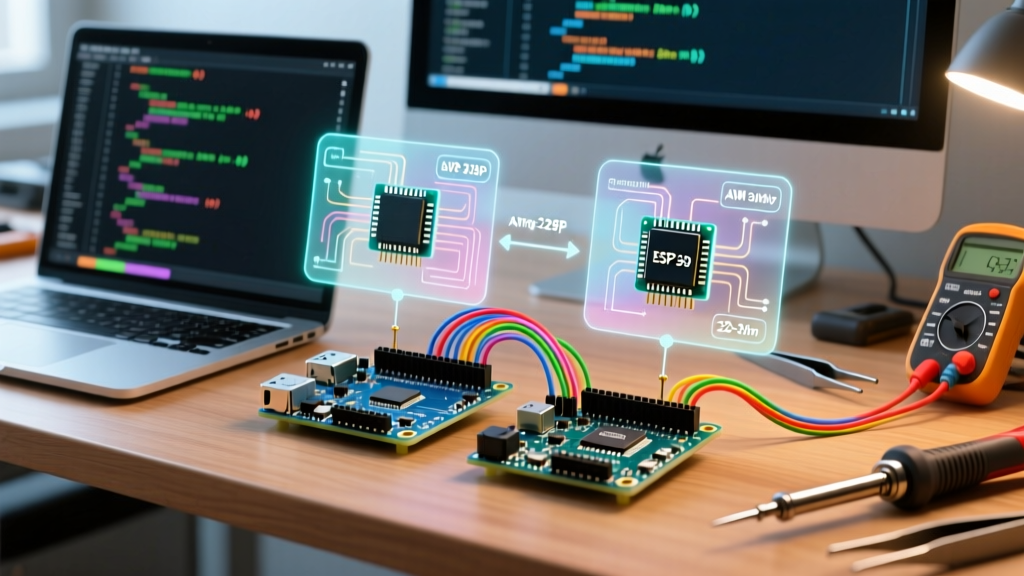
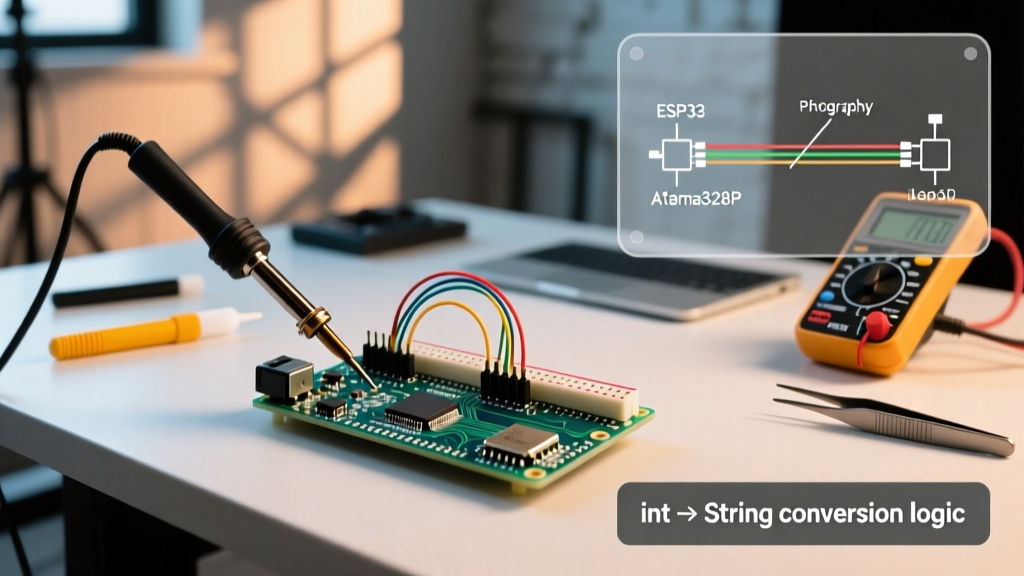
As the maker ecosystem transitions deeper into 2026, the shift from legacy 8-bit AVR microcontrollers (like the ATmega328P on the Arduino Uno) to 32-bit powerhouses (like the ESP32-S3 and Raspberry Pi RP2040) is nearly universal. Hobbyists and professional engineers alike are upgrading to leverage Wi-Fi 6, BLE 5.0, and dual-core processing. However, when porting legacy sketches, developers frequently encounter silent failures rooted in how variables in Arduino are handled across different architectures. This migration guide dissects the exact memory, data width, and pointer pitfalls you must resolve when upgrading your hardware.
The int Trap: 16-Bit vs 32-Bit
On the 8-bit ATmega328P, an int is 16 bits (2 bytes), storing values from -32,768 to 32,767. On 32-bit ARM Cortex-M0+ (RP2040) or Xtensa LX7 (ESP32-S3) architectures, an int is 32 bits (4 bytes), storing values up to 2,147,483,647. While more memory seems universally beneficial, it introduces severe bitwise logic bugs during migration.
Consider a legacy bitmask operation designed to check a sign bit or trigger a specific hardware flag:
int mask = 1 << 15;
if (mask < 0) {
  // AVR: Executes (mask is 0x8000, interpreted as -32768)
  // ARM: Fails silently (mask is 0x00008000, interpreted as +32768)
}
On an 8-bit AVR, shifting 1 left by 15 bits fills the sign bit, resulting in a negative number. On a 32-bit MCU, the 16th bit is merely a positive value in a much wider register. To fix this during migration, you must replace architecture-dependent types with explicit fixed-width integers from the <stdint.h> library.
Standardizing with Fixed-Width Integers
The golden rule for modern Arduino variable migration is to abandon generic C-types in favor of explicit widths. This guarantees identical behavior whether your code is compiled for an Arduino Nano or a Teensy 4.1.
| Data Type | AVR (ATmega328P) | ARM (RP2040) | Xtensa (ESP32-S3) | Migration Replacement |
|---|---|---|---|---|
int | 16-bit (2 bytes) | 32-bit (4 bytes) | 32-bit (4 bytes) | int16_t or int32_t |
long | 32-bit (4 bytes) | 32-bit (4 bytes) | 32-bit (4 bytes) | int32_t |
float | 32-bit (4 bytes) | 32-bit (4 bytes) | 32-bit (4 bytes) | float (No change) |
double | 32-bit (4 bytes) | 64-bit (8 bytes) | 64-bit (8 bytes) | double (Verify precision needs) |
void* (Pointer) | 16-bit (2 bytes) | 32-bit (4 bytes) | 32-bit (4 bytes) | uintptr_t for math |
Memory Architecture: Deprecating PROGMEM and the F() Macro
One of the most significant architectural shifts when migrating variables in Arduino is the move from Harvard architecture (AVR) to Von Neumann or unified memory architectures (ARM/ESP32). On the ATmega328P, SRAM is severely limited (2KB), while Flash memory is abundant (32KB). To prevent string constants from consuming precious SRAM, AVR developers use the PROGMEM attribute or the F() macro to force variables into Flash.
Migration Warning: On the ESP32 and RP2040, Flash memory is memory-mapped and executed in place (XIP). Strings are stored in Flash by default. UsingPROGMEMon an ESP32-S3 will often trigger compiler warnings or be entirely ignored by the GCC toolchain, while theF()macro is redefined as a no-op that simply returns the string pointer.
Refactoring String Arrays for 32-Bit MCUs
If your legacy code uses complex pgm_read_word() or pgm_read_byte() macros to pull data from Flash, these must be stripped out during your 32-bit upgrade. Direct pointer dereferencing is not only safe but required on modern MCUs.
Legacy AVR Code:
const char myString[] PROGMEM = "Sensor Data";
char buffer[20];
strcpy_P(buffer, myString);
Migrated 32-Bit Code:
const char* myString = "Sensor Data";
char buffer[20];
strcpy(buffer, myString);
Pointer Arithmetic and Memory Addressing Pitfalls
When working with custom memory buffers, DMA (Direct Memory Access), or low-level peripheral registers, developers often cast pointers to integers to perform arithmetic. On an 8-bit AVR, a pointer is 16 bits. Casting a pointer to an int works perfectly. On a 32-bit MCU, pointers are 32 bits. Casting a pointer to a 16-bit int16_t will truncate the upper 16 bits of the memory address, leading to catastrophic memory corruption or hard faults.
To future-proof pointer math during your upgrade, always use uintptr_t from <stdint.h>. This specialized type is guaranteed to be exactly the same width as a pointer on any target architecture, whether it is 16, 32, or 64 bits.
Floating-Point Math and Hardware FPUs
The handling of floating-point variables represents a massive performance upgrade when moving to 32-bit boards, but it requires careful variable auditing. On the AVR architecture, both float and double are implemented as 32-bit (4-byte) IEEE 754 single-precision floats. Furthermore, all floating-point math is emulated in software, consuming hundreds of clock cycles per operation.
On the RP2040 and ESP32-S3, double is a true 64-bit (8-byte) double-precision float. More importantly, these chips feature dedicated hardware Floating-Point Units (FPUs). However, the hardware FPU on the RP2040's Cortex-M0+ is single-precision only. If you accidentally use double variables in a high-speed control loop on the RP2040, the compiler will silently fall back to slow software emulation. For high-performance PID loops or sensor filtering in 2026, explicitly declare your variables as float to ensure hardware FPU acceleration is utilized.
Your 2026 Variable Migration Audit Checklist
Before flashing your legacy sketch to a modern 32-bit development board, run through this actionable refactoring checklist to ensure variable integrity:
- Audit Bitwise Operations: Search your codebase for
<<and>>operators. Ensure that shifts beyond 15 bits are not relying on 16-bit integer overflow behaviors. - Replace Generic Types: Use your IDE's find-and-replace to swap critical
intdeclarations withint16_torint32_tbased on the original logic requirements. - Strip AVR-Specific Memory Macros: Remove
PROGMEM,EEMEM, andpgm_read_*functions. Rely on standard C/C++ pointers and let the 32-bit linker handle Flash mapping. - Verify Pointer Casts: Search for
(int)casts applied to pointers or memory addresses. Replace them with(uintptr_t)to prevent address truncation. - Optimize FPU Usage: If targeting the RP2040 or ESP32, ensure high-frequency math loops use
floatinstead ofdoubleto leverage the single-precision hardware FPU. - Check Endianness Assumptions: While both AVR and ARM/Xtensa are little-endian, if your legacy code interfaced with external big-endian SPI EEPROMs via byte-shifting, verify that your 32-bit integer shifts still align correctly with the bus width.
Conclusion
Upgrading your hardware is only half the battle; upgrading your software paradigms is where the real engineering work lies. By understanding how variables in Arduino shift across architectural boundaries, you can transform fragile legacy sketches into robust, portable, and high-performance firmware. Embracing fixed-width integers and modern memory models ensures your code will remain viable across the rapidly evolving MCU landscape of 2026 and beyond.
For deeper architectural specifications and compiler behaviors, consult the Arduino Language Reference, the Raspberry Pi RP2040 Datasheet, and the ESP32-S3 Technical Reference Manual.