
Why 12V WS2815 LEDs Dominate Modern Xmas Builds
If you have ever wrapped a 7-foot outdoor pine tree with standard 5V WS2812B addressable LEDs, you likely encountered the dreaded 'pink tail'—where the final 50 LEDs turn a sickly pinkish-white due to severe voltage drop. As of 2026, the maker community has largely migrated away from 5V strips for large-scale holiday installations, adopting the 12V WS2815 architecture instead. The WS2815 chip features an internal backup data line and a higher voltage tolerance, making it the undisputed champion for DIY Arduino Xmas lights.
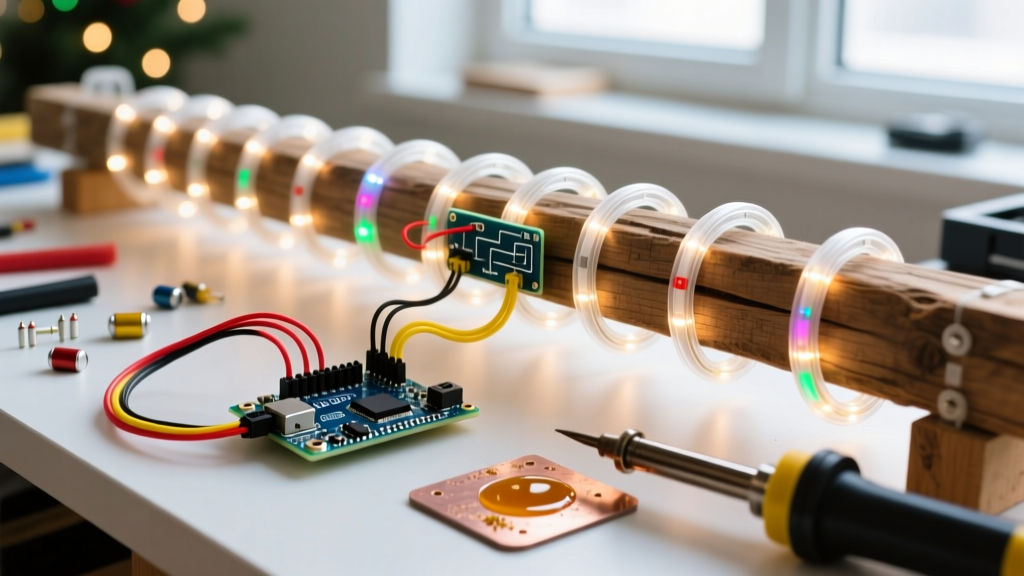
In this comprehensive tutorial, we will design, wire, and code a robust, weatherproof Arduino-based Xmas light controller capable of driving 300 individual addressable nodes without a single flicker. We will cover power injection mathematics, critical safety capacitors, and FastLED library implementation.
Hardware Bill of Materials (BOM)
Building a reliable holiday display requires moving beyond cheap USB power banks. Below is the professional-grade BOM for a 5-meter (300 LED) Xmas tree wrap.
| Component | Recommended Model / Spec | Est. 2026 Cost | Engineering Notes |
|---|---|---|---|
| Microcontroller | Arduino Uno R4 Minima | $22.00 | 5V logic, eliminates need for level shifters. |
| LED Strip | BTF-Lighting WS2815 (12V, 60LED/m, IP65) | $45.00 | IP65 silicone coating prevents UV yellowing. |
| Power Supply | Mean Well LRS-150-12 (12V, 12.5A) | $28.00 | Enclosed metal casing, built-in OVP/OCP. |
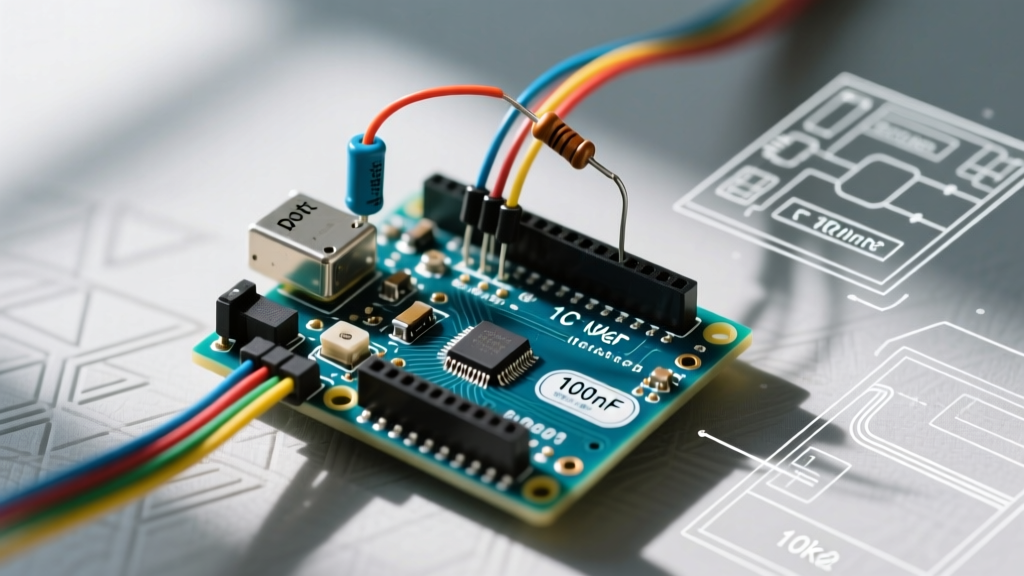
| Data Resistor | 470Ω 1/4W Carbon Film | $0.10 | Prevents high-frequency ringing on data line. |
| Filter Capacitor | 1000µF 25V Electrolytic (Low ESR) | $1.50 | Absorbs inductive kickback and current spikes. |
| Wiring | 18 AWG Silicone Stranded (Red/Black/Green) | $15.00 | Silicone jacket remains flexible in freezing temps. |
Power Mathematics: Sizing Your PSU
A common failure mode in DIY Arduino Xmas lights is undersizing the power supply, which triggers the PSU's over-current protection (OCP) and shuts down the tree mid-animation. Let us calculate the exact requirements for 300 WS2815 LEDs.
- Max Current per LED: 13mA per color channel (Red, Green, Blue) = 39mA total at full white.
- Theoretical Max Draw: 300 LEDs × 0.039A = 11.7 Amps at 12V (140.4 Watts).
- Real-World Xmas Duty Cycle: Holiday patterns (like candy canes, snowfall, or twinkle) rarely exceed a 35% average duty cycle. Therefore, continuous draw is roughly 4.1 Amps.
By selecting the Mean Well LRS-150-12 (12.5A / 150W), we provide a 20% safety headroom above the absolute theoretical maximum, ensuring the power supply runs cool and silent throughout the holiday season.
Critical Wiring Rules & Safety Protocols
Addressable LEDs are highly sensitive to electrical noise and transient voltage spikes. According to the Adafruit NeoPixel Überguide, failing to implement basic protection circuitry will eventually destroy your microcontroller's GPIO pins or the first LED in the chain.
1. The Mandatory Filter Capacitor
You must solder a 1000µF (or larger) electrolytic capacitor directly across the 12V and GND terminals of your power supply. When 300 LEDs switch from black to full white simultaneously, they create a massive instantaneous current spike. This spike can cause the 12V rail to dip momentarily, resetting your Arduino Uno R4. The capacitor acts as a local energy reservoir to smooth these transients.
2. The 470Ω Data Line Resistor
Place a 470-ohm resistor in series with the data wire, as close to the first LED's DIN pad as possible. This resistor dampens high-frequency ringing caused by the capacitance of the long wire and the LED's internal logic gates, preventing 'phantom' data signals that cause random LEDs to flash.
3. Shared Ground Architecture
Crucial E-E-A-T Warning: The Arduino's GND must be tied directly to the Power Supply's GND. The data signal is a voltage reference relative to ground. If the MCU and the LED strip do not share a common ground plane, the 5V data pulse will be misinterpreted by the WS2815 chip, resulting in chaotic color shifting.
4. Power Injection for Long Runs
While 12V strips suffer less voltage drop than 5V variants, the copper traces on standard flexible printed circuit boards (FPCB) are typically only 2oz. For a 5-meter spool, you must inject 12V power at both the beginning and the end of the strip to prevent the final LEDs from dimming or shifting toward red (as the blue and green channels require a higher forward voltage and starve first).
Software: FastLED vs. Adafruit NeoPixel
When coding Arduino Xmas lights, you have two primary library choices. For complex, multi-layered holiday animations, FastLED is the superior engine. As detailed in the FastLED GitHub Wiki, the library utilizes hardware-specific optimizations, direct port manipulation, and interrupt-free clocking to push data to the LEDs with microsecond precision.
- Adafruit NeoPixel: Excellent for simple, static color wipes. Uses interrupts, which can conflict with WiFi/Bluetooth stacks if you later upgrade to an ESP32.
- FastLED: Supports advanced color math (CHSV), hardware dithering, and parallel output. Essential for smooth 'snowfall' or 'fire' effects on large Xmas trees.
Implementing the 'Candy Cane' FastLED Code
Below is the foundational C++ structure for initializing the WS2815 strip and generating a moving Candy Cane pattern using FastLED's CHSV (Hue, Saturation, Value) color space. Using HSV prevents the harsh color banding often seen with standard RGB math.
#include <FastLED.h>

#define DATA_PIN    6
#define NUM_LEDS    300
#define LED_TYPE    WS2815
#define COLOR_ORDER RGB
#define BRIGHTNESS  180

CRGB leds[NUM_LEDS];

void setup() {
  // Initialize FastLED with WS2815 specific timing
  FastLED.addLeds<LED_TYPE, DATA_PIN, COLOR_ORDER>(leds, NUM_LEDS).setCorrection(TypicalLEDStrip);
  FastLED.setBrightness(BRIGHTNESS);
}

void loop() {
  candyCanePattern();
  FastLED.show();
  delay(20); // ~50 FPS refresh rate
}

void candyCanePattern() {
  for(int i = 0; i < NUM_LEDS; i++) {
    // Create alternating red and white bands that scroll
    int wave = (i + millis() / 10) % 20;
    if(wave < 10) {
      leds[i] = CRGB::Red;
    } else {
      leds[i] = CRGB::White;
    }
  }
}
Weatherproofing & Outdoor Deployment
If your Arduino Xmas lights are braving snow, sleet, and freezing rain, selecting the correct IP rating is non-negotiable.
- IP30 (Bare PCB): Indoor use only. Condensation will short the data pads instantly.
- IP67 (Silicone Tube): Avoid for outdoor Xmas use. The sealed tube traps humidity, and temperature swings cause internal condensation that cannot escape, eventually corroding the copper pads and turning the silicone yellow from UV exposure.
- IP65 (Silicone Coating): The optimal choice. A thin layer of clear silicone is painted directly over the components. It sheds snow and rain while allowing the PCB to breathe and dissipate heat.
To protect the Arduino Uno R4 and the Mean Well power supply, house them in an NEMA 4X rated polycarbonate junction box. Use IP68-rated nylon cable glands for the 18 AWG wires entering the box, and apply a bead of marine-grade RTV silicone around the glands to block driven rain.
Troubleshooting Common Failure Modes
The 'First LED is Always Yellow/Green' Bug
If the very first LED on your strip displays the wrong color while the rest of the tree behaves normally, your data line is suffering from signal degradation. This is almost always caused by missing the 470Ω resistor or using a data wire longer than 12 inches between the Arduino and the first LED. Move the MCU closer to the tree base.
Random Flickering at High Brightness
If the tree flickers violently when you set the brightness above 80%, your power supply wires are too thin. Upgrading your main power injection wires from 18 AWG to 14 AWG will reduce the voltage drop across the cables, stabilizing the 12V rail at the strip's input pads.
Conclusion
Building DIY Arduino Xmas lights with 12V WS2815 LEDs bridges the gap between fragile commercial holiday strands and professional architectural lighting. By respecting power injection mathematics, utilizing the FastLED library, and implementing proper IP65 weatherproofing, your custom holiday display will remain vibrant, stable, and safe for many winters to come.