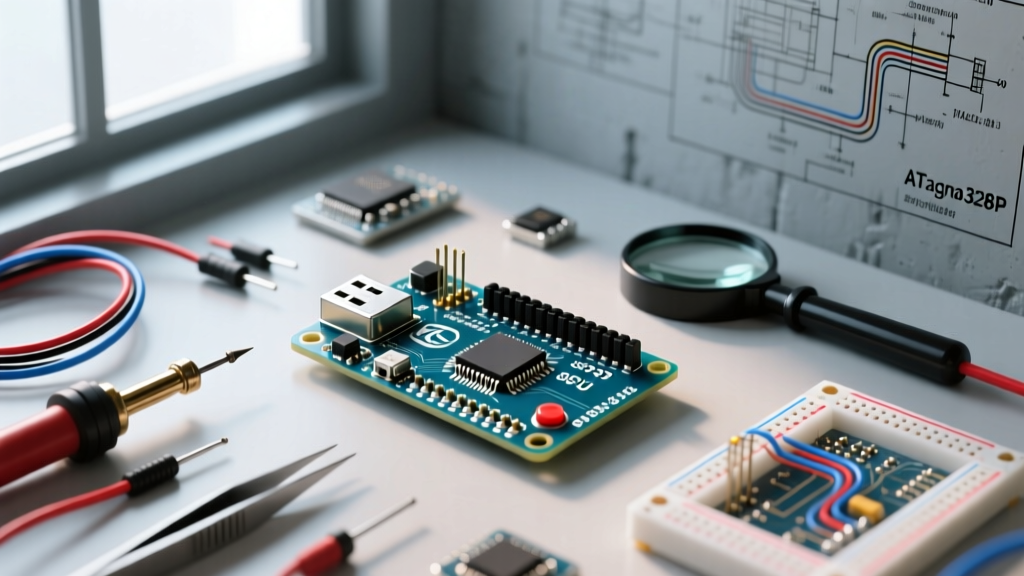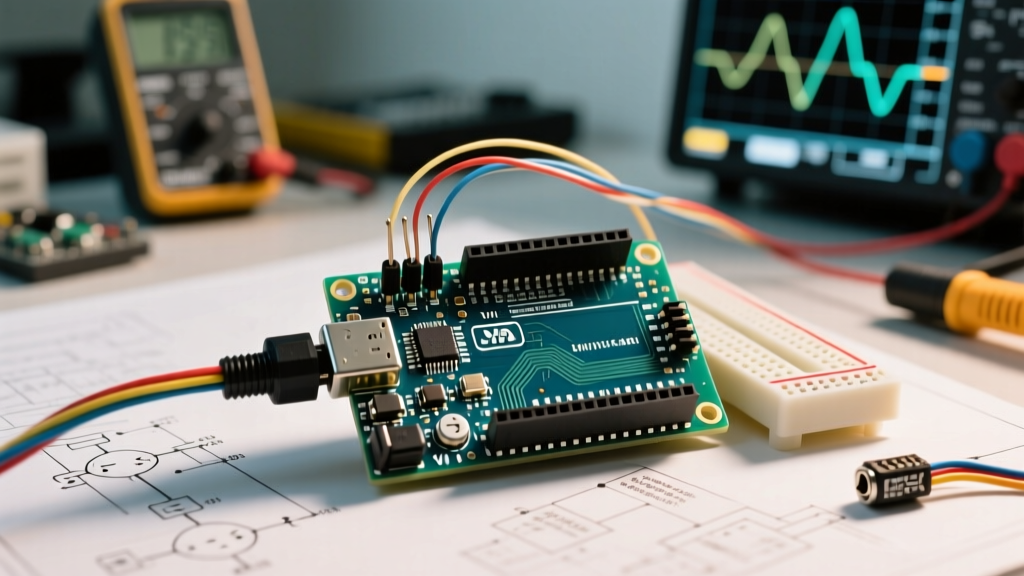

The 2026 Reality of the ATmega328P
In an era dominated by dual-core microcontrollers with native Wi-Fi 6 and hardware-accelerated AI inference, the Arduino Uno Rev3 remains a paradoxical staple on workbenches worldwide. First introduced over a decade ago, this board is powered by the 8-bit Microchip ATmega328P. Yet, in 2026, it continues to command a premium price ($29.00 for genuine Italian-made boards, compared to $4-$8 for overseas clones) and maintains massive market share.
Why? The answer lies in ecosystem inertia, 5V logic robustness, and an unparalleled library of legacy shields. However, deploying an Uno Rev3 for the wrong application in 2026 is a recipe for frustration, memory bottlenecks, and thermal failures. This project suitability analysis dissects exactly when you should reach for the classic Uno Rev3, and when you must pivot to modern alternatives like the ESP32-C3 or Raspberry Pi Pico.
Core Hardware Specifications at a Glance
Before evaluating project fit, we must establish the hard physical limits of the board. According to the official Arduino hardware documentation, the Rev3 iteration introduced the ATmega16U2 for USB-to-Serial conversion, replacing the older FTDI chip, but the core processing unit remains unchanged.
| Parameter | Specification | Practical Implication |
|---|---|---|
| Microcontroller | ATmega328P-PU (DIP-28) | Socketed chip allows easy replacement if fried. |
| Operating Voltage | 5V Logic | Directly interfaces with older 5V sensors and relays. |
| Digital I/O Pins | 14 (6 provide PWM) | Limits complex multiplexing without shift registers. |
| Analog Input Pins | 6 (10-bit ADC) | Adequate for basic potentiometers, poor for precision audio. |
| Flash Memory | 32 KB (0.5 KB used by bootloader) | Sufficient for logic, inadequate for large lookup tables. |
| SRAM | 2 KB | Severe bottleneck for string manipulation and buffers. |
| Clock Speed | 16 MHz | Too slow for high-speed software-based signal processing. |
Where the Uno Rev3 Excels: The 'Sweet Spot'
Despite its age, the Uno Rev3 possesses specific architectural traits that make it superior to modern 3.3V ARM-based boards for certain niche applications.
1. 5V Logic Interfacing and Industrial Prototyping
Modern microcontrollers operate at 3.3V or lower. Interfacing them with 5V industrial sensors, automotive relays, or legacy TTL equipment requires logic level shifters, which add BOM cost, wiring complexity, and propagation delay. As detailed in SparkFun's guide to logic levels, mixing voltage domains without proper translation risks destroying silicon. The Uno Rev3 outputs a true 5V HIGH signal, making it the ultimate plug-and-play brain for 5V relay modules, ULN2003 stepper drivers, and older LCD character displays.
2. Education and Fault Tolerance
The ATmega328P is remarkably resilient to minor wiring errors compared to highly integrated System-on-Chips (SoCs). Furthermore, the DIP-28 socketed package is a massive advantage in educational environments. If a student accidentally shorts an I/O pin to ground while it is set HIGH, the ATmega328P will likely perish, but it can be replaced with a $2.50 chip rather than scrapping a $25 surface-mounted ESP32 module.
3. The Shield Ecosystem
If your project requires a specific hardware add-on—such as a CNC motor shield, a legacy GSM module, or an arcade joystick shield—the physical Uno R3 footprint remains the undisputed standard. While adapters exist, native shield compatibility guarantees mechanical and electrical alignment without the signal integrity issues introduced by jumper wires.
Where the Uno Rev3 Fails: Modern Limitations
Do not use the Arduino Uno Rev3 if your project requirements include any of the following:
- IoT and Wireless Connectivity: Adding an ESP-01 Wi-Fi module via AT commands over Serial is a clunky, unreliable workaround. Use an ESP32 instead.
- High-Resolution Audio or DSP: The 10-bit ADC and 16 MHz clock cannot handle real-time Fast Fourier Transforms (FFT) or high-fidelity audio sampling.
- Complex Data Logging: Without native SDIO or high-speed SPI buses, logging high-frequency sensor data to an SD card will result in buffer overflows due to the 2KB SRAM limit.
Suitability Matrix: Uno Rev3 vs. Modern Alternatives
To make an objective engineering decision, compare the Uno Rev3 against the current 2026 market leaders for DIY electronics.
| Feature | Arduino Uno Rev3 | ESP32-C3 SuperMini | Raspberry Pi Pico (RP2040) |
|---|---|---|---|
| Architecture | 8-bit AVR | 32-bit RISC-V | 32-bit Dual-Core ARM Cortex-M0+ |
| Logic Level | 5V Tolerant | 3.3V (5V tolerant on some pins) | 3.3V (Strict) |
| Wireless | None | Wi-Fi 4 + BLE 5.0 | None (Pico W has Wi-Fi/BLE) |
| SRAM | 2 KB | 400 KB | 264 KB |
| Best For | 5V Relays, Shields, Education | IoT, Smart Home, Cloud APIs | Motor Control, PIO, USB Devices |
Critical Failure Modes and Edge Cases
When designing with the Uno Rev3, engineers must account for hardware quirks that are rarely mentioned in beginner tutorials.
The Linear Voltage Regulator Thermal Trap
The Uno Rev3 utilizes a linear drop-out (LDO) regulator (typically an NCP1117ST50T3G) to step down the barrel jack input voltage to 5V. Linear regulators dissipate excess voltage as heat. If you supply 12V via the barrel jack and draw 200mA from the 5V pin to power a servo or LED strip, the regulator must dissipate 1.4 Watts of heat (12V - 5V = 7V drop; 7V × 0.2A = 1.4W). The SOT-223 package lacks a heatsink, and the thermal resistance will cause the chip to hit its 150°C thermal shutdown threshold rapidly, causing the board to brownout and reset. Rule of thumb: Never draw more than 100mA from the 5V pin if your input voltage exceeds 9V.
SRAM Heap Fragmentation
With only 2,048 bytes of SRAM, using the Arduino String class for dynamic text manipulation (like parsing JSON from a serial GPS module) will quickly fragment the heap, leading to unpredictable crashes. Expert developers must rely on C-style character arrays (char[]) and utilize the PROGMEM macro to store static text and lookup tables in the 32KB Flash memory, bypassing the SRAM bottleneck entirely. The Microchip ATmega328P datasheet outlines the Harvard architecture memory boundaries that dictate these software constraints.
EEPROM Wear Limits
The ATmega328P includes 1KB of EEPROM for non-volatile storage. However, it is rated for only 100,000 write cycles. If your project logs a sensor reading to EEPROM every 5 seconds, the memory will degrade and fail in roughly 5.7 days of continuous operation. For heavy logging, you must implement wear-leveling algorithms in software or use an external I2C FRAM chip.
Final Decision Framework
Use this checklist to finalize your component selection:
- Choose the Uno Rev3 if: Your project relies on 5V logic, requires physical stacking of legacy Arduino shields, involves educational fault-tolerance, or operates in an environment where replacing a socketed DIP chip is easier than soldering surface-mount components.
- Choose the ESP32 if: Your project requires MQTT, HTTP requests, Bluetooth pairing, or battery-powered deep sleep cycles.
- Choose the RP2040 if: Your project demands high-speed custom protocols via Programmable I/O (PIO), dual-core multitasking, or native USB HID emulation.
Expert Takeaway: The Arduino Uno Rev3 is no longer the default 'do-everything' microcontroller it was in 2015. In 2026, it is a specialized tool. Treat it as a robust, 5V-tolerant I/O expander and educational platform, and defer to 32-bit architectures for compute-heavy or connected workloads.