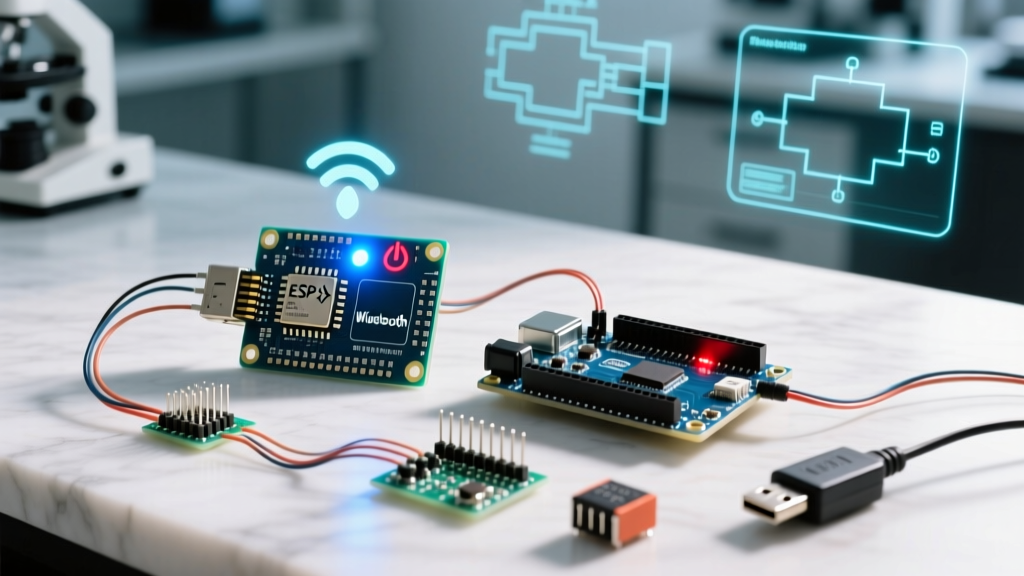

The Core Philosophy: Maker Simplicity vs. IoT Powerhouse
When evaluating the ESP32 vs Arduino debate in 2026, looking solely at clock speeds or SRAM is a beginner's mistake. The true differentiator lies in their surrounding ecosystems: the toolchains, community libraries, physical form factors, and cloud integrations that dictate how fast you can move from a breadboard prototype to a deployed, reliable product.
Arduino has spent over a decade cultivating an ecosystem built on absolute hardware abstraction and backward compatibility. Espressif, conversely, has engineered the ESP32 ecosystem around raw connectivity, high-throughput data processing, and seamless integration with modern smart-home frameworks like ESPHome. Understanding these divergent philosophies is critical for selecting the right platform for your next microcontroller project.
Hardware Lineup: Arduino Uno R4 vs. ESP32-S3
To make a fair ecosystem comparison, we must look at the current flagship development boards. The classic Arduino Uno R3 and original ESP32 are now legacy hardware. Today's battleground features the Arduino Uno R4 WiFi and the ESP32-S3 DevKit.
| Feature | Arduino Uno R4 WiFi | Generic ESP32-S3 DevKit |
|---|---|---|
| Core Architecture | Renesas RA4M1 (48MHz Cortex-M4) + ESP32-S3 (WiFi/BLE Coprocessor) | Espressif ESP32-S3 (Dual-core Xtensa LX7 @ 240MHz) |
| Connectivity | WiFi 4 / BLE 5.0 (via onboard ESP32-S3 module) | WiFi 4 / BLE 5.0 (Native) |
| SRAM / Flash | 32KB SRAM / 256KB Flash (Main MCU) | 512KB SRAM / 8MB+ Flash (Typical) |
| Typical Price | ~$27.50 USD | ~$8.50 USD |
| Primary Ecosystem Focus | Education, Shield Compatibility, Arduino IoT Cloud | IoT, Edge AI, ESPHome, High-Speed Peripherals |
As noted in the Arduino Uno R4 WiFi Documentation, the R4 uses a clever dual-MCU architecture. The Renesas chip handles your standard I/O, while a secondary ESP32-S3 acts purely as a network coprocessor. This preserves 5V logic tolerance for legacy shields but adds complexity and cost. The ESP32-S3, detailed in the Espressif ESP32-S3 Official Overview, handles everything natively on a single, highly capable silicon die, operating strictly at 3.3V logic.
The Toolchain and IDE Ecosystem
The software ecosystem is where developers spend 90% of their time. Both platforms have evolved significantly beyond their early days.
Arduino IDE 2.x and Cloud Integration
The modern Arduino IDE (version 2.x) introduces proper autocomplete, real-time syntax checking, and native hardware debugging (on supported boards). The Arduino ecosystem shines in its Arduino IoT Cloud, which allows you to generate C++ boilerplate, provision devices via secure ECC608 crypto chips, and build dashboards without writing frontend code. However, the cloud ecosystem requires a paid subscription for advanced features like webhook integrations and multi-device syncing.
ESP-IDF, PlatformIO, and the ESPHome Juggernaut
Espressif's native ESP-IDF (IoT Development Framework) is an enterprise-grade, RTOS-based toolchain. It is notoriously complex for beginners, requiring CMake configuration and terminal-based flashing. However, the community has bridged this gap via PlatformIO's Espressif 32 Platform Guide, which packages the ESP-IDF into a seamless VS Code extension.
Expert Insight: If you are building smart home devices in 2026, the ESP32 ecosystem is the undisputed king due to ESPHome. Maintained by Nabu Casa, ESPHome allows you to configure complex I2C sensors, PWM lighting, and secure Home Assistant API connections using simple YAML files, entirely bypassing the need to write C++ boilerplate. Arduino has no native equivalent to this level of declarative IoT provisioning.
Physical Ecosystem: Shield Compatibility vs. Breadboard Reality
Hardware modularity is a massive factor in prototyping speed.
- The Arduino Shield Standard: The Uno R4 maintains the exact 1.1 x 2.1-inch footprint and 0.1-inch header spacing of the R3. You can stack decades' worth of third-party motor drivers, relay boards, and GPS modules directly on top. This mechanical standard is Arduino's strongest physical moat.
- The ESP32 Breadboard Chaos: ESP32 DevKits lack a standardized shield form factor. The dual-row 0.1-inch headers are typically too wide for a standard solderless breadboard, blocking one side of the tie-points entirely. The ESP32 ecosystem relies heavily on custom carrier boards, Dupont wires, or designing your own PCB in KiCad once the prototype phase is over.
Real-World Failure Modes and Edge Cases
True expertise in the ESP32 vs Arduino comparison requires understanding how these boards fail in the field. Here are the specific edge cases that catch intermediate developers off guard.
ESP32-S3 Strapping Pin Conflicts
The ESP32-S3 uses specific GPIO pins to determine boot modes and voltage configurations during power-on reset. If you wire a sensor or relay to GPIO 3, GPIO 45, or GPIO 46 and inadvertently pull them high or low during boot, the chip will enter download mode, switch to single-core operation, or alter the serial log voltage. Fix: Reserve strapping pins strictly for internal use or ensure external circuits have high-impedance states during the first 500ms of boot.
ESP32 Brownout Detector (BOD) Triggers
When the ESP32's WiFi radio transmits, current draw spikes to ~250mA for microseconds. If your 3.3V power supply (like a cheap AMS1117 LDO on a clone board) cannot respond fast enough, the voltage sags below 2.4V. The ESP32's internal Brownout Detector will instantly trigger a reboot loop. Fix: Always solder a 470µF low-ESR electrolytic capacitor directly across the 3.3V and GND pins on your breadboard when testing high-draw WiFi routines.
Arduino Uno R4 ADC Resolution Gotchas
The Renesas RA4M1 on the Uno R4 features a highly accurate 12-bit Analog-to-Digital Converter (0-4095 range). However, to maintain backward compatibility with millions of lines of legacy R3 code, the Arduino core defaults to a 10-bit resolution (0-1023). If you are reading precision load cells or gas sensors, you are leaving 75% of your resolution on the table. Fix: You must explicitly call analogReadResolution(12); in your setup() block to unlock the hardware's true capabilities.
Decision Framework: Which Ecosystem Fits Your Project?
Use this matrix to finalize your platform selection based on your project's end goal.
Choose the Arduino Ecosystem If:
- You need 5V logic tolerance: Interfacing with legacy industrial equipment, older GPS modules, or automotive relays without logic level shifters.
- Mechanical modularity is paramount: You are building a robotics kit for education and need to stack motor shields and sensor arrays without soldering.
- You require guaranteed long-term supply chains: Arduino's manufacturing partnerships ensure that the Uno footprint will remain available and consistent for industrial deployments.
Choose the ESP32 Ecosystem If:
- You are building Smart Home / IoT nodes: ESPHome integration makes deploying secure, OTA-updatable sensors to Home Assistant a 10-minute task.
- Cost and BOM optimization matter: At ~$8.50 per unit, the ESP32-S3 is vastly more economical for producing batches of 50+ custom PCBs.
- You need Edge AI or Audio processing: The ESP32-S3 includes vector instructions for neural networks and native I2S interfaces for digital microphones, capabilities the Uno R4 entirely lacks.
Ultimately, the ESP32 vs Arduino decision isn't about which chip is 'better.' It is about whether your project demands the rugged, standardized, and abstracted physical ecosystem of Arduino, or the hyper-connected, cost-effective, and software-defined ecosystem of Espressif.