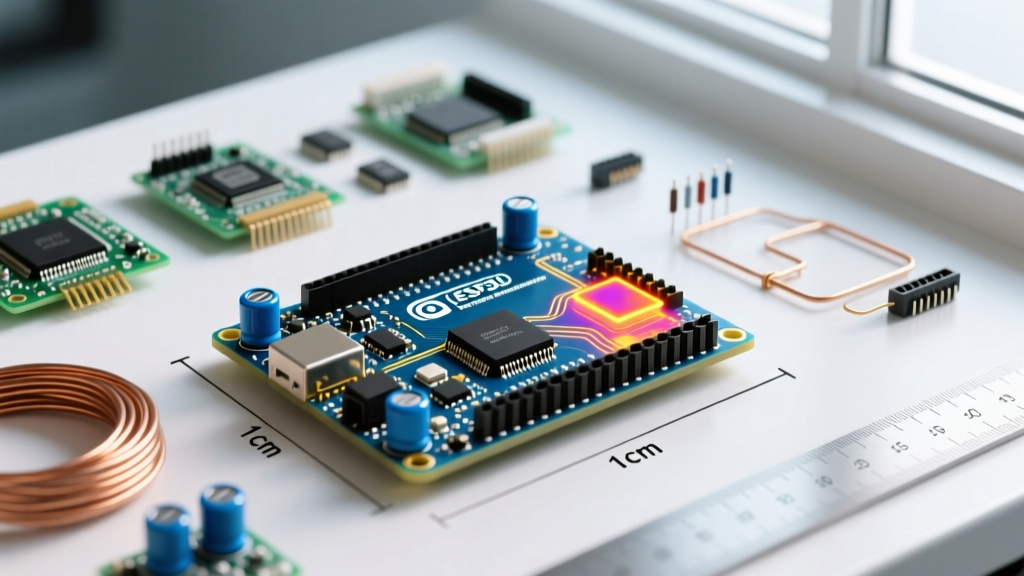

Most makers evaluate microcontrollers based strictly on clock speed, flash memory, or core architecture. However, in the open-source hardware ecosystem, physical dimensions dictate community adoption and software evolution. The Arduino Mega size—measuring exactly 101.52 mm x 53.3 mm (4.0 x 2.1 inches)—is not merely a PCB footprint; it is the foundational architecture that enabled the largest shield ecosystem and most robust community library support in the DIY electronics space. While smaller boards like the Nano or ESP32 dev kits dominate compact IoT builds, the expansive real estate of the Mega has fostered a unique, heavy-duty community focused on robotics, 3D printing, and industrial automation.
The Physical Blueprint: Understanding the Arduino Mega Size
To understand the community support surrounding this board, we must first analyze its physical geometry. The genuine Arduino Mega 2560 Rev3 is built around the Microchip ATmega2560, a 100-pin TQFP microcontroller. Routing 54 digital I/O pins (15 of which are PWM-capable) and 16 analog inputs requires significant PCB trace real estate. Consequently, the board stretches to 101.52 mm in length—roughly 33 mm longer than the standard Arduino Uno.
This extended length is not arbitrary; it directly accommodates four standard M3 mounting holes (spaced at 50.8 mm and 97.79 mm) and separates the pin headers into distinct, logical blocks. As noted in the official Arduino Mega 2560 documentation, the physical separation of the Communication pins (0-13), PWM pins, and the extended Digital pins (22-53) into dual-row headers was a deliberate design choice to prevent signal crowding and allow for robust mating connectors.
Expert Insight: The dual-row header configuration on pins 22-53 is a direct enabler for ribbon cable integration. Community developers heavily leverage this physical layout to route mass I/O to relay banks and stepper drivers without requiring custom PCB fabrication.
Form Factor as a Catalyst for Shield Ecosystems
The physical dimensions of the Mega created a standardized canvas for third-party developers. Because the Arduino Mega size maintains the exact same width (53.3 mm) and baseline header alignment as the Uno, it is backward-compatible with most standard shields. However, its extended rear section provides an additional 18x2 pin header block. This specific physical addition birthed the 'Mega-specific shield' industry.
Developers realized they could design shields that physically plug into the Uno-compatible front headers for power and SPI/I2C, while simultaneously routing heavy-load traces to the extended rear headers. This hybrid physical approach led to the creation of massive, multi-layered shields that simply cannot exist on smaller form factors.
| Board Form Factor | Dimensions (mm) | Max Digital I/O | Primary Shield Ecosystem Focus | Community Library Depth |
|---|---|---|---|---|
| Arduino Nano | 45 x 18 | 22 | Breadboard prototyping, micro-IoT | Low (Sensor specific) |
| Arduino Uno | 68.58 x 53.3 | 14 | General purpose, single motor control | Massive (General) |
| Arduino Mega | 101.52 x 53.3 | 54 | 3D printing, CNC, multi-axis robotics | Deep (Motion & UI) |
| Arduino Due | 101.52 x 53.3 | 54 | DSP, high-speed audio, ARM dev | Niche (ARM specific) |
Library Support: The Byproduct of Physical Expansion
Hardware dictates software. The physical breakout of Hardware Serial ports (Serial1, Serial2, and Serial3) along the extended right-side header of the Mega directly led to massive community library support for multi-device communication. While Uno users are forced to rely on software-based serial emulation (like SoftwareSerial) which consumes heavy CPU cycles and interrupts, Mega users utilize dedicated hardware UART pins.
U8g2 and Advanced Display Libraries
Driving multiple high-resolution SPI or I2C displays requires substantial SRAM for frame buffers. The Mega’s 8 KB of SRAM (compared to the Uno’s 2 KB) combined with its physical space for dual-row headers makes it the default target for complex UI libraries like U8g2. The community has written extensive Mega-specific initialization routines within U8g2 to map hardware SPI pins to the ICSP header block, ensuring reliable rendering on 2.4-inch TFT and OLED matrices without flickering.
AccelStepper and Multi-Axis Motion
The AccelStepper library is a staple in the maker community, but managing more than three stepper motors simultaneously on an Uno results in timing jitter due to interrupt starvation. The Mega’s physical layout provides dedicated PWM and digital pins spaced far enough apart to prevent crosstalk, allowing community forks of motion libraries to smoothly interpolate up to 6 axes simultaneously. As of 2026, the standard pricing for a genuine Mega hovers around $48.00, while high-quality third-party clones (like Elegoo or HiLetgo) range from $14.00 to $18.00, making multi-axis motion experiments highly accessible.
Marlin Firmware and the 3D Printing Revolution
Nowhere is the intersection of physical size and community support more evident than in the RepRap 3D printing movement. The community standardized heavily on the Arduino Mega size because it physically mates with the RAMPS 1.4 (RepRap Arduino Mega Pololu Shield) and its modern successors like the BTT SKR boards. According to the RepRap Wiki archives, the RAMPS shield was designed to slide perfectly over the Mega's extended headers, utilizing the physical footprint to safely route 12V/24V heated bed currents away from the low-voltage logic traces.
This physical marriage gave birth to Marlin Firmware. As detailed in the official Marlin documentation, Marlin leverages the Mega's hardware serial ports for host communication, its multitude of digital pins for endstops and stepper enable lines, and its analog pins for thermistor readings. The community support for Marlin on the Mega architecture is unparalleled; thousands of GitHub forks, custom LCD UI libraries (like FYSETC Mini), and auto-bed-leveling plugins (BLTouch) exist solely because the Mega's physical I/O capacity could handle the hardware requirements of modern 3D printers.
Edge Cases: When the Arduino Mega Size Becomes a Limitation
While the expansive PCB size drives library support, it introduces specific electrical edge cases that advanced makers must navigate:
- Parasitic Capacitance on Extended Traces: The physical distance from the ATmega2560 chip to the furthest digital pins (e.g., Pin 53) introduces trace lengths exceeding 80mm. This adds roughly 2-5pF of parasitic capacitance. When using these pins for high-speed I2C or software SPI, community developers recommend adding 4.7kΩ pull-up resistors directly at the sensor end to sharpen signal rise times.
- Breadboard Incompatibility: The 53.3mm width means the Mega spans exactly across the center trough of a standard 830-point solderless breadboard, leaving zero exposed holes on either side for jumper wires. The community workaround is to use specialized 'Mega Breadboard Adapters' or transition directly to protoboard shields.
- Enclosure Sizing: Designing 3D-printed enclosures for the Mega requires accounting for the height of the USB-B and DC barrel jacks, which protrude slightly past the 101.52mm PCB edge. Standard community CAD models often add a 3mm rear lip to accommodate these overhangs.
Frequently Asked Questions (FAQ)
Is the Arduino Mega size identical to the Arduino Due?
Yes, physically. The Arduino Due was designed to match the exact 101.52 mm x 53.3 mm footprint and mounting hole placement of the Mega 2560. This physical compatibility ensures that shields designed for the Mega (like the RAMPS 1.4) can mechanically mate with the Due, though electrical voltage differences (3.3V vs 5V) require careful software and hardware level-shifting managed by community adapter libraries.
Why do clone manufacturers stick to the exact Mega dimensions?
The open-source nature of the Arduino ecosystem means that the physical Gerber files and shield dimensions are standardized. If a clone manufacturer alters the Arduino Mega size by even a millimeter, the board will fail to mate with the thousands of existing community-designed shields, CNC gantry mounts, and 3D printer control boxes, instantly destroying its market viability.
Can I use standard Uno libraries on the Mega?
Most Uno libraries will compile and run on the Mega without modification. However, because the Mega's physical SPI pins are routed to the ICSP header block rather than pins 11-13, community library maintainers often include specific #if defined(__AVR_ATmega2560__) macros in their code to automatically remap chip-select pins to accommodate the Mega's physical layout.