
Strategic Lab Stocking: Navigating the Types of Electronic Components in 2026
When stocking a professional or advanced DIY laboratory in 2026, understanding the nuanced differences between the various types of electronic components is the difference between a seamless prototyping experience and a frustrating cycle of failed builds. The post-shortage era has stabilized global supply chains, but the market is now flooded with hyper-specific variants, surface-mount miniaturizations, and unfortunately, sophisticated counterfeits. This buying guide moves beyond generic advice, providing actionable, engineering-grade specifications on exactly what to buy, what to avoid, and how to build a resilient component inventory for modern electronics design.
Passive Components: The Foundation of Every Circuit
Passive components do not amplify signals, but they dictate the stability, timing, and power integrity of your designs. Buying the wrong tolerance or dielectric material is a primary cause of prototype failure.
Resistors: Beyond the Basic Assortment
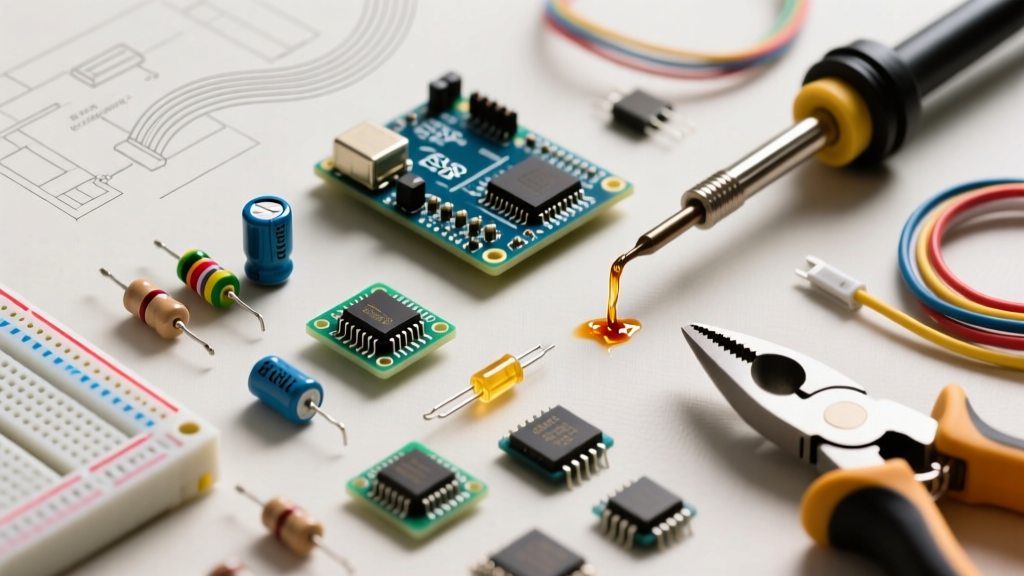
Skip the cheap, unbranded carbon film kits found on generic marketplaces. For a modern lab, you need 1/4W Metal Film Resistors with 1% tolerance. Metal film offers lower thermal noise and a tighter temperature coefficient (typically 50 ppm/°C) compared to carbon film.
- Series to Buy: Stock the E24 series (24 values per decade) for general use, and supplement with E96 values for precision feedback networks in op-amp circuits.
- Recommended Brands: Vishay (PR01 series) or Yageo (MFR-25 series).
- Pricing: Expect to pay $18–$25 for a comprehensive 600-piece laboratory kit from authorized distributors.
Pro Tip: Use the Digi-Key Resistor Calculator to quickly verify 4-band and 5-band color codes when sorting loose inventory.
Capacitors: Dielectrics and the DC Bias Trap
Capacitor selection requires deep attention to dielectric materials, especially for Multi-Layer Ceramic Capacitors (MLCCs). As detailed in SparkFun's Capacitor Tutorial, not all ceramics behave equally under voltage.
- C0G/NP0 (Class 1): Buy these for timing circuits, oscillators, and audio filters. They exhibit zero capacitance shift with temperature or applied DC voltage. They are more expensive but non-negotiable for precision analog work.
- X7R/X5R (Class 2): Ideal for general decoupling and power supply bypassing. However, be aware of the DC Bias Effect: a 10µF X5R MLCC might lose up to 50% of its actual capacitance when its rated DC voltage is applied. Always oversize X7R/X5R capacitors by at least 2x for power rail filtering.
- Electrolytic (Aluminum): Stock Panasonic FR or FM series for low Equivalent Series Resistance (ESR), crucial for switching power supply outputs.
Inductors and Ferrite Beads
Often ignored by beginners, ferrite beads are essential for suppressing high-frequency Electromagnetic Interference (EMI). Stock the Murata BLM18AG series (0603 SMD) or their through-hole equivalents for isolating noisy digital grounds from sensitive analog audio or RF sections.
Active Components: Semiconductors and Integrated Circuits
Active components require power to operate and are responsible for signal amplification, switching, and logic processing. According to industry guides like SparkFun's Transistor Guide, understanding the exact switching thresholds of your discrete semiconductors is vital for modern low-voltage microcontroller interfacing.
Discrete Semiconductors
- Bipolar Junction Transistors (BJTs): The 2N3904 (NPN) and 2N3906 (PNP) remain the undisputed kings of general-purpose switching and small-signal amplification. Buy them in TO-92 through-hole packages for breadboarding.
- MOSFETs: This is where many buyers make critical errors. If you are switching high-current loads (like motors or LED strips) using a 3.3V or 5V microcontroller GPIO, you must buy Logic-Level MOSFETs like the IRLZ44N (Vgs threshold < 3V). Standard MOSFETs like the IRF520 require 10V+ on the gate to fully turn on; using them with a 5V Arduino will result in partial conduction, massive heat generation, and catastrophic thermal failure.
- Diodes: Stock 1N4148 for fast signal switching, 1N4007 for general rectification, and Schottky diodes like the 1N5819 for low-voltage-drop reverse polarity protection.
Integrated Circuits (ICs)
For a hybrid prototyping lab, focus on Dual In-Line Package (DIP) ICs that fit standard 0.1-inch breadboards.
- Timers & Oscillators: NE555P (TI or Signetics). Avoid the CMOS TLC555 unless you specifically need low-power rail-to-rail operation, as it is more susceptible to static damage.
- Operational Amplifiers: LM358P for single-supply, low-frequency applications. TL072CP for audio and dual-supply applications requiring low noise and high slew rates.
- Logic Families: The 74HC series (e.g., SN74HC595N shift registers, SN74HC4051N multiplexers) is the modern standard, operating safely from 2V to 6V, making them perfect for bridging 3.3V and 5V logic domains.
Warning on Counterfeit ICs: In 2026, the secondary market is rife with counterfeit LM2596 buck converter modules and fake ATmega328P microcontrollers. These parts often fail under load or exhibit erratic clock speeds. Always source active ICs from authorized distributors like Mouser, Digi-Key, or Farnell, rather than unvetted third-party marketplace sellers.
Electromechanical Components and Interconnects
Mechanical failures account for a vast majority of field returns in consumer electronics. Do not skimp on interconnects.
Connectors: The Pitch Matters
Standardize your lab around specific JST connector families to avoid the nightmare of mismatched crimps.
- JST-XH (2.54mm pitch): The standard for internal PCB-to-wire connections, battery leads, and 3D printer wiring. Compatible with standard 0.1" header pins.
- JST-PH (2.0mm pitch): The ubiquitous standard for LiPo battery connectors and compact consumer electronics.
- Screw Terminals: Buy 5.08mm pitch PCB-mount terminal blocks rated for at least 15A for mains and high-power DC wiring.
Switches and Relays
For tactile switches, the 6x6x5mm through-hole variety is standard, but ensure you buy units with a minimum 100,000 cycle lifespan (brands like C&K or Omron). For switching AC loads or high-current DC, stock Omron G5LE series PCB relays. Ensure you buy the DC coil versions matching your logic voltage (e.g., 5VDC coil) and always include a 1N4148 flyback diode across the coil pins to protect your driving transistor.
SMD vs. THT: A 2026 Purchasing Matrix
While Surface-Mount Device (SMD) technology dominates manufacturing, Through-Hole Technology (THT) remains relevant for education and heavy-duty power applications. Here is how to balance your purchasing strategy.
| Feature | Through-Hole (THT / DIP) | SMD (0805 / SOIC) | SMD (0603 / 0402) |
|---|---|---|---|
| Prototyping Speed | Excellent (Breadboard compatible) | Moderate (Requires breakout boards) | Poor (Requires custom PCBs) |
| Hand Soldering | Very Easy | Easy (Standard iron & tweezers) | Requires Microscope & Hot Air |
| Component Cost | Higher ($0.05 - $0.15 each) | Low ($0.01 - $0.05 each) | Ultra-Low (Fractions of a cent) |
| Parasitics | High (Long leads add inductance) | Low | Ultra-Low (Ideal for RF/High-Speed) |
| Lab Recommendation | Stock for logic, power, and learning | Stock for custom PCB decoupling | Buy only on tape for specific designs |
Strategic Sourcing and Storage Methodology
How you store your components is just as critical as what you buy. Humidity and electrostatic discharge (ESD) silently degrade sensitive parts over time.
The Storage Setup
Invest in an Akro-Mils 44-drawer cabinet or a Stanley 25-drawer organizer for THT components. For SMD components, never remove them from their anti-static tape reels until needed. Store all CMOS logic ICs and MOSFETs in metallic shielding ESD bags with fresh silica gel desiccant packets. Moisture absorption in IC packaging can lead to the "popcorn effect"—where trapped water turns to steam and cracks the IC package during reflow soldering.
Where to Buy in 2026
- Digi-Key & Mouser: The gold standard for guaranteed authentic ICs, specialized sensors, and high-quality passives. Use their parametric search filters to find exact replacements.
- LCSC: Excellent for bulk passive SMD kits (resistors, capacitors) and generic connectors at a fraction of the cost of Western distributors, with highly reliable quality control for non-critical parts.
- Tayda Electronics: A favorite for DIY guitar pedal builders and audio enthusiasts, offering high-quality audio-taper potentiometers, specific op-amps, and rugged enclosure hardware.
Frequently Asked Questions
1. Should I buy pre-packaged Amazon component kits?
While convenient, most sub-$30 assortment kits on Amazon suffer from severe quality control issues. Resistors are often mislabeled (e.g., a 10kΩ resistor that actually measures 8.2kΩ), and electrolytic capacitors may be old stock with dried-out electrolyte, leading to high ESR and premature circuit failure. Buy individual, branded kits from authorized electronics hobbyist stores instead.
2. What is the most versatile IC to stock for beginners?
The CD4017BE (Decade Counter) and the NE555P (Timer). These two DIP ICs can be combined to create everything from LED chasers and clock generators to simple synthesizers and PWM motor controllers without requiring a single line of microcontroller code.
3. How do I handle static-sensitive components when buying in bulk?
When ordering ESD-sensitive components like MOSFETs or advanced CMOS logic, ensure the distributor ships them in proper ESD shielding bags. Upon arrival, ground yourself using an ESD wrist strap connected to a verified earth ground before opening the bags and transferring the parts to your storage cabinets.