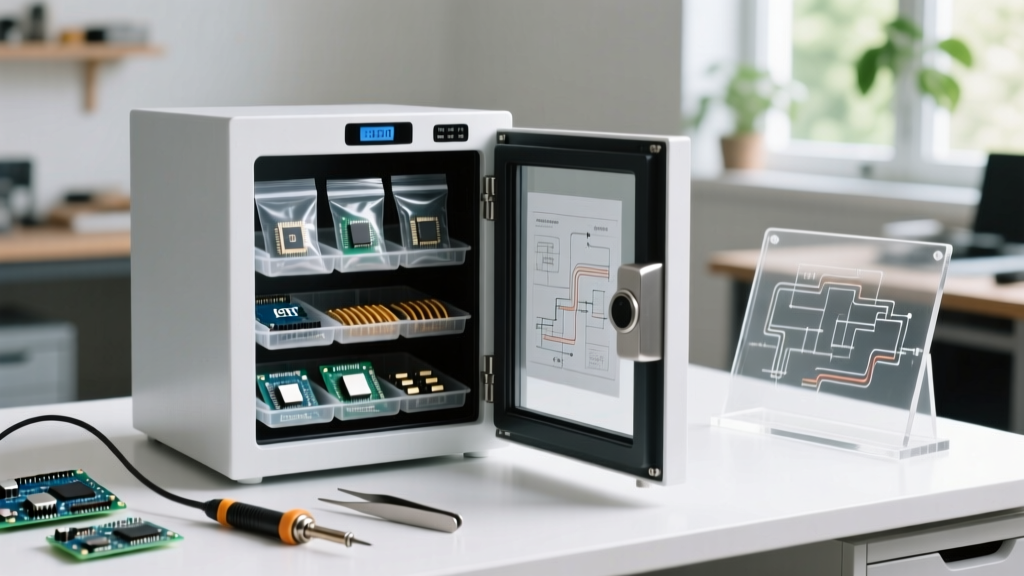

In the high-stakes world of modern PCB assembly, moisture is a silent killer. As component geometries shrink to 01005 passives and ultra-fine-pitch BGAs dominate 2026 board designs, the internal delamination caused by trapped moisture—colloquially known as the 'popcorn effect'—can destroy thousands of dollars of inventory in a single reflow cycle. Investing in a high-quality dry cabinet for electronic components is no longer optional for serious electronics labs, SMT (Surface Mount Technology) lines, and repair facilities; it is a critical insurance policy.
This comprehensive buying guide cuts through the marketing jargon to explore the engineering realities of moisture control. We will break down the IPC/JEDEC standards, compare dehumidification technologies, and evaluate the top cabinet models available on the market today.
The Physics of Failure: Why Ambient Air is the Enemy
When moisture-sensitive devices (MSDs) are exposed to ambient humidity, water vapor permeates the plastic encapsulation of the IC. During the reflow soldering process, temperatures rapidly exceed 240°C. The trapped moisture instantly vaporizes, expanding in volume by over 1,000 times. This creates immense internal hydrostatic pressure, leading to micro-cracking, wire sweep, and catastrophic delamination between the silicon die and the leadframe.
To combat this, the industry relies on the IPC/JEDEC J-STD-033 standard, which dictates the handling, packing, and storage of moisture/reflow-sensitive surface-mount devices. The standard categorizes components into Moisture Sensitivity Levels (MSL), which dictate their maximum 'floor life' before they must be baked or scrapped.
MSL Ratings and Required Storage Environments
Understanding your inventory's MSL distribution is the first step in sizing your dry storage infrastructure. Below is the standard breakdown for floor life at 30°C/60% RH, and the required dry storage parameters to effectively 'pause' the floor life clock.
| MSL Rating | Floor Life (30°C/60% RH) | Required Dry Storage RH | Typical Components |
|---|---|---|---|
| MSL 1 | Unlimited | Ambient | Standard passives, basic logic ICs |
| MSL 2 | 1 Year | < 10% RH | Thick QFPs, some SOICs |
| MSL 3 | 168 Hours (1 Week) | < 5% RH | Standard BGAs, mid-size QFNs |
| MSL 4 | 72 Hours (3 Days) | < 5% RH | Large BGAs, complex RF modules |
| MSL 5 | 48 Hours (2 Days) | < 2% RH | Ultra-fine-pitch BGAs, 3D SiP |
| MSL 6 | Mandatory Bake before use | < 2% RH (Post-bake) | Highly specialized optoelectronics |
Dehumidification Technologies: Which Engine Drives Your Cabinet?
Not all dry boxes are created equal. The method used to extract moisture dictates the cabinet's power consumption, recovery time, and ultimate RH floor. In 2026, three primary technologies dominate the market.
1. Electronic Zeolite (Auto-Dry) Technology
This is the gold standard for modern SMT facilities. Zeolite is a synthetic molecular sieve that aggressively adsorbs water vapor. The cabinet uses a microcomputer-controlled heater to periodically warm the zeolite cartridge, expelling the trapped moisture out of a one-way exhaust valve. Pros: Requires no water drainage, consumes very little power (averaging 5-15W), and can reliably maintain <2% RH. Cons: Slower initial pull-down time compared to nitrogen.
2. Peltier (Thermoelectric) Condensation
Peltier systems cool a metal plate below the dew point, causing ambient moisture to condense into liquid water, which is then collected in a tray or drained via a tube. Pros: Fast initial cooling, cheap to manufacture. Cons: Physically incapable of dropping below 8-10% RH. Do not buy Peltier cabinets for MSL 3, 4, or 5 components. They also require manual emptying of water trays or plumbing.
3. Nitrogen Purge Systems
Instead of extracting moisture from the air, these cabinets flood the enclosure with dry nitrogen gas (N2), displacing the humid air entirely. Pros: Near-instantaneous recovery times (seconds). Ideal for high-throughput lines where doors are opened dozens of times an hour. Cons: Requires a continuous supply of N2 cylinders or a generator, plus plumbing infrastructure. High ongoing operational costs.
2026 Market Leaders: Top Dry Cabinet Models Compared
When sourcing a dry cabinet for electronic components, brand reliability and sensor calibration accuracy are paramount. Here are the top-tier systems currently defining the industry.
1. Dr. Storage Auto-Dry Series (Best for Mid-Volume SMT)
Dr. Storage has long been the workhorse of the electronics manufacturing sector. Their Auto-Dry line utilizes advanced zeolite molecular sieves.
- Model to Watch: Dr. Storage D-142 (142L capacity). Features dual independent zones, allowing you to store MSL 3 components at 5% RH on top, and MSL 5 optics at 1% RH on the bottom.
- 2026 Pricing: $750 - $950 USD.
- Key Feature: Anti-static ESD-safe paint and shelving with a surface resistivity of 10^6 to 10^9 ohms/sq, fully compliant with ANSI/ESD S20.20.
2. Totech Ultra Dry (Enterprise & High-Throughput)
For enterprise SMT lines, Totech Dry Cabinets offer unparalleled build quality and data logging. Totech units are heavily favored in aerospace and medical device manufacturing where traceability is legally required.
- Model to Watch: Totech Super Dry SD-1100. Includes built-in Ethernet/Wi-Fi for continuous RH and temperature data logging directly to your factory's MES (Manufacturing Execution System).
- 2026 Pricing: $2,800 - $3,500 USD.
- Key Feature: Ultra-fast recovery door seals and optional N2-purge hybrid integration for high-traffic pick-and-place feeders.
3. Sentry Air / Budget ESD Desiccator Boxes (R&D and Repair Labs)
For hobbyists, repair technicians, or low-volume R&D labs, manual desiccant cabinets (using rechargeable silica gel cassettes) remain a viable entry point.
- 2026 Pricing: $150 - $300 USD.
- The Catch: You must manually monitor the color-changing silica beads and bake the cassettes in an oven when they saturate. If you forget, your components are exposed to ambient humidity.
Critical Buying Criteria Beyond the Price Tag
Choosing the right unit requires looking past the advertised minimum RH percentage. Pay close attention to these operational realities.
ESD Safety and Grounding Architecture
Moisture control is useless if the cabinet generates electrostatic discharge that fries the very ICs it is protecting. A true electronics dry cabinet must feature ESD-safe acrylic viewing windows, conductive shelving, and an external grounding lug. Verify that the manufacturer provides a calibration certificate for ANSI/ESD S20.20 compliance. Standard powder-coated steel acts as an insulator and can harbor dangerous static charges.
Recovery Time and Door Seal Integrity
'Recovery time' is the metric that separates professional gear from consumer camera-lens storage boxes. If a technician opens the door for 30 seconds to retrieve a tray of BGAs, the internal RH will spike to ambient levels (often 40-60% RH). A high-quality zeolite cabinet should recover to <5% RH within 10 to 15 minutes. Look for units with heavy-duty magnetic silicone gaskets and reinforced steel doors that do not warp under vacuum pressure.
Calibration and Maintenance Realities
Even the best dry cabinets suffer from sensor drift. The capacitive RH sensors used to monitor internal humidity degrade over time, especially if exposed to volatile organic compounds (VOCs) like flux fumes.
Expert Maintenance Tip: Never store freshly cleaned PCBs or components with residual no-clean flux outgassing inside your dry cabinet. The VOCs will coat the RH sensor, causing it to read artificially low, which tricks the dehumidifier into shutting off prematurely. Always use an independent, NIST-traceable digital hygrometer (like a Fluke 971) to cross-check the cabinet's built-in display every 6 months.Furthermore, inspect the door gaskets annually. If the silicone becomes brittle or compressed, the cabinet will run its dehumidification engine continuously, leading to premature zeolite degradation and spiked electricity costs.
Frequently Asked Questions
Can I use a dry cabinet to 'bake' moisture out of already compromised components?
No. Dry cabinets are designed for storage and floor-life pausing, not active dehydration. If your MSL 3 components have exceeded their 168-hour floor life, they must be placed in a dedicated convection bake oven at 40°C to 125°C (depending on the component spec sheet) for 8 to 24 hours to drive the moisture out of the silicon substrate before reflow.
Is it safe to store lithium-ion batteries in a dry cabinet?
Generally, no. While lithium batteries degrade in high humidity, storing them in ultra-dry environments (<2% RH) can dry out the electrolyte separator and degrade the seal integrity. Standard climate-controlled storage (20°C-25°C, 40% RH) is preferred for battery chemistry.
Do I need a dry cabinet for through-hole (THT) components?
Traditional through-hole components with metal or ceramic packaging (MSL 1) do not require dry storage. However, modern THT components with plastic encapsulation, such as certain electrolytic capacitors and plastic-bodied relays, can still suffer from moisture ingress and should be evaluated against their specific datasheets.
Final Verdict
Securing a reliable dry cabinet for electronic components is a non-negotiable investment for any facility handling modern surface-mount technology. For the vast majority of mid-volume SMT lines and advanced repair labs, an electronic zeolite Auto-Dry cabinet in the 100L to 150L range offers the perfect balance of low maintenance, ESD safety, and strict adherence to IPC/JEDEC J-STD-033 standards. Avoid Peltier-based units entirely, and ensure your chosen model features verifiable ANSI/ESD grounding to protect your most sensitive silicon.